
TL;DR / Executive summary: how LLMs ‘judge’ and select content to cite
What you’ll learn in this post:
AI search platforms and chatbots — from Google’s AI Overviews to Claude and ChatGPT — don’t cite content at random. They first evaluate it for its potential as a source to inform its generative responses. Research into LLM-as-a-Judge systems reveals that AI models apply a quality rubric when selecting sources, scoring content on features like helpfulness, relevance, reliability, and more.
It’s worth noting that citation preferences aren’t identical across every AI platform. Each model reflects the priorities baked into its training data, retrieval architecture, and safety guidelines — which is why Gemini, ChatGPT, Claude, and Perplexity don’t always pull from the same sources. That said, a strong baseline seems to apply across most consumer-facing AI platforms: high-quality, well-structured, evidence-based, expert-led content with clear credibility signals is more likely to be used for answer generation than thin or unattributed content.
The good news for SEO and content teams: the content quality signals AI systems are generally trained to trust map closely onto E-E-A-T (experience, expertise, authority, and trustworthiness) — the content quality framework you’re likely already familiar with from traditional search strategies.
In this post, we cover:
- What peer-reviewed LLM research tells us about how AI systems filter and select external sources
- How Anthropic, Google, and Microsoft are explicitly training their models to reward trustworthy content
- Why E-E-A-T is no longer just a traditional SEO concept — and how it translates directly to GEO/AEO
- A practical checklist to audit and strengthen your content’s quality and credibility signals for AI search
Which external content sources are preferred by AI?
An academic paper updated last year (“From Generation to Judgment: Opportunities and Challenges of LLM- as-a-Judge”) surveyed the emerging field of ‘LLM judges’ (that is, AI systems built to evaluate, score, and ‘judge’ inputs — or their own outputs). One thing is clear from the research: AI systems are getting increasingly good at content evaluation.
Understanding how LLMs are currently used for evaluation across various use cases — and what criteria they excel (or fail) at assessing — can give us some insights into how AI platforms may evaluate and select citations from external content (like yours!).
A primer on RAG (Retrieval-Augmented Generation)
RAG is an approach to generative AI where an AI model’s internal knowledge base or training data is augmented with information retrieved from external sources prior to generating a response.
Unlike traditional LLM models that depend solely on fixed training data, RAG systems dynamically expand AI’s knowledge base at the moment of query to improve the relevance of generated answers.
TLDR? → RAG augments the inputs considered by an AI system with external information before it generates its answers.
Why understanding RAG matters for GEO / AEO:
Understanding RAG is foundational to GEO because the retrieval step is where your content either enters, or is excluded from, the inputs that inform an AI-generated answer. Content that is semantically clear, well-structured, and authoritative is more likely to be retrieved.
Your goal as a GEO-focused marketer is to make your content a trusted, easily retrievable source of information for RAG systems.
AI researchers (see sources under ‘Further Reading’ below) have found that LLMs prefer content that is:
- Relevant to the questions users are asking
- Coherent, well-evidenced, and logically structured
- Validated by others (ie, highly cited or frequently mentioned by others)
- Includes credible citations to others, substantiating its claims and trustworthiness
- “Helpful, honest, and harmless” (See notes on Claude’s ‘Constitution’, below)
- Complete in its topical coverage
- Recent
- Easily extractable
Further reading on AI’s content selection preferences
These academic research papers helped inform our understanding of how AI platforms are evaluating external sources today:
- “From Generation to Judgment: Opportunities and Challenges of LLM- as-a-Judge” – (By researchers at: Arizona State University, University of Illinois Chicago, University of Maryland, Baltimore County, Northwestern University, University of California, Berkeley, Emory University)
- “What Evidence Do Language Models Find Convincing?” – (UC Berkeley paper)
- “Trusted Source Alignment in Large Language Models” – (Google Research)
- “What External Knowledge is Preferred by LLMs?” – (Chang, et al.)

“We need to understand how AI interprets our content and generates answers so we can adapt our strategies and ensure our content appears in results.”
— Ana Perez, SEO Manager
Why content quality matters more than ever in the age of AI search
Your content quality matters in AI search because generative systems rely heavily on retrieval signals, source reputation, and structured knowledge to decide which content to incorporate into their answers. Modern AI-powered search experiences do not generate responses from thin air — they draw from indexed web content, ranked sources, and retrieval-augmented pipelines.
When determining which external sources to cite, summarize, or rely on, AI systems draw on many of the same credibility signals that underpin traditional ranking systems: domain authority, consistent authorship, factual alignment, and corroboration across trusted sources.
In practice, high E-E-A-T (experience, expertise, authority, and trustworthiness) content is more likely to be retrieved, retained in context, and considered safe to reuse in AI-generated answers.
SEO professionals will already be very familiar with the concept of E-E-A-T. The idea stems from Google’s internal Search Quality Rater Guidelines, the massive manual used by thousands of human testers to grade Google’s search algorithm.
First popularized as a benchmark for “Your Money or Your Life” (YMYL) topics, E-E-A-T has evolved from a niche set of quality guidelines into a foundational pillar of how search algorithms identify and reward the most credible voices in any given field.
E-E-A-T can also serve as a strong content framework for GEO/AEO, as AI search systems have an incentive to prioritize factually accurate, credible, trustworthy content in order avoid the reputational damage caused by LLM hallucinations (we’ve all seen plenty of examples of this in the press over the past few years!).

On content quality in the age of AI search:
“Content quality is always going to be a trending topic, but even more so in 2026. Brands that rely too heavily on AI to write copy will struggle to demonstrate genuine E-E-A-T. Google and OpenAI’s models are already learning to evaluate who is behind the content, why it exists, and what value it adds, so I would say content quality should be on everyone’s radar! “
—Chloe Steele, SEO Account Manager at Verde Digital
(Hear more from Chloe in our Lumar webinar session: “SEO & GEO Trends for 2026”)
AI’s grading rubric: how LLMs can evaluate content quality today
To understand why some content is cited and others ignored, we must look at how AI evaluates quality.
The LLM-as-Judge paper we mentioned earlier outlines the primary benchmarks that today’s AI systems can use to “judge” external inputs as well as their own outputs.
For a piece of content to survive the AI’s internal filtering process, it should score high across six critical areas:
- Helpfulness
- Harmlessness
- Relevance
- Reliability
- Feasibility, and
- Overall Quality
These aren’t just abstract concepts; they are specific metrics an AI “judge” might use to decide if your content is authoritative enough to present to a user.
But are these AI-powered evaluations actually being implemented by public-facing AI platforms today? Yes, it seems so.
Anthropic’s Claude 2 Model Card, for example, discusses their work to train Claude on the three H’s; they have explicitly stated that they are training their LLM to be Helpful, Honest, and Harmless.
Per the Claude 2 Model Card document:
“Our core research focus has been training Claude models to be helpful, honest, and harmless. Currently, we do this by giving models a Constitution – a set of ethical and behavioral principles that the model uses to guide its outputs.”
“You can read about Claude 2’s principles in a blog post we published in May 2023 [See: Claude’s Constitution]. . . . We use the constitution in two places during the training process. During the first phase, the model is trained to critique and revise its own responses using the set of principles and a few examples of the process. During the second phase, a model is trained via reinforcement learning, but rather than using human feedback, it uses AI-generated feedback based on the set of principles to choose the more harmless output.”
What is Constitutional AI?
Constitutional AI is a method used by Anthropic to make AI systems safer and more accurate. Instead of relying solely on human feedback, the AI evaluates its own outputs based on a predefined set of principles—its “constitution.” These principles guide the model to be helpful, honest, and harmless, while avoiding outputs that are harmful, biased, or encourage unethical behavior.
→ Learn more about constitutional AI in Anthropic’s paper, “Constitutional AI: Harmlessness from AI Feedback.”
Industry analysis of Google’s documentation suggests that its AI Overviews are not a fully separate silo; they are powered in part by some of the same core ranking systems as traditional search, including the “Helpful Content System.” If content is deemed “helpful” and demonstrates strong E-E-A-T according to Google’s search evaluation criteria, chances are, it’s also more likely to be considered a valuable source for AI summarization.
When it comes to other companies’ AI search tools, like those embedded in Microsoft Bing, we also have clues that these AI systems are being developed to prioritize trustworthy content. In Microsoft’s “Responsible AI” document, it underscores Microsoft’s commitment to “Fairness,” “Reliability & Safety,” and “Transparency” in its AI systems. For Bing’s Copilot to be reliable, safe, and transparent, the sources it uses for information should be demonstrably accurate and trustworthy.
Likewise, in Perplexity’s help articles, it states that: “When you ask Perplexity a question, it uses advanced AI to search the internet in real-time, gathering insights from top-tier sources.” — Again, content quality and E-E-A-T signals are at work here.
“SEO best practices remain essential even as AI search grows. Focus on building brand visibility across multiple channels, creating AI-friendly content with structured headings and quotable insights, researching real user questions, and incorporating first-party data and unique perspectives. Above all, make your content genuinely helpful.”
— Ana Perez, SEO Manager
How to improve EEAT for GEO
As AI-generated content floods the web, human expertise is becoming a differentiating factor rather than a baseline expectation. LLMs are increasingly trained to recognize who produced content, why it exists, and what real-world experience backs it up. Surface-level content is increasingly filtered out in favor of genuinely authoritative sources.
As Jon Clark, Managing Partner at Moving Traffic Media, puts it:
On taking E-E-A-T to the next level:
“With all this AI-generated content spilling out onto the web, human expertise is about to become a major differentiator. Again. It’s the un-apologetic authors, the credentials that stand up to scrutiny and the real hands-on experience that sets the regurgitated reviews and surface-level tat apart from genuine authority.
[In] 2026, both Google and the AI systems they’re building will be looking for the all-important trust credentials – where did that insight come from, and who put their name on it.”
- (Note: You can hear more from Jon in his Lumar GEO/AEO webinar session, “The New Metrics of AI Search – GEO/AEO KPIs You Should Track Now.” )
Get EEAT Analytics in Lumar
Our AI Authority / E-E-A-T reports in Lumar can help you ensure your content signals expertise, experience, authority, and trustworthiness.
Get a Lumar GEO platform demo to see our E-E-A-T reports in action— alongside our many other GEO/AEO reporting and analytics tools, like our GEO Content Evaluator.
Content Quality Checklist for GEO / AEO
Practically, creating high-quality, strong E-E-A-T content for generative engine optimization means incorporating the following into your content production workflows:
□ Named authorship with verifiable credentials — Content attributed to real experts with demonstrable experience signals trust to both human readers and AI systems evaluating source quality.
□ First-party data and original research — Proprietary statistics, surveys, and case studies give AI systems unique, citable material that they cannot source elsewhere.
□ Factual accuracy and consistency — Contradictions between pages on your own site, or between your content and established facts can erode AI trust in your brand as a reliable source.
□ Transparent sourcing — Citing reputable external references, studies, and named experts reinforces the factual grounding of your content.
New Lumar tools for GEO content optimization
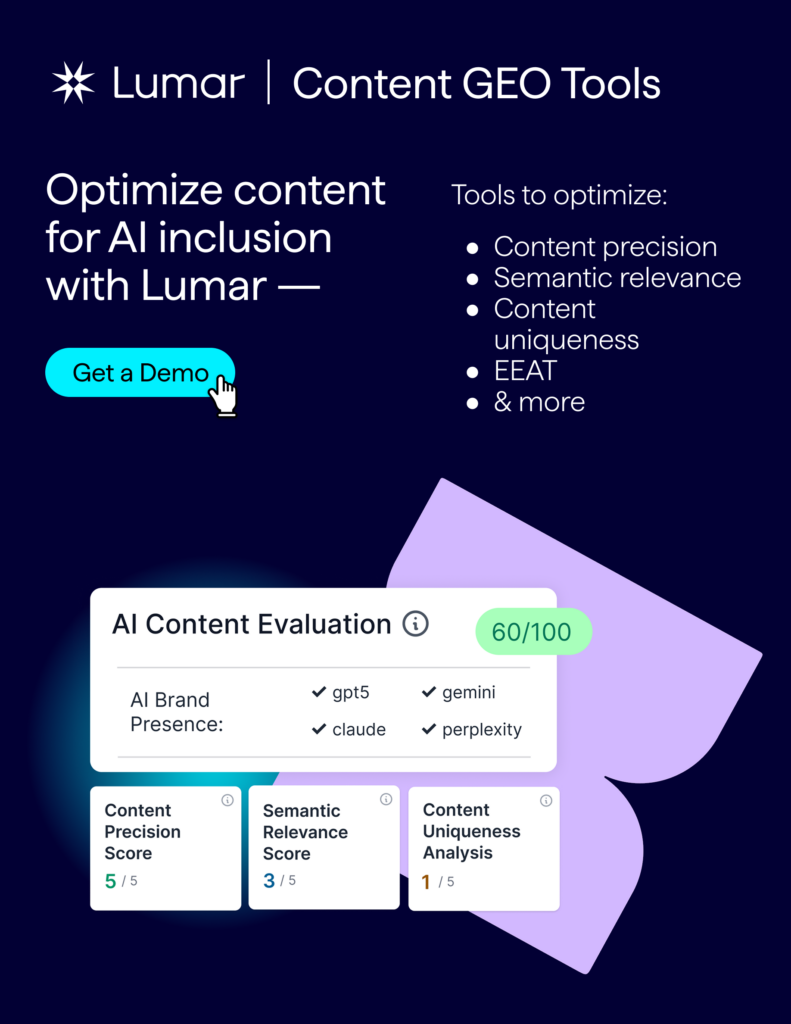
Explore Lumar’s powerful platform features for GEO content optimization:
Get Lumar’s FULL guide to GEO / AEO
Ready to dive deeper into how to build a strong GEO / AEO strategy for AI search? Get our full, free “AI Search Optimization Playbook” now.
About Lumar’s GEO / AEO explainer series
In this Lumar series, we’re exploring strategies for generative engine optimization (GEO), also known as answer engine optimization (AEO) — that is, how to boost your brand’s AI visibility and likelihood of earning mentions or citations from LLMs and AI-powered platforms like ChatGPT, Claude, Gemini, Perplexity, or Google’s AI Overviews and AI Mode.