
TL;DR: Content GEO in 30 seconds
Content GEO, or content-focused generative engine optimization, is the practice of creating and structuring content so AI systems can understand it, evaluate it, retrieve it, summarize it, and cite it confidently.
It is one pillar of a broader GEO strategy, which should include:
- Technical GEO: helps AI bots access and process your website.
- Content GEO (what we’ll be discussing below!): helps AI systems understand and select your content.
- Entity GEO: helps AI systems recognize who you are / what your brand does.
- Brand Authority GEO: helps AI systems decide whether your brand is trustworthy enough to cite.
In short: Technical GEO helps AI find your content. Entity GEO helps AI recognize your brand. Brand Authority GEO helps AI trust your brand. Content GEO provides AI with useful, easily extractable source material to use when it’s generating answers.
An introduction to Content GEO
Content GEO is about ensuring your content is built for both human understanding and AI retrieval, assessment, selection, and inclusion. It requires focus on publishing factually accurate, well-structured, semantically relevant, and comprehensive content that AI systems can extract, summarize, and cite confidently.
For human readers, your content still needs to be clear, useful, accurate, persuasive, and easy to navigate.
For AI systems, your content also needs to be structured in a way that makes its meaning, relevance, evidence, and expertise easy for machines to identify.
That means Content GEO is not about writing robotic copy or chasing GEO/ AEO “hacks.” It is about making your best expertise easier for machines to understand without making it less useful for people.
A good Content GEO strategy should address questions like:
- Is this content clearly about the topic it claims to cover?
- Does it answer the user’s question directly?
- Does it contain accurate, specific, and useful information?
- Does it show why the brand is qualified to speak on this topic?
- Can an AI system extract a useful answer from this page without misrepresenting it?
- Does the content strengthen the brand’s association with the topics it wants to own?
If Technical GEO determines whether your content is accessible to AI bots, Content GEO determines whether it is deemed useful, trustworthy, and likely to be chosen. It ensures that once an AI system can access your content, recognize your brand, and trust your authority (see also: Entity GEO and Brand Authority GEO), it has the right material to use when generating its responses for users.
Why It Matters Now: As AI-generated “slop” floods the web, LLMs are being trained to prioritize “helpful, honest, and harmless” content (the 3 Hs!). To survive the AI’s internal filtering process, your content must score high in helpfulness, reliability, and overall quality.
Differences between SEO content and GEO content
Where traditional SEO content aimed to align with keyword queries, Content GEO focuses on satisfying AI reasoning — ensuring your brand’s insights, explanations, and expertise become the material LLMs rely on when generating answers.
In an AI-driven search landscape, your content adds yet another dimension to its role in your broader marketing toolkit; it becomes training material for the models shaping the future of online search.

“We need to understand how AI interprets our content and generates answers so we can adapt our strategies and ensure our content appears in results.”
— Ana Perez, SEO Manager
Traditional SEO content has often been built around ranking for a keyword and earning the click. Content GEO expands that goal.
In AI search, visibility may happen before, after, or without a website visit. Your content might influence an AI-generated answer even when the user does not click. Your brand might be cited directly, mentioned without a link, summarized as part of a recommendation, or omitted entirely.
That means content teams need to think beyond traffic alone. Content can now shape:
- AI understanding: Whether AI systems correctly understand what your brand knows, offers, and stands for.
- AI inclusion: Whether your content is selected as part of an AI-generated response.
- AI citation preference: Whether your content is chosen over a competitor’s when multiple sources could answer the same question.
- Brand-topic association: Whether AI systems consistently connect your brand with the topics that matter to your category.
- Answer accuracy: Whether AI systems describe your brand, products, services, and expertise correctly.
This does not make traditional SEO obsolete. Strong SEO fundamentals still matter. Many AI search experiences rely on traditional search indexes, established content signals, and web-wide authority signals. But Content GEO asks content teams to build pages that are not only optimized for ranking and reading, but also for retrieval and reuse.
Content SEO and Content GEO overlap, but they are not identical.
Traditional content-focused SEO tactics often start with a search query, keyword opportunity, ranking gap, or traffic goal. The main question is: How do we create the best page to rank and earn the click?
Content GEO starts with a slightly different question: How do we create the best source for an AI system to understand, trust, and use when generating an answer?
That shift changes the content brief.
A traditional SEO-focused content brief might emphasize target keywords, search volume, H1s, title tags, internal links, and SERP competitors. A GEO content brief still includes those considerations, but it also asks for clearer answers, more explicit definitions, stronger evidence, better topical alignment, visible expertise, and page sections (or ‘chunks’) that make sense when interpreted outside of the full page context.
The best Content GEO work does not abandon SEO. It raises the quality bar.
Where Content GEO fits in the AI visibility funnel
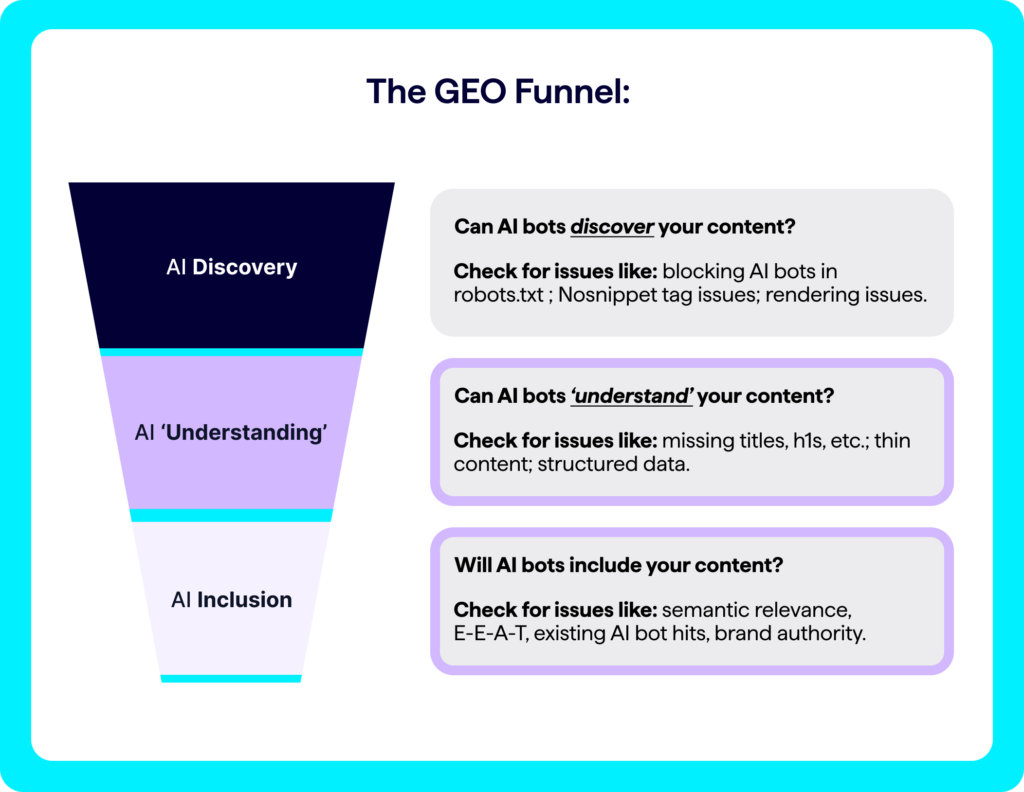
Content GEO sits primarily in the AI Understanding and AI Inclusion stages of the AI visibility funnel.
At the discovery stage, technical factors determine whether AI bots and search crawlers can access your content. That is the domain of Technical GEO.
But once your content can be accessed, the next questions are different:
- Can AI systems understand what this content is about?
- Can they connect it to the right topics and entities?
- Can they identify a useful answer?
- Can they evaluate the content as accurate, helpful, and trustworthy?
- Can they confidently include it in a generated response?
Those are Content GEO questions.
This is why Content GEO cannot operate in isolation. It works best when the other GEO pillars are already in motion. If AI cannot crawl your page, the content may not be discovered. If AI cannot recognize your brand as an entity, the brand may not be properly associated with the content. If AI does not see enough authority signals around your brand, even strong content may lose out to a more trusted source.
Content GEO is the layer that turns access and authority into usable answers.

“In 2026, GEO/AEO will be essential for visibility, requiring content to be highly structured, fact-based, and semantically rich to be considered authoritative enough for AI to reference.
Rather than chasing rankings alone, SEOs must now optimise for inclusion in zero-click, conversational responses — ensuring that brand-owned content is answer-ready and aligned with user intent at a granular level.”
— Rejoice Ojiaku, Senior Content Specialist at Wise
(Check out Rejoice’s Lumar webinar session: “SEO in the Age of AI: A Conversation on GEO, AEO & the Future of Search.”)
How Content GEO influences AI search visibility
A strong Content GEO strategy can improve four key aspects of AI search visibility.
1. Extractability
Extractability is how easily an AI system can pull a clear, factual answer from your page.
Content that buries the answer under long intros, vague claims, or disconnected paragraphs is harder to reuse. Content that states the answer clearly, defines key terms, and explains the surrounding context is more likely to support AI-generated responses.
2. Citation preference
Citation preference is whether an AI system chooses your content instead of another source.
For competitive topics, AI systems often have multiple possible sources to draw from. Your content needs to give them a reason to prefer yours: clearer explanations, stronger evidence, better specificity, fresher information, original insights, or more complete coverage.
3. Topical association
Topical association is how consistently AI systems connect your brand with a specific subject area.
One optimized article rarely builds durable AI visibility on its own. Content GEO works best when individual pages support a broader topical footprint. Over time, your content should help AI systems understand what your brand is known for.
4. Completeness
Completeness is whether your content covers enough of the topic to satisfy the user’s real question and likely follow-up questions.
AI search experiences are conversational. A single prompt may imply several related needs. Content that only answers the narrowest version of a query may be less useful than content that anticipates the user’s next question, defines scope, addresses nuance, and points toward the right next step.
What Content GEO is not
Content GEO is not keyword stuffing for AI. It is not adding an FAQ block to every page and calling the job done. It is not generating thousands of generic articles to “feed” LLMs.
In fact, generic AI-written content can make the problem worse. If every brand publishes the same surface-level explanations, AI systems have little reason to choose one source over another.
Content GEO is about making your content more distinctive, more useful, more structured, and more grounded in real expertise.
That can include original research, expert commentary, unique customer insights, product knowledge, practical examples, data, comparisons, and clearly sourced claims.
The goal is not simply to produce more content. The goal is to produce content that AI systems can confidently interpret as useful source material.
Your Content GEO checklist
The later posts in this GEO/AEO series will cover specific Content GEO tactics in depth. For now, use this as a strategic overview of what your GEO content program should be working toward:
□ Write clear, factual, answer-first content that directly addresses user questions.
□ Optimize for semantic relevance and full coverage of related sub-topics.
□ Build evidence-based content with citations and sources.
□ Structure content into easily retrievable “chunks” (clear sections with H2/H3 headings.
□ Ensure entity clarity in ‘chunk’ passages (avoid pronouns replacing key entities).
□ Create multimodal content (video, audio, images) and add transcripts to video/audio; descriptive alt text to images.
□ Demonstrate E-E-A-T (Experience, Expertise, Authority, Trustworthiness) through expert authorship, original data, and transparent sourcing.

“The way forward is to treat content as a cross-platform ecosystem. Make videos, images, and audio AI-friendly with proper metadata, captions, and transcripts.
Ensure entity and topic alignment so AI systems recognize your authority, no matter the format.”
— Jon Clark, Managing Partner at Moving Traffic Media
- (Hear more from Jon in his Lumar GEO/AEO webinar session, “The New Metrics of AI Search – GEO/AEO KPIs You Should Track Now.” )
The bottom line: content is becoming AI source material
Content has always helped brands educate audiences, build trust, and drive demand. In the AI search era, it has another role: it becomes source material for the systems shaping how people discover, compare, and choose brands.
That does not mean every page should be written for machines first. It means content teams need to recognize that machines are now part of the audience. The strongest content will serve both: useful enough for humans to value, and clear enough for AI systems to understand, retrieve, and cite.
The brands that win in AI search will not be the ones that publish the most. They will be the ones that make their expertise easiest to understand, verify, and reuse.
About Lumar’s GEO / AEO explainer series
In this Lumar series, we’re exploring strategies for generative engine optimization (GEO), also known as answer engine optimization (AEO) — that is, how to boost your brand’s AI visibility and likelihood of earning mentions or citations from LLMs and AI-powered platforms like ChatGPT, Claude, Gemini, Perplexity, or Google’s AI Overviews and AI Mode.
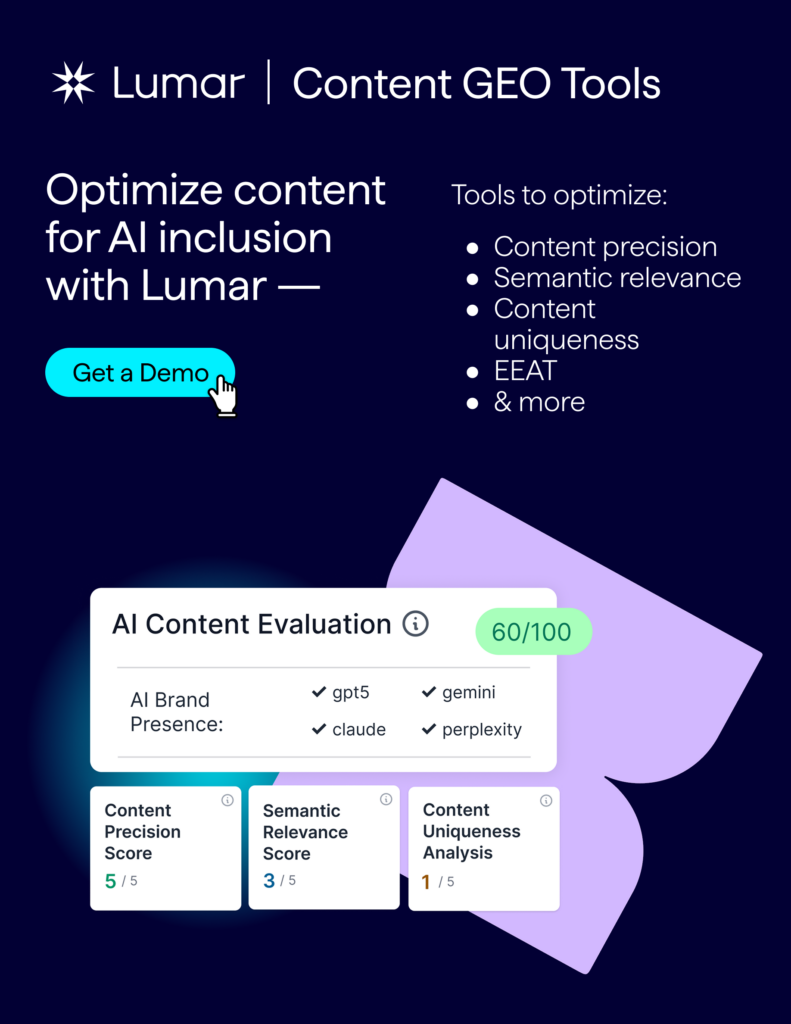
Explore Lumar’s powerful platform features for GEO content optimization
Get Lumar’s FULL guide to GEO / AEO
Ready to dive deeper into how to build a strong GEO / AEO strategy for AI search? Get our full, free “AI Search Optimization Playbook” now.