Watch now:
The New Set of GEO/AEO KPIs: AI Visibility Metrics You Should Track in 2026
As AI overviews and generative engines reshape the online search landscape, tracking traditional SERP rankings and organic traffic alone leaves you blind to how your brand performs in AI-powered search platforms like Perplexity, Claude, Gemini, and ChatGPT.
So, what new generative engine optimization (GEO) metrics do SEO, content, and digital marketing teams need to track in 2026?
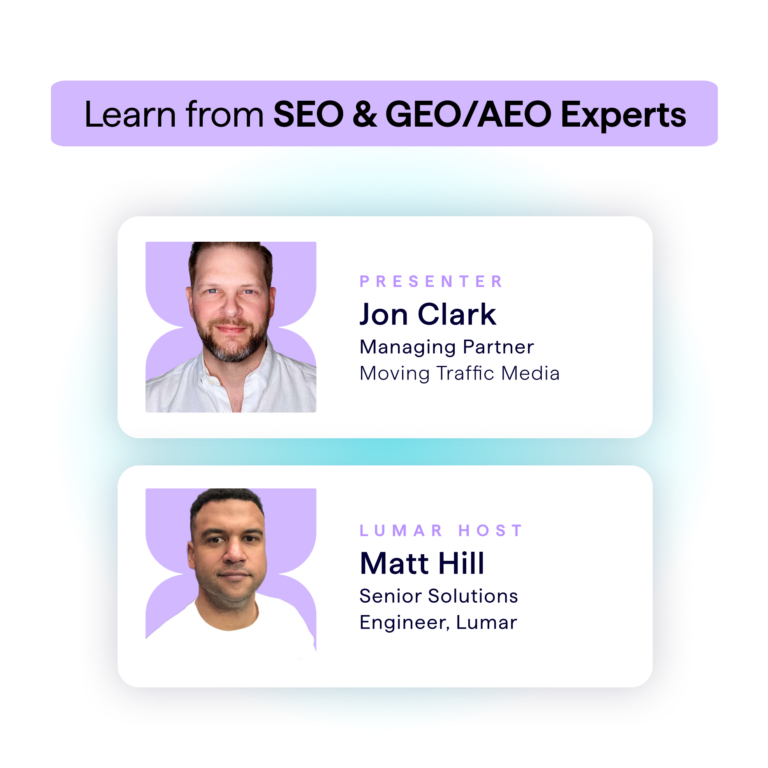
In this AI search measurability session, Lumar host Matt Hill, Senior Solutions Consultant at Lumar, and presenter Jon Clark, Managing Partner at Moving Traffic Media, break down the evolving GEO/AEO reporting and KPIs landscape, from modifying traditional SEO metrics to tracking new AI visibility indicators like AI citation traffic, prompt visibility, and AI bot engagement.
Discover which AI brand visibility metrics matter most for measuring success in the GEO/AEO era and learn practical approaches to building your AI visibility measurement stack in this in-depth, expert-led Lumar webinar session. You’ll leave with a clear framework for evaluating your brand’s presence in AI search.
Get clarity on how to evaluate your brand’s presence in AI search from some of the best in the business.
Watch the full Lumar webinar session above, or read on for some key takeaways.
Executive Summary: AI search KPIs to track now
As AI search changes how people discover, evaluate, and choose brands, SEO teams need to measure more than rankings, traffic, and clicks. But that does not mean abandoning traditional SEO KPIs.
In this Lumar webinar, Jon Clark, managing partner at Moving Traffic Media, joined Lumar host Matt Hill to explain how SEO and marketing teams should rethink measurement for the GEO/AEO era.
The core message: Traditional SEO still matters, but teams should augment their existing KPIs with AI visibility metrics that show whether their brand is being mentioned, cited, represented accurately, and associated with the right topics inside AI-generated answers.
Key AI visibility metrics to start tracking include:
- AI citation frequency: How often your brand or content is referenced in AI-generated answers.
- Answer inclusion rate: The percentage of relevant prompts where your brand or content appears.
- Prompt coverage: How broadly your brand appears across different prompt types, topics, funnel stages, and models.
- Brand mentions without links: When AI systems reference your brand without sending referral traffic.
- Topic association strength: Whether AI systems consistently associate your brand with the subjects you want to own.
- AI share of voice: How often your brand appears compared with competitors.
- Answer accuracy and narrative control: Whether AI systems are describing your brand, products, pricing, and expertise correctly.
- AI referral and action tracking: How AI-driven visits, landing pages, direct traffic spikes, and conversion patterns show up in GA4 or other analytics tools.
Clark’s practical recommendation: Start small. Build a controlled prompt library, track outputs manually in a spreadsheet, look for patterns, and only move into automation once you know which prompts, models, and metrics matter to your business.

Webinar Recap:
Rethinking organic search KPIs
Why do we need to rethink our organic search KPIs now?
There are three things we need to remember when thinking about the answer to this, according to Clark.
- Traditional search still dominates – Google processes over 3.5 billion searches daily, but AI assistants are growing fast. Perplexity alone handled 780 million queries in May 2025 – that’s roughly what Google processes in five hours.
- AI indexing via Google ranking – If your content ranks in Google, it’s already being indexed by AI systems. You’re not starting over. You’re expanding what you measure. The foundational work you’ve done in SEO directly supports AI visibility.
- The challenge? Attribution is tough. There’s no clear link between AI citations and business outcomes yet. But that doesn’t mean we can’t track meaningful signals.
For Clark, this means we need to adapt our measurement framework across the following layers:
- Input metrics (what you control)
- Channel metrics (visibility snapshots)
- Performance metrics (engagement signals)
- Authority metrics (trust indicators)
“A lot of organizations sort of make a mistake,” Clark says. “They hear AI search is growing, they start wondering if they should deprioritize their traditional SEO investment.”
“Traffic volumes tell us this story pretty clearly. Traditional search remains the primary driver of organic discovery and website visits.”
So, as Clark points out, there’s not necessarily a dire need to change trajectory. But there’s another dimension to all of this: SERP utilization within LLM training.
SEOs need to remember that, in the AI era, Google search results are heavily represented in the information that trains large language models. With that in mind, traditional search performance isn’t just driving clicks today. It’s influencing what AI systems learn and associate with your brand.
Foundational search metrics
Clark calls these his North Star metrics…
Search visibility
- Impressions by query and page
- Average ranking position
- Top 10 and top 3 keyword coverage
- SERP feature presence (snippets, PAA, rich results)
Traffic engagement
- Organic sessions
- Engaged sessions and engagement rate
- Pages per session
- Unique page views
- Return visitors from search
Indexing health
- Indexing rate
- Crawl and rendering issues
- Core Web Vitals
- Content decay (ranking and traffic loss)
- Server response time
The overall message here is that SEOs should not abandon these traditional search metrics but rather augment them.
Understanding AI assistant KPIs
In traditional SEO, impressions and clicks tell us how often we’re appearing.
But while Clark acknowledges there haven’t been a lot of dashboards available to SEOs with AI/LLM hard data, Bing Webmaster Tools is leading the charge. He notes the KPIs they provide so far:
- Mentions… occur when your domain or brand name is referenced in a generative answer.
- Impressions… is whenever the answer is shown, regardless of whether a user clicks through it.
- Action… when someone clicks, expands, or copies the reference.
AI surface presence metrics
Alongside the KPIs we’re starting to see in platforms such as Bing Webmaster Tools, Clark highlights several specific AI surface presence metrics to measure the frequency and breadth of your brand in AI search, as well as how your content is displayed.
AI citation frequency
- Track how often your brand or content is referenced in AI-generated answers across different assistants.
- This is your baseline visibility metric in the AI ecosystem.
Prompt coverage
- Measure the percentage of relevant user prompts where your content influences responses.
- This reveals the breadth of your AI visibility across different query types and topics.
Answer inclusion rate
- Monitor whether your content appears verbatim, summarized, or paraphrased in AI responses.
- The quality and accuracy of how your content is represented matters as much as frequency.
Brand attribution signals in AI answers
Clark also highlights brand-centric considerations when looking into AI search results.
Brand mentions without links
- AI assistants frequently reference brands and sources without providing clickable links.
- The mentions still build awareness and authority, even when they don’t drive direct traffic.
Explicit brand referencing
- Watch for phrases like “according to…” or “experts at…” that attribute information directly to your brand.
- This explicit attribution is valuable for brand credibility.
Topic association strength
- Measure how consistently AI systems associate your brand with specific subject areas.
- Strong, consistent associations position you as a go-to expert in your domain.
Estimation methods:
How to estimate AI impressions
Clark notes that without official dashboards, we need to infer visibility using indirect signals.
- Identify prompt types
- Catalog the types of queries where you appear in assistants.
- Are they broad, informational, or niche?
- This establishes your coverage baseline.
- Gauge search interest
- Use Google Trends to measure search interest for those same queries.
- Higher volume indicates more users are likely seeing AI answers for these topics.
- Track response consistency
- If you appear across multiple assistants for similar prompts, you can reasonably assume high impression potential.
- Consistency across platforms signals strong relevance.
4 practical steps to building a clearer picture of AI-driven actions
- Set up dedicated AI traffic tracking
Create a custom GA4 exploration or channel group using regex filters to isolate all AI referral sources. Use a pattern to capture traffic from major platforms.
- Add UTM parameters
When you control link placement – in shared content, citations you can influence, or public URLs – add identifiable parameters.
- Track AI landing pages
Add “landing page + query string” as a dimension in your AI traffic exploration which specific pages assistants are citing.
- Monitor direct traffic patterns
Watch for unexplained spikes in direct traffic, especially to specific landing pages that assistants commonly cite. This may indicate free-tier AI users clicking through without referrer data.
Brand metrics:
Authority metrics: trust signals for SEO + AI
“Here’s where traditional SEO and AI optimization converge nicely,” Clark says. “The trust signals that AI systems use to evaluate whether to cite content are largely the same, in terms of what traditional SEO looks for.”
Trust & Expertise Signals
- E-E-A-T alignment (Experience, Expertise, Authority, Trust)
- Use of recognized authors and subject matter experts
- High-quality backlinks and editorial citations
- Consistency of topic coverage over time
Structural Authority Signals
- Strong internal linking and topic clusters
- Scannable summaries and well-structured headings
- Clear information hierarchy
- Schema markup and structured data
Brand strength indicators
“Brand metrics connect visibility to business outcomes,” Clark says. These help you understand whether increased AI presence translates to broader brand awareness and consideration.
Branded Search Growth
Track year-over-year growth in branded searches and prompts. Strong brands see consistent increases as awareness builds through all channels, including AI citations.
Share of Voice
Measure how often your brand appears in AI responses compared to competitors for your core topics. Higher share of voice indicates stronger topical authority.
Next steps:
Building your AI tracking stack
Clark recommends starting small by verifying your site in Bing Webmaster Tools and getting going with a basic spreadsheet. Expensive tools and complex automations aren’t necessary right at the beginning, but over time some interesting patterns and themes should start to emerge.
Essential columns to track:
- Date of observation
- AI assistant used (ChatGPT, Perplexity, Copilot, etc.)
- Prompt/query used
- Citation found (yes/no)
- URL cited (if applicable)
- Competitor citations observed
- Notes on phrasing or ranking position
Summary: Clark’s 4-step action plan for tracking AI visibility
1. Keep Your Foundation Strong
- Traditional SEO metrics remain essential.
- Don’t abandon proven KPIs – they support both traditional search and AI visibility.
2. Start Tracking AI Signals
- Begin with manual observation in a spreadsheet.
- Track citations, prompt coverage, and referral patterns.
- Build your baseline before investing in automation.
3. Focus on Attribution
- Look at ways to close that gap/deal.
- Use GA4 to look at ways to improve your quick look at what’s happening.
4. Measure What Matters
- Prioritize metrics that connect to business outcomes, brand mentions, topic authority, and actions taken.
- Visibility without impact is vanity!
Key takeaway on AI search KPIs
According to Clark, the online visibility measurement landscape is evolving, but the fundamental principle remains: track what you can influence, measure what drives results, and adapt as the ecosystem matures.
Don’t miss the next Lumar webinar!
Sign up for our newsletter below to be alerted about upcoming webinars, or give us a follow on LinkedIn to stay up-to-date with all the latest news in SEO, GEO, and digital optimization.
Want even more SEO insights on-demand? Browse Lumar’s full library of SEO and website optimization webinars here.