
Discover how AI platforms cite you as a source, or what’s stopping your pages from making the cut.
Watch now:
AI search is reshaping how people discover brands — but most SEO and content teams are still flying blind. You don’t know which prompts surface your content, how often AI platforms cite you as a source, or what’s stopping your pages from making the cut. That’s a problem you can’t fix if you can’t see it.
Here, Ali Habibzadeh (Chief Technology Officer, Lumar) and Matt Hill (Senior Solutions Engineer, Lumar) provide a hands-on walkthrough of Lumar’s AI visibility and GEO/AEO optimization features — built to give you exactly the insights you need to improve your AI brand presence.
In this session, you’ll learn how to use Lumar to:
- Track your brand’s appearance across the AI prompts that matter most to your business.
- Identify where you’re being cited by LLMs — and where you’re being overlooked.
- Use Lumar’s content optimization suggestions, aligned to E-E-A-T principles, to improve your chances of being used as source material by AI platforms.
- Report on AI visibility in a way that actually means something to stakeholders.
Watch the full webinar and demo above, or read on for our key takeaways from the session.
The rules have changed
For Habibzadeh, search has moved from being about links to being about answers.
“And to be the answer,” he says. “You just cannot shortcut your way in any more.”

This means core SEO practices such as link building, structured data, indexability, performance etc. are still relevant. But Habibzadeh also points to building genuine authority on the topics you want your brand to be known for as another area we need to be investing in over time.
This isn’t new either. EEAT (experience, expertise, authority, trust) has been a big part of SEO content for a while. It is the baseline framework AI engines use to filter and prioritize sources. Because LLMs and AI search engines synthesize answers from trusted, high-credibility websites it is more important in the AI, answer-led era.
And, crucially, it is about long-term strategy and investment. Not quick wins.
Topic monitoring in the Lumar platform
For Lumar, it starts with topics.
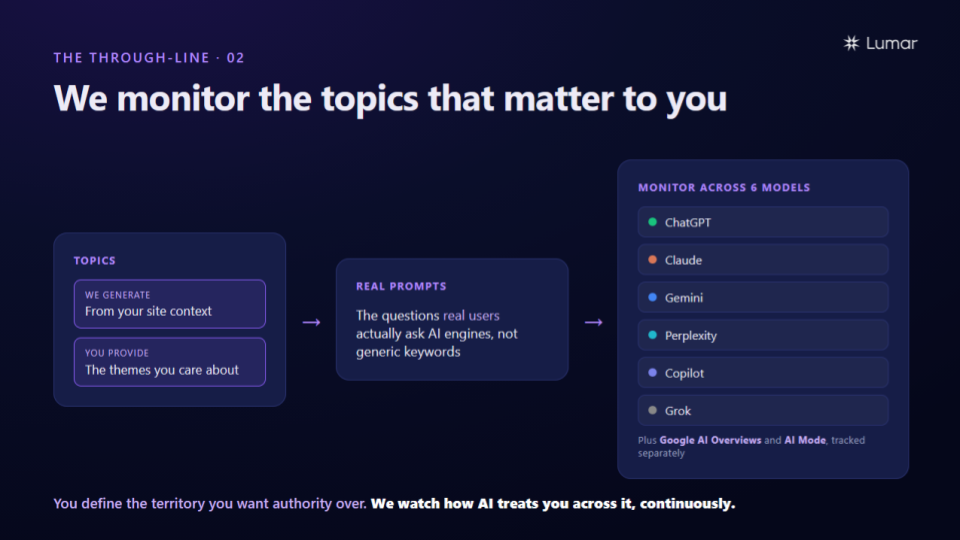
“Some we generate for you based on knowledge graphs, agentic flows,” Habibzadeh says. “And some we ask you directly – and we put those together.”
These topics are then turned into real prompts which actual users ask AI engines.
We monitor those prompts across six models: ChatGPT, Claude, Gemini, Perplexity, Copilot, and Grok. Our platform also tracks Google AI overviews and AI mode separately.
Discover pages
Monitoring these topics surfaces the pages that actually matter.
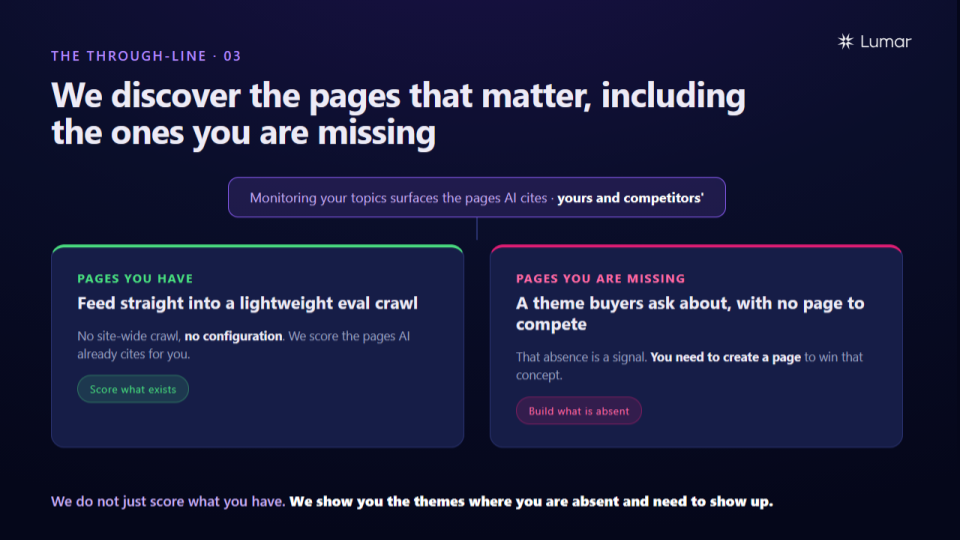
“We do not just score what you have,” Habibzadeh says. “We show you the themes you are absent from as well (and need to show up for) because they’re highly relevant in a knowledge graph to your area of expertise.”
Score on evals (which are grounded in EEAT)
Lumar scores your pages on real repeatable criteria, not vanity metrics.
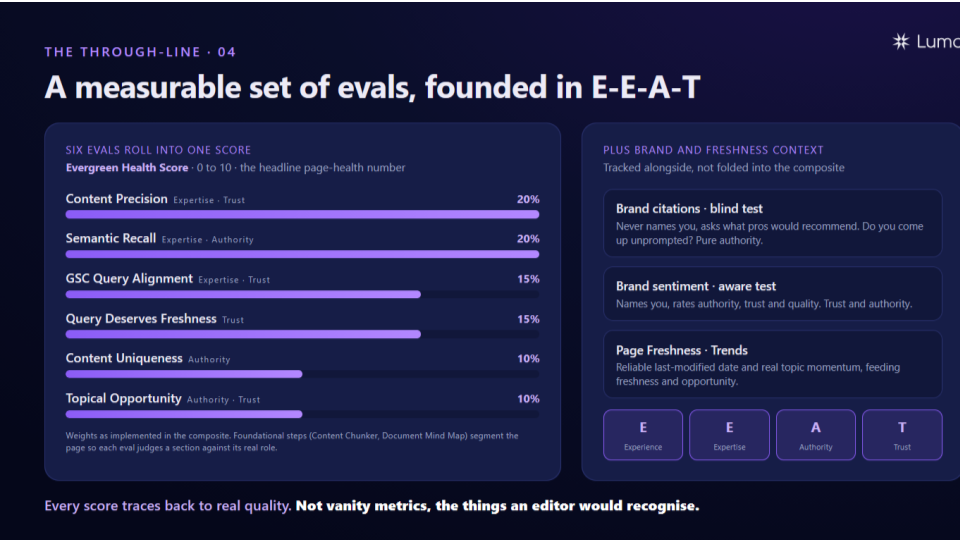
Habibzadeh notes that each eval ties back to a facet within EEAT. Because that is what earns citations.
If they don’t map directly, the platform identifies that they are an indirect contributor. There is also a composite score that shows how your pages are doing across all evaluations.
In summary, our evals are:
- Content Precision – Scores each section, or each logical chunk of your page according to the dimensionality of a specificity, completeness, accuracy, clarity, and purpose. Weighs earlier sections more heavily.
- Semantic Recall – Scores how comprehensively the page covers the intended concept it has. E.g. a product page is judged differently to a how-to guide. The dimensionality of the semantic recall is based on breadth, depth, coherence, completeness, and authority.
- GSC Query Alignment – Are your pages aligned to user demand? We take the queries, convert them into natural sounding questions, and then assess whether the content on the page meets the demand of those queries.
- Content Uniqueness – Differentiation is crucial; being original, having your own voice, coming across as unique – even on a repeated topic your competitors might be sharing. We compare your page against top-ranking Google competitors for that topic and score how distinct you are.
- Query Deserves Freshness – We score how time-sensitive each user query is. We run a Google Trend and social media news analysis on a given intended concept and see whether there is a trend that is happening. Both contribute to a topical opportunity…
- Topical Opportunity – Do you need to update your page because the topic has changed, or more users are talking about it on social media etc.? Lumar brings this to your attention.
“The scores on their own are a diagnosis, not a cure.” Habibzadeh says. “So we turn them into action.”
Using Lumar’s editorial cards to shape your strategy
From the eval output, Lumar generates a content strategy for that page across a ‘thesis,’ an
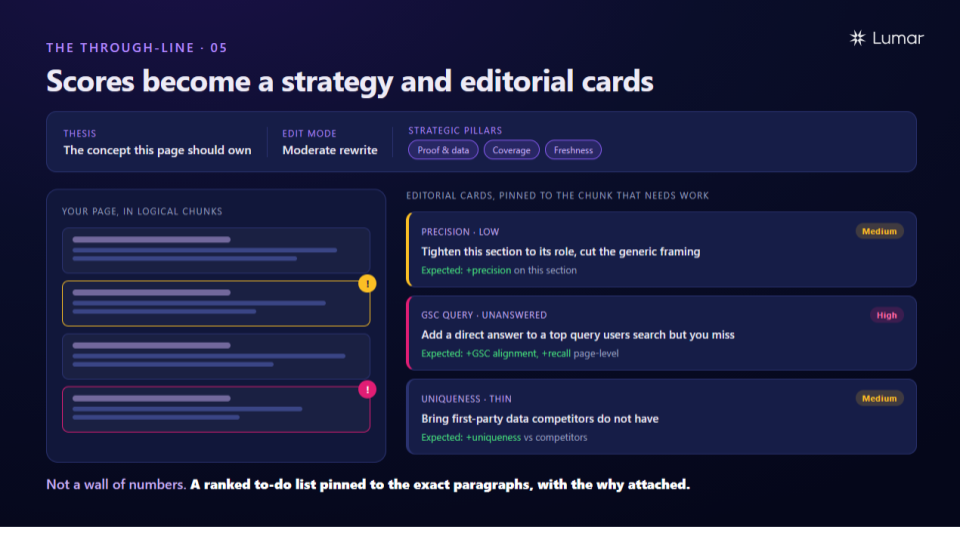
Habibzadeh points to how our platform breaks down that strategy into a set of editorial cards.
Each has a specific bounded piece of work tied to a real eval signal that maps back to EEAT and our eval scores, as well as to specific sections of the page.
“It’s not a wall of numbers,” he says. “You get a ranked to-do list pinned to the exact paragraphs of your webpages.”
Closing the loop with our copywriter agent
This is where the Lumar platform takes measurement and turns it into improvement.
Our copywriting agent reads the editorial cards, the metrics behind it, the strategy and the live article. It then proposes a list of edits to the relevant sections.
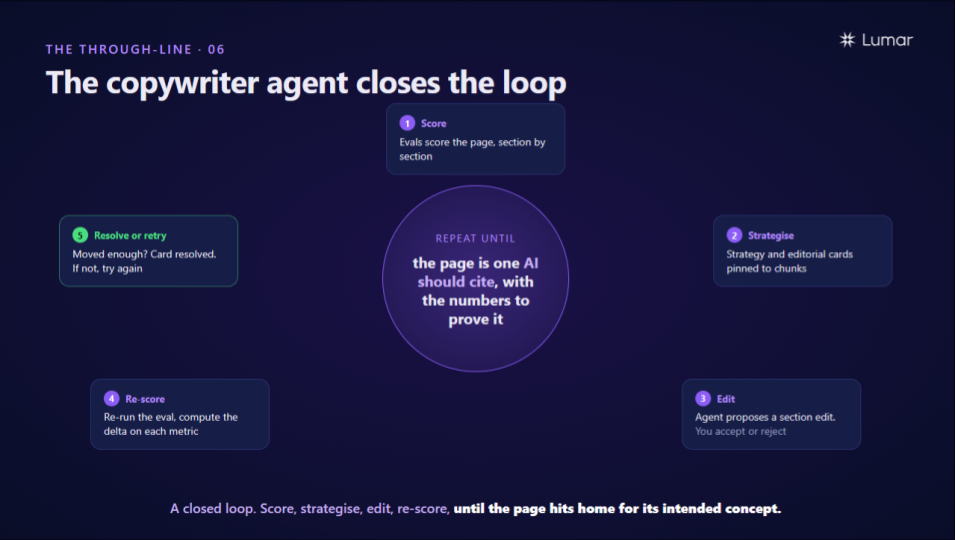
You can accept or reject a section edit. After an edit you can run a re-evaluation. If the score moves meaningfully, the card is marked as resolved.
“This is a closed loop,” Habibzadeh says. “Score, strategize, edit, and re-score until the page gets cited and hits home.”

Don’t miss the next Lumar webinar!
Sign up for our newsletter below to be alerted about upcoming webinars, or give us a follow on LinkedIn to stay up-to-date with all the latest news in SEO, GEO, and digital optimization.
Want even more SEO insights on-demand? Browse Lumar’s full library of SEO and website optimization webinars here.