Watch now:
What SEO trends will drive organic search success in 2026?
Is your SEO strategy ready for 2026? In this Lumar webinar, we’re bringing together a panel of top SEO experts to discuss the search industry trends they’re following closely this year, from GEO/AEO to EEAT, brand authority metrics, building AI-powered SEO workflows, and so much more.
Watch the full Lumar webinar above, or read on for our top takeaways
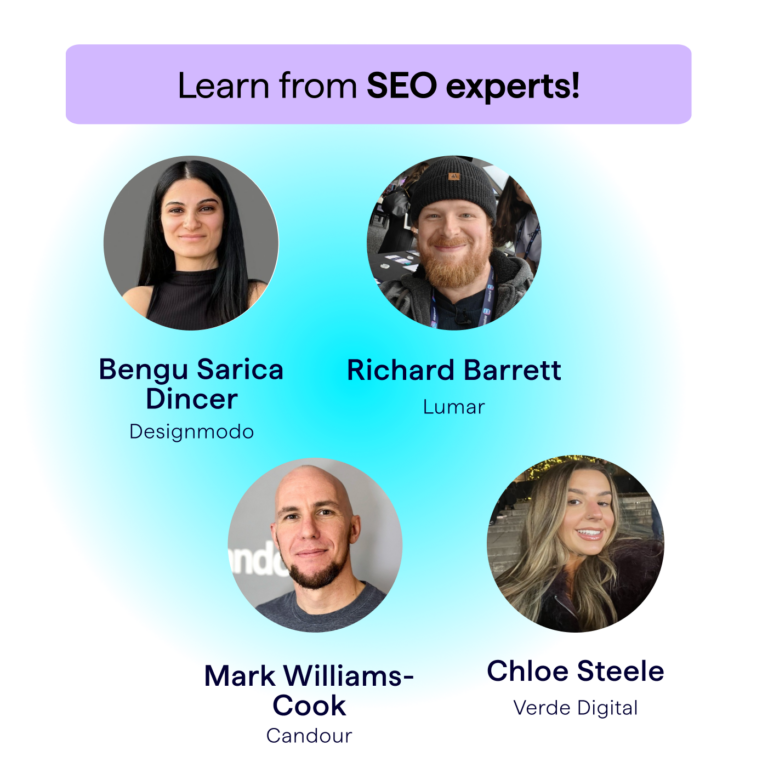
Meet the Webinar Speakers
- Mark Williams-Cook – Director, Candour
- Bengu Sarica Dincer – SEO Manager, Desigmodo
- Chloe Steele – SEO Account Manager, Verde Digital
- Richard Barrett, Head of SEO Pro Services, Lumar
GEO / AEO / AI search optimization in 2026
For Designmodo’s Bengu Sarica Dincer, there isn’t really any need to separate SEO and GEO. Ultimately, they are the same thing.
“I believe that search engines and AI systems are both trying to do one core thing,” she says. “They try to understand what humans are looking for and decide who is the most helpful to provide results.”
Of course, search interfaces are changing with the inclusion of summaries, assistants, answers – instead of just links. But the underlying goal has not been changed at all.
With increasingly AI-leaning SERPs, then, come new terms to remember. Such as:
- Chunkability – if content is broken into chunks it’s more likely to be retrieved.
- Topical consistency – unfocused pages are harder to retrieve.
- Trust signals – clear authorship, expertise, site-wide consistency.
But as Dincer reminds us, these are terms SEOs have been using for years and have long been essential for search visibility best practice.
This doesn’t mean we shouldn’t do things a little differently in the AI era. Giving our content better structure, providing clearer answers, and avoiding vague claims are all key to appealing to humans and AI search.
Mark Williams-Cook from Candour adds to this.
“There’s things we can do on understanding more about how conversations happen,” he says, “what the next most likely question is going to be, as opposed to optimizing for one shot.”
He notes that there is some confusion currently about AI output from Google and why there isn’t often a bigger overlap between the pages that rank for a term vs. what is cited in the AI overview.
This is because when the AI mode or AIO is grounding itself, it’s not necessarily doing the same query that you typed in. It’ll be doing a fan-out of semantically similar queries.
It’s still effectively searching for relevant documents for a search term. But we don’t see what the actual term is that is relevant to the AI overview.
“I think we can update our SEO skills to become more visible within AI search services,” he says. “But I don’t see it as a separate thing.”
Verde Digital’s Chloe Steele reiterates the overarching need to optimize for users, not search engines.
SEOs need to know their audience. Who are they creating this content for?
Those who have done this brand-building work, who are proving themselves to be authoritative voices in their space, are seeing their content being retrieved in AI search.
SEO data analysis
For Dincer, data is one of the most misunderstood parts of SEO today.
She collects prompt tracking data and referral data. But admits that while these show us pieces of the customer journey, it is not the full story when we acknowledge the proliferation of AI interfaces.
“Trying to force all attribution models onto these journeys can give us false confidence,” she says.
Her approach focuses on 3 layers:
- Discovery signals – e.g. how often our brand appears across search and AI interfaces.
- Recognition signals – branded queries, repeated visits.
- Outcome signals – conversions, revenue retention, product usage.
For Williams-Cook, it’s important to think about measuring that part of the journey when users are not yet on your site.
“Marketing is about influence,” he says. “So if I can get an LLM to say a good thing about my brand or service, and the person never even visits my website, I’ve still achieved – kind of – my marketing goal.”
This is currently a big challenge. He looks to prompt tracking as something of a litmus test, but argues that: “It’s borderline criminal to use it as a performance metric.”
“Even of you ignore personalization,” Williams-Cook says. “You’re not getting consistent citations, results, synthesized answers.”
Williams-Cook sees the digital world becoming smaller for brands in the AI era. With AI being able to summarize everything on the web, customers can very quickly be directed to very specific companies that might have been missed out of the top 10 links before.
“It’s more important than ever to have a clearly defined proposition,“ he says. “Having that footprint in the base model is going to be particularly important because all prompts are generated from that.”
If you have documentation about your brand vision and your target customers, and then interrogate the base model – SEOs can score how aligned they are.
“That gives you a strategy to say, we should be known for safety, for instance, and that’s not coming up. Let’s speak to our social media team and make sure they’re talking about that more regularly.”
Broadening the SEO skill set in 2026
Steele sees 2026 as an important year for SEOs to broaden their skills – especially when it comes to understanding how different channels work together.
She notes how CRO (Conversion Rate Optimization) is a key focus for her content and web pages that are still getting traffic.
How can we push users through to key commercial pages? For ecommerce sites in particular, can we review internal site search data and talk to other teams about pushing that traffic to conversion?
Understanding the full customer journey, today, is not only about understanding how LLMs synthesize information from multiple sources, but also digging into how your particular audience is discovering your brand and researching your topic.
“I don’t think you need to become an expert in every single channel,” Steele says.
Social search, short-form video content, and analysing sentiment in Reddit threads (which is a huge source for LLM citations) are all crucial for having a more holistic view of how your brand is perceived.
“It’s worth spending some proper hours learning how LLMs work,” Williams-Cook adds. “They’re pretty complicated, and understanding the sharp edges can really help.”
For instance, LLMs don’t store training data. But they store probabilities that variations of characters appear together.
“It’s just a big probability table, essentially,” he adds. “So it doesn’t make sense that it would include things that aren’t text [like HTML], because this spoils the probability.”
This challenges the received wisdom about schema and LLMs.
Schema is, still, of course, a factor for reducing ambiguity in search. But in LLMs, it’s really the content itself that matters more than the signposting – even when discussing chunking and context windows.
Ultimately for Williams-Cook, part of broadening the skill set is taking the time to learn about LLMs and seeing the big picture about how they are actually sourcing content.
SEO stakeholder communications
“I’ve heard people in the industry essentially saying, oh, I have to call it GEO if I want to get budget,” Williams-Cook says.
Rather than argue with stakeholders that AI search is still SEO, or that search best practice is broadly the same as its always been, he’s taken the micro-dosing with education approach – sharing shortform videos about topics such as AI affecting SEO, loss of clicks, how LLMs surface things etc.
This allows clients and other stakeholders to form their own opinions.
For Dincer, being able to talk with stakeholders is one of the most underrated SEO skills.
Fundamentally, she advises that we avoid SEO language if possible. This means avoiding words such as crawl, indexing, schema… anything that could be a barrier to alignment.
Multi-channel and multi-modal search strategies
Steele highlights that in the AI era, it’s no longer just about what’s on your website and the content you have.
She reminds us that LLMs synthesize information on your brand from many different sources, including Wikipedia, Reddit, etc.
If you’re a brand sold on major ecommerce platforms (Amazon et al.), these can be authoritative domains too.
It’s never possible to have all the answers when it comes to understanding every source LLMs use, but it is possible to reverse engineer queries by way of directly asking ChatGPT etc. where they got the information they just presented to you.
Steele also recommends auditing Wikipedia, Amazon, App stores etc. to ensure they are up-to-date and aligned with what you want your brand to be known for.
For Dincer, being recognizable where it matters is more important than being everywhere.
“For me, multi-channel and multi-modal strategy is really about consistency of meaning,” she says. “If someone encounters our brand in different places do they understand the same thing about who we are and what we are good at?”
“From a multi-modal perspective, text alone is not always the best way to explain something. So sometimes, an infographic, a diagram, video content, or a clear example does a much better job for both users and for machines.”
2026 SEO & GEO summary – our panel’s top tips
Bengu Sarica Dincer (Designmodo)
- Don’t try to chase every trend, every new surface, or change.
- Don’t be obsessed over numbers.
- Focus on being clearly useful, clearly positioned, and easy to understand. Let the data support decisions.
Mark Williams-Cook (Candour)
- If you’re interested in AI search visibility, you should know whether the prompts or topics you’re interested in are grounded or not. (Gemini has an affordable grounding API, ChatGPT exposes it through the browser, and there are free Chrome extensions…)
- It’s important to ensure you’re turning up for the semantically similar, conversational, fan-out queries in your niche.
Chloe Steele (Verde Digital)
- Focus on understanding all of the different channels that your customers use to research and discover your brand.
- Focus on brand authority – making sure it’s as consistent and strong as it can be across all channels.

Don’t miss the next Lumar webinar!
Sign up for our newsletter below to be alerted about upcoming webinars, or give us a follow on LinkedIn to stay up-to-date with all the latest news in SEO, GEO, and digital optimization.
Want even more SEO insights on-demand? Browse Lumar’s full library of SEO and website optimization webinars here.