

What happened in SEO & AI search news this month?
Each month, Lumar’s in-house tech SEO experts hand-pick some of the SEO industry’s top news stories from across the web to keep you up-to-date on all things SEO and website optimization.
For our March 2026 SEO & GEO/AEO news roundup, the top headlines include:
- The presence of Google’s AI Overviews in search results grew 58% in one year.
- Google will enable sites to opt out of AI Search features: Following guidance from the UK’s Competition and Markets Authority (CMA), Google has confirmed it’s working on a way to allow sites to opt out of generative AI features like AI Overviews.
- Google’s AI Mode is increasingly sending users back into its own ecosystem via self-referencing links.
- 67% of ChatGPT citations within a given topic are captured by only around 30 domains.
- Shopify launches “Agentic Storefronts” that allow merchants to sell directly inside ChatGPT, AI Mode, and more.
- Walmart’s 3x Conversion Gap: ChatGPT checkouts significantly underperformed compared to standard web traffic for the major US retailer, leading the company to rework its approach to agentic ecommerce.
- (and much more, below!)
Dive into the details behind the SEO and GEO/AEO headlines this month below…
But first: Lumar’s new, free 80-page guide to GEO/AEO has just launched!

With actionable checklists and in-depth explainers on each area of GEO, & real insights from 20+ SEO experts,, this 80-page playbook is a must-read for SEOs, content strategists, and digital marketing leaders alike.
Ready to take your GEO/AEO strategy to the next level? Get the free 2026 GEO/AEO guide now.
March 2026 SEO & GEO/AEO News Roundup:
Google is testing AI-driven title rewrites in search results
Google has confirmed it’s experimenting with AI to rewrite page titles in SERPs. Of course, Google rewriting titles is nothing new, but this is the first time Google has openly confirmed that AI is being used for this purpose. According to Google, the end goal is to generate titles that better match user intent and drive greater engagement. However, publishers are understandably concerned about the potential for AI to completely alter the tone and meaning of titles, diminishing user trust as a result.
(Source: Search Engine Land )
Google’s own dominance in AI Mode responses grows
New research from SE Ranking suggests that Google’s AI Mode is increasingly sending users back into its own ecosystem via self‑referencing links. Google.com is now the most cited source in AI Mode responses, accounting for roughly 17.4% of all citations. That’s up from 5.7% last year, and is more than the next six domains combined.
While organic links still appear in AI Mode, there’s clearly a focus on encouraging users to continue their search within Google. This raises real visibility challenges for publishers, with potentially even less traffic being sent to their own sites.
(Source: SE Ranking )
67% of ChatGPT citations within a given topic are captured by around 30 domains
A new study by Kevin Indig reveals that ChatGPT citations are significantly more concentrated than traditional search results. Analyzing 1.2 million ChatGPT responses, the research found that roughly 30 domains capture 67% of all citations within a specific topic.
While ranking #1 on Google remains a strong signal—with 43.2% of top-ranking pages earning a citation—the AI is remarkably selective. ChatGPT retrieves approximately six times more pages than it actually cites, effectively “ignoring” 85% of the content it analyzes during its search process.
(Sources: Kevin Indig, Search Engine Land)
Google’s AI Overviews continue to surge across multiple industries
Google’s AI Overviews are rapidly expanding, with coverage growing by 58% YoY according to a new study from Brightedge. As of February 2026, AIOs appear in almost half of all search results, with a particular focus on nine major industries. It’s a clear shift away from AIOs being shown purely for informational queries. Their presence is now commonplace across a diverse range of sectors, including healthcare, travel and ecommerce.
The average AIO block also now exceeds 1,200px in height and places the top organic result below the fold. With only around 17% of sources cited in AIOs also ranking in the organic top 10, there’s real pressure on sites from these industries to increase visibility within AI-led search features.
(Source: Search Engine Journal )
Analysis from Google’s Discover update shows a shift in distribution
New data from NewzDash reveals that February’s Google Discover core update caused notable shifts in behavior, with less diversity and fewer unique publishers appearing in top placements. Much of this change was due to a push towards regional personalisation in the results. Data from New York and California shows increased visibility for country and state-specific publishers over the update period.
However, the data also shows a shift towards publishers that can show clear topical expertise. Specialist publishers are performing better post-update, with fewer generalist sites appearing in top placements. There’s also been a tilt toward more timely, authority‑driven topics rather than sensational clickbait, which was originally listed by Google as one of the main goals of the update.
(Source: NewzDash )
Google makes improvements to its Universal Commerce Protocol for AI shopping
Google has announced fresh updates to its Universal Commerce Protocol (UCP), improving core features like catalog and cart functionality. There’s also a more streamlined onboarding process for merchants wanting to be early adopters of the protocol.
The update focuses on reducing friction and accelerating adoption, as UCP paves the way for bigger breakthroughs in agentic commerce. More information on the changes can be found in the official help documentation, published earlier this month.
(Source: Google: The Keyword Blog )
Google is winning the AI search race, but at a cost to publisher clicks
New data from Sistrix places Google at the top of the pile for AI Search, but argues that it’s distribution, rather than quality, keeping it there. Unlike its competitors, Google has the benefit of its AI models being baked into an already established Search product, with no change in user behaviour required. However, this win for Google comes at a heavy price for publishers. By integrating AI-powered features into the core Search platform, the number of organic clicks per search is decreasing.
(Source: Sistrix )
Google will enable sites to opt out of AI Search features
Following guidance from the UK’s Competition and Markets Authority (CMA), Google has confirmed it’s working on a way to allow sites to opt out of generative AI features like AI Overviews. We’re yet to learn exactly how this would work, or whether it will impact sites outside of the UK. However, it’s a clear step towards giving sites more control over their presence in AI-powered search features.
Site owners can currently opt-out of AIOs and AI Mode by using the nosnippet meta tag. However, its usage also has broader implications for traditional web search, image search and Discover. The new controls being worked on by Google will presumably be limited to AI features only.
(Source: Google: The Keyword Blog )
Google completes rollout of GSC-branded queries filter
Google has expanded its branded queries filter to all eligible Search Console properties, letting site owners easily distinguish between branded and non-branded traffic in the Performance report. The ability to do this is nothing new, but previously required manual regex filters that are now available at the click of a button.
(Source: Search Engine Land )
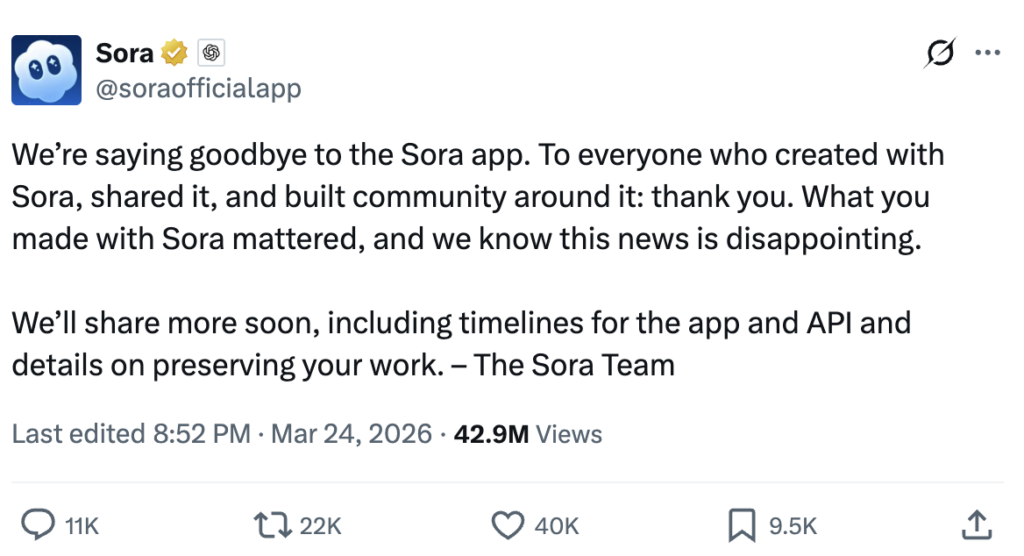
OpenAI shuts down Sora, its generative video tool
One of the more surprising AI product reversals this month came from OpenAI, which announced this week that it is shutting down Sora, its AI video app. The decision lands less than a year after Sora became one of the company’s most attention-grabbing consumer launches, and just months after OpenAI and Disney announced a $1 billion licensing deal, which would have seen iconic characters licensed for AI video creation.
OpenAI has said they are choosing to shut down Sora in order to refocus on other developments, like robotics, “that will help people solve real-world, physical tasks,” according to the BBC.
Despite the massive viral interest at launch, Sora apparently struggled to convert hype into profit. Market intelligence firm Sensor Tower highlighted a staggering revenue gap between OpenAI’s Sora video product vs. its core ChatGPT product: while ChatGPT generated $1.9 billion in global net revenue over the same period, Sora managed just $1.4 million, according to BBC reporting.
According to reporting from The Guardian, the app’s brief run was overshadowed by familiar generative-media problems: deepfake concerns, moderation challenges, misleading content, and questions over copyright and creator rights. Disney responded by saying it understood OpenAI’s decision and remained committed to exploring AI responsibly, but the shutdown still marks a sharp end to what had looked like one of the most commercially significant entertainment partnerships in the generative AI market.
For digital marketers, this story is less about video creation alone and more about the fragility of AI platform ecosystems. It shows how quickly a product can go from breakout launch to strategic retreat — and why teams building on third-party AI platforms need to think carefully about dependency risk, content rights, and long-term platform stability.
(Sources: BBC, The Guardian, Al Jazeera, MediaPost, Sora on X)
Shopify launches agentic AI for e-commerce: merchants can now sell directly inside ChatGPT, Google AI Mode, and more
This month, Shopify rolled out Agentic Storefronts, giving its millions of merchants out-of-the-box access to sell inside AI chatbot interfaces — including ChatGPT, Microsoft Copilot, Google’s AI Mode, and the Gemini app — all managed from the Shopify admin dashboard with no additional integrations required. Shopify has also launched a standalone Agentic Plan for brands not using Shopify as their primary ecommerce platform, allowing them to list products in Shopify Catalog and gain visibility across the same AI surfaces.
Underpinning the Google-Shopify AI integrations is the Universal Commerce Protocol (UCP) — an open AI e-commerce standard co-developed by Shopify and Google.
(Source: Shopify Announcement)
Walmart sees 3x lower conversion rates with ChatGPT checkout vs. on their own website
While Shopify announced more agentic AI ecommerce tools this month, Walmart revealed that its initial test of an AI-powered checkout experience inside ChatGPT suggests the model still needs work. According to reporting from Inc., Walmart’s conversion rates for purchases completed within ChatGPT were around three times lower than on Walmart’s own website, with customers finding the experience “unsatisfying.”
Despite the weaker performance with AI checkout, Walmart is doubling down. The retailer is embedding its own AI assistant, Sparky, into ChatGPT to maintain control over personalization, assortment, and the overall customer experience.
Walmart is also maintaining its broader AI commerce strategy, with a separate Google Gemini partnership announced in January that has yet to launch.
Why it matters for SEO: This is an early real-world data point on AI-driven commercial conversion — and it confirms what many in the industry suspected: being discoverable in an AI interface is not the same as converting there. For SEO and ecommerce teams, it underscores the importance of owning the checkout journey and not assuming that AI surface visibility automatically translates into revenue.
(Sources: Search Engine Land, Inc., Retail Dive)
Did you know you can now optimize for AI search and LLM brand mentions with Lumar?
Lumar’s GEO tools for AI search optimization provide data-driven insights to help you optimize your website for AI-driven search visibility, earn more AI citations, and improve brand visibility across LLMs.