

What happened in SEO & AI search news this month?
Each month, Lumar’s in-house tech SEO experts hand-pick some of the SEO industry’s top news stories from across the web to keep you up-to-date on all things SEO and website optimization.
For our April 2026 SEO & GEO/AEO news roundup, the top headlines include:
- Google AI Mode is coming to Chrome’s address bar — users will soon be able to query AI Mode directly from the browser, with responses able to reference open tabs, images, and files.
- Google’s March 2026 core update is complete — specialist, niche sites continued to outperform content aggregators, extending a familiar trend in recent updates.
- Google bans back button hijacking — sites that use redirect tricks to prevent users from returning to previous pages will face manual spam actions or automated demotions starting June 15th, 2026.
- Google Search is evolving into a task engine — new AI Mode features let users track hotel prices, build full trip itineraries, and even have Google AI call stores to check stock.
- Cloudflare redirects AI training bots to canonical URLs — a new feature automatically turns canonical tags into 301 redirects for crawlers like GPTBot and ClaudeBot.
- AI traffic to US retail sites is surging — but most aren’t optimized for it — Adobe data shows high-intent AI-referred shoppers arriving at e-commerce sites that aren’t yet machine-readable.
- OpenAI ends its exclusivity deal with Microsoft — OpenAI can now pursue cloud deals with rivals like Amazon and Google, while Microsoft retains a non-exclusive license through 2032.
- OpenAI launches GPT-5.5, its most agentic model yet — with stronger multi-step reasoning and tool use, pushing ChatGPT further toward a closed-loop “super app” model.
- Anthropic released Claude Opus 4.7 with improved multi-step reasoning and multimodal capabilities.
- EU weighs classifying ChatGPT search as a “Very Large Online Search Engine” — at 159 million monthly EU users, it clears the 45 million threshold that would trigger DSA compliance obligations.
- (and more, below!)
Dive into the details behind the SEO and GEO/AEO headlines this month below…
But first: New AI visibility tools launched in Lumar this month!
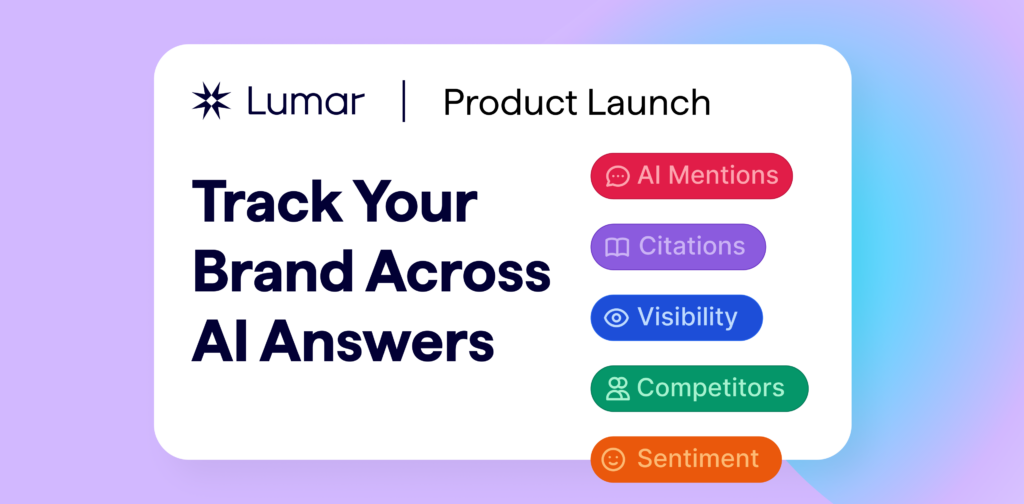
Know where you stand in AI answers. New AI Visibility tools in Lumar track your brand’s AI presence, sentiment, and citations across the AI models your buyers are using — and tell you exactly what to do about the gaps.
April 2026 SEO & GEO/AEO News Roundup:
Google announces greater integration for AI Mode in Chrome
Google has been continuing its mission to better integrate AI Mode with everyday workflows. Soon, AI Mode will be available directly within Chrome via the address bar, allowing users to ask complex questions while staying on a page. AI Mode will also be able to reference open tabs, images, and files for extra context.
Clicking on links from these AI responses will also now open a side-by-side view, rather than replacing the current page. The goal is to reduce so-called ‘tab hopping’ and allow users to deep-dive into specific topics from one static location.
(Source: Google’s The Keyword Blog)
Google’s March 2026 core update completes its rollout
The update ran from March 27th to April 8th. There was no specific focus to this one, although SERP volatility was high. Much of the analysis that followed, including this article by Aleyda Solis, showed specialist, targeted sites performing better than content aggregators and comparison sites. It’s a familiar pattern that’s become a bit of a trend in recent updates, rewarding established brands that have built a strong reputation within their niche.
(Source: Google Status Dashboard)
Google makes recommendations for ‘Read more’ link inclusion
Google has published new guidance on optimizing content for ‘Read more’ link inclusion. These links have been cropping up more frequently in SERPs in recent months, but this is the first time Google has made any actionable recommendations to improve eligibility for the feature.
Recommendations focus on ensuring that content is accessible and directly visible on page load. Content hidden behind tabs or other expandable sections is less likely to appear here.
(Source: Search Engine Land)
‘Back button hijacking’ is about to be penalized by Google
Google has updated its spam policies to explicitly ban back button hijacking. This covers any behavior that stops users from returning to the previous page when they click the back button within the browser, such as redirecting them to a page they haven’t visited before.
Possible penalties include manual spam actions or automated demotions, which can impact the site’s performance in Google Search results. The new rules come into place from June 15th and sites have until then to disable this behavior.
(Source: Google Developers Blog)
Cloudflare turns canonical tags into redirects for AI training bots
Cloudflare has launched a new feature that automatically turns canonical tags into 301 redirects for certain AI training bots, such as GPTBot and ClaudeBot. The aim is to prevent AI crawlers from ingesting so much duplicate content, instead redirecting them straight to the primary version of each page.
The change will only impact AI training bots, so AI assistants will be unaffected. The change also won’t have any impact on Googlebot or human users. Even so, it brings canonical strategy into focus and is yet another way that AI crawlers will be acting differently from traditional search engines.
(Source: Cloudflare)
Google says efficiency is key when it comes to page weight concerns
In a recent episode of the Search Off The Record podcast, Gary Ilyes and Martin Splitt highlighted a growing discussion around increasing page sizes. The pair confirmed that larger pages aren’t necessarily a problem for Google. However, they do point to whether elements making up page weight are actually beneficial to users.
Bigger pages tend to rely heavily on things like JavaScript, images and structured data. Rather than looking at the size of the page in silo, it’s important to consider whether these elements are getting in the way of efficiency – both for crawlers and users.
(Source: Search Engine Journal)
Google demystifies Googlebot and the 2MB fetch limit
In a recent blog post, Google has provided a rare glimpse into the inner workings of Googlebot. No longer referring to a single crawler, Googlebot has evolved into an umbrella term that covers dozens of different clients, all working to process content for use across Google’s wide range of products and platforms.
The blog post also references the 2MB limit, which sent shockwaves through the SEO industry when it was first mentioned back in February. Googlebot currently fetches up to the first 2MB of each individual URL. If your HTML file is larger than this, fetching will stop exactly at the 2MB cutoff. Each referenced resource in the HTML will have its own separate byte count and will not count towards the size of the parent page they were found on.
(Source: Google Developers Blog)
AI traffic surges for US retailers, but many sites are still not optimized for AI bots
A recent report from Adobe confirms that AI sources are sending rapidly growing volumes of high-intent traffic to U.S. retail sites, with shoppers using chatbots and AI browsers to research products and find the best deals. However, many e-commerce pages are still not fully optimized for AI search, especially when it comes to PDPs. This limits visibility in AI-powered searches and greatly reduces retailers’ ability to be cited within these AI shopping experiences.
(Source: Adobe)

Google Search is evolving into a task engine: AI travel-planning and AI calling features expand in search
Google rolled out a cluster of new features in April that let users complete real-world tasks without leaving Search. This month, Google launched hotel price tracking globally, letting users monitor individual properties and receive email alerts when rates change — directly from the search bar. Alongside that, AI Mode’s Canvas tool now builds full trip itineraries for all US users from a natural language prompt, pulling together flights, hotels, mapped attractions, and refining results through follow-up questions. And AI Mode gained agentic calling — the ability for Google’s AI to phone local stores, check whether a specific item is in stock, and report back — extending a capability that has been available in Search since November.
Taken individually, these are useful travel features. Taken together, they represent a meaningful step toward a more agentic version of Google Search; one where users don’t find information and then go do things, but where Search handles the doing directly.
For SEOs and digital marketers, agentic features in Search will reward businesses whose data is accurate, structured, and machine-queryable, not just findable by humans. If AI Mode is calling your store to check stock, your Google Business Profile and inventory data are now effectively front-line marketing assets. Schema.org markup, consistent local listings, and real-time operational accuracy matter in ways that go well beyond traditional ranking signals. The window to get ahead of this is now, before agentic search is the default expectation rather than the notable new feature.(Source: Search Engine Journal ; Travel + Leisure ; Google’s The Keyword Blog)
OpenAI ends exclusivity deal with Microsoft
This week, OpenAI and Microsoft have restructured their long-standing partnership. The headline change: Microsoft has dropped its exclusive right to sell OpenAI’s AI models, opening the door for OpenAI to pursue cloud deals with rivals like Amazon or Google.
This is a mutual unwinding of exclusivity rather than a total breakup of the partnership. Microsoft retains a non-exclusive license to OpenAI’s models through 2032, but trades away exclusive distribution rights in exchange for no longer having to pay OpenAI a revenue share. OpenAI gains a cap on its payments to Microsoft and the freedom to operate across multiple cloud providers, which can help it expand its enterprise AI offerings.
OpenAI launches GPT-5.5, enabling more agentic task handling in ChatGPT
This month, OpenAI has launched GPT 5.5, describing it as its “smartest and most intuitive” model to date and a key step toward a unified AI experience that brings search, productivity, and task execution into a single interface. The new GPT 5.5 model introduces stronger multi-step reasoning, improved tool use, and more agent-like behavior — enabling users to complete complex tasks without leaving the ChatGPT environment.
Per OpenAI’s announcement post:
“GPT‑5.5 understands what you’re trying to do faster and can carry more of the work itself. It excels at writing and debugging code, researching online, analyzing data, creating documents and spreadsheets, operating software, and moving across tools until a task is finished.”
GPT 5.5 is rolling out to Plus, Pro, Business, and Enterprise users in ChatGPT and Codex, with plans to bring the model to the API soon.
For SEO and digital marketers, the bigger story is strategic. OpenAI is moving toward a closed-loop “super app” model, where users search, evaluate, and act all within the AI platform rather than clicking out to websites. This raises the stakes for achieving AI brand visibility, as brands increasingly compete to be cited or surfaced in AI responses, not just indexed and ranked in search engines.
(Sources: TechCrunch ; OpenAI announcement)
Anthropic launches Claude Opus 4.7 with improvements in instruction-following and multimodal understanding
Like OpenAI, Anthropic also shipped a model update this month with the launch of Claude Opus 4.7. This latest Anthropic model is focused on improving performance in complex, multi-step tasks. Anthropic highlights that Opus 4.7 offers better instruction-following, greater ability to remember important notes across multiple sessions, and improved multimodal understanding.
(Sources: Anthropic announcement )
EU moves to classify ChatGPT as a “Very Large Online Search Engine”
The European Commission is assessing whether to designate ChatGPT’s search feature as a Very Large Online Search Engine (VLOSE) under the Digital Services Act, which would require stronger compliance with EU digital platform regulations. OpenAI’s transparency report revealed ChatGPT’s search feature averaged 159.1 million monthly active users in the EU — well above the 45 million threshold that triggers the classification.
Per OpenAI documentation:
“For the six-month period ending 31 March 2026, ChatGPT search had approximately 159.1 million average monthly active recipients in the European Union.”
A VLOSE designation would place ChatGPT alongside Google, Microsoft, Amazon, Meta, and X, thereby requiring systemic risk assessments, algorithmic transparency, independent audits, and obligations for researchers to access data.
(Sources: Reuters ; TechRepublic)
Did you know you can now optimize for AI search and LLM brand mentions with Lumar?
Lumar’s GEO tools for AI search optimization provide data-driven insights to help you optimize your website for AI-driven search visibility, earn more AI citations, and improve brand visibility across LLMs.