SEO, GEO, & AEO: A Conversation With Search Pros
Join Rejoice Ojiaku (Senior Content Specialist at Wise) and Lumar search expert Matt Hill for a transparent look at how real SEO leaders are pivoting their strategies for the AI era of GEO and AEO.
Watch now:
Traditional SEO playbooks are being rewritten in real-time to accommodate new AI-led brand discoverability pathways. But what does “optimizing for AI” actually look like on the ground? In this exclusive dialogue, we’re moving past the buzzwords to discuss how real SEO pros are navigating these tectonic shifts in search behavior and online visibility.
Pull up a chair for a high-level conversation between SEO experts, as they trade insights on how to maintain brand authority when the “search results page” is supplemented by an AI discovery.
Watch the full Lumar webinar session above, or read on for the key takeaways.
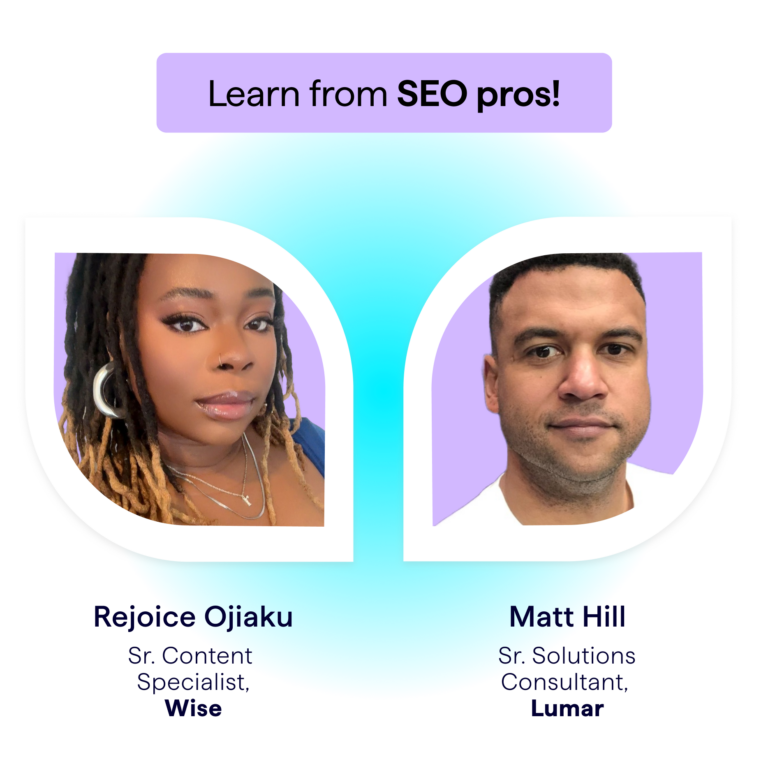
Meet the Webinar Speakers
- Guest: Rejoice Ojiaku, Senior Content Specialist at Wise
- Host: Matt Hill, Senior Solutions Consultant at Lumar
TL;DR / Executive Summary: SEO in the Age of AI
AI search is changing what SEO visibility means. Rankings, traffic, and clicks still matter, but they no longer tell the full story. As AI Overviews, LLMs, and answer engines increasingly synthesize information before users click through to websites, brands need to understand whether they are being represented accurately in AI-generated answers.
In this Lumar webinar, Rejoice Ojiaku, senior content specialist at Wise, and Matt Hill, senior solutions consultant at Lumar, discuss why SEO teams need to shift from optimizing only for rankings to optimizing for representation, inclusion, and influence across the wider web.
Key takeaways:
- Ranking no. 1 in Google does not guarantee AI visibility. Brands can perform well in traditional SERPs and still be absent from AI-generated answers.
- Visibility now includes citations, summaries, and narrative ownership. SEO teams need to know whether their brand is being cited, how it is being summarized, and whether third-party sources are shaping the story on their behalf.
- Content needs to be extractable, not just valuable. Clear, structured, answer-first content is more likely to be understood, reused, and cited by AI systems.
- The basics matter more than ever. Strong information hierarchy, readability, logical formatting, and frameworks like “PEE (Point, Evidence, Explain)” can help both humans and machines understand content faster.
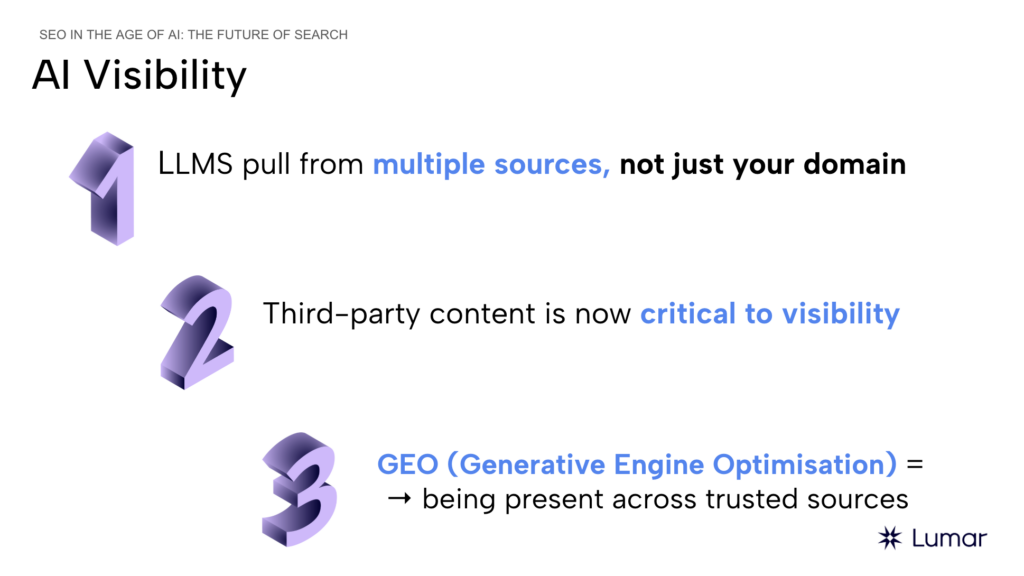
- Authority is now multi-source. AI systems pull from far more than your website, including PR, reviews, forums, editorial mentions, social content, partnerships, and video platforms.
- SEO is becoming more cross-functional. AI visibility depends on collaboration across SEO, content, PR, brand, product, social, and analytics teams.
- Measurement needs to evolve. Alongside rankings and traffic, teams should track AI mentions, citations, share of voice, prompt visibility, answer positioning, competitor inclusion, and sentiment.
The core message: SEO is not dead. It is expanding. To succeed in AI search, brands need to build a clear, consistent, and authoritative presence across the entire discovery ecosystem — not just their own websites.
Webinar Recap: “SEO in the Age of AI”
From Rankings to Representation
Wise’s Rejoice Ojiaku is clear that search is no longer just about rankings.
“They’re no longer the full picture,” she says. “They still matter. You still want to have great rankings within the SERPs.”
But it’s not enough when we think about the landscape of GEO and AEO.
You can rank well, but your brand can still go undiscovered if AI is shaping the answer and you’re not being included before the user gets a chance to browse the list of links below.
“One of the most important mindset shifts that I had to think about when taking a deep dive into AO search is that this new era of accepting the old success model is almost becoming incomplete in its own self,” Ojiaku adds.
Even ranking #1 in Google doesn’t guarantee inclusion in AI-generated answers. And it doesn’t guarantee a click.
“If a user asks a question, and it gets polished/synthesized, or it gets answered before they even scroll, or before they even click – your number one ranking now may not carry the same value as it once did.”
So the question is: What are we actually optimizing for now?
- Are we optimizing for rankings?
- Are we optimizing simply for inclusion in AI answers (as a reference/link)?
- Are we optimizing our content to be summarised and cited?
The quick answer is… all of the above.
For Lumar’s Matt Hill, AI search is really exposing folks:
“Chasing rankings really shouldn’t have been your goal over the past 10 years,” he says. “But there are still people who cling on to that KPI because it’s easy.”
He reflects on how ranking first used to be like a prize we could hack for.
“Let’s be real, in this world of AI search, GEO, I haven’t found a way to hack any of these methodologies, these workflows,” he says.
“You really have to take into account these multi-layers, these multi-factors that really do impact what we call the representation.”
SEOs have been forced to evolve beyond hacks.
The rise of answer-led content (AEO)
Today, we are moving away from asking Where do I rank? to Am I represented?
“It’s not just a wording change,” Ojiaku says. “I think it’s a different way that we need to see the job of SEO, to see the purpose of SEO.”
Crucially, users are not necessarily clicking through the SERPs. They are now, according to Ojiaku, ‘reading, they’re absorbing, they are moving on.’
New questions we need to be asking include:
- Does my brand actually show up when these answers come up within these LLM systems?
- Is our expertise also presented in the right narrative?
- Is our viewpoint being presented?
The fact is, many brands might not be able to answer yes to any of these questions. Even while on paper our SEO is good for ranking, it might not be working for LLMs/AI-generated answers.
Visibility now means:
- Being cited
- Being summarised
- Being part of the narrative
“These systems are not just retrieving one page and repeating it back. They’re actually stitching together an answer from multiple sources, multiple entities, multiple points of evidence,” Ojiaku says. “So if your brand is not part of that narrative construction within AI, you are losing visibility.”
SEOs need to broaden their definition of success.
“Context matters,” Hill says. “Are you the one as the brand providing that representation in the LLM output or is it mostly third-party sites speaking on behalf of your brand?”
This means we need to think about the sentiment of the content around your mentions too. Is it positive? Neutral? Negative?
How much control do we have over that? How are we monitoring it?
Ojiaku highlights that it can even be quite dangerous when third parties are left to fill the gap where LLMs want to reference you. She recalls an example of a client, a brewery running tours in the UK, that was keen to be seen as a historical site of interest but was rarely considered a priority location to visit in third-party reviews. And thus, frequently othered in AI results.
“The value on its own is not necessarily enough,” she says. “It needs to be easy for machines to understand and isolate it and therefore lift that content to present it back.”
This means that if your content is buried under too much fluff, the answer will come too late. It won’t be surfaced.
For Ojiaku, the best-performing content often looks like a well-structured essay. We don’t need to overcomplicate things.
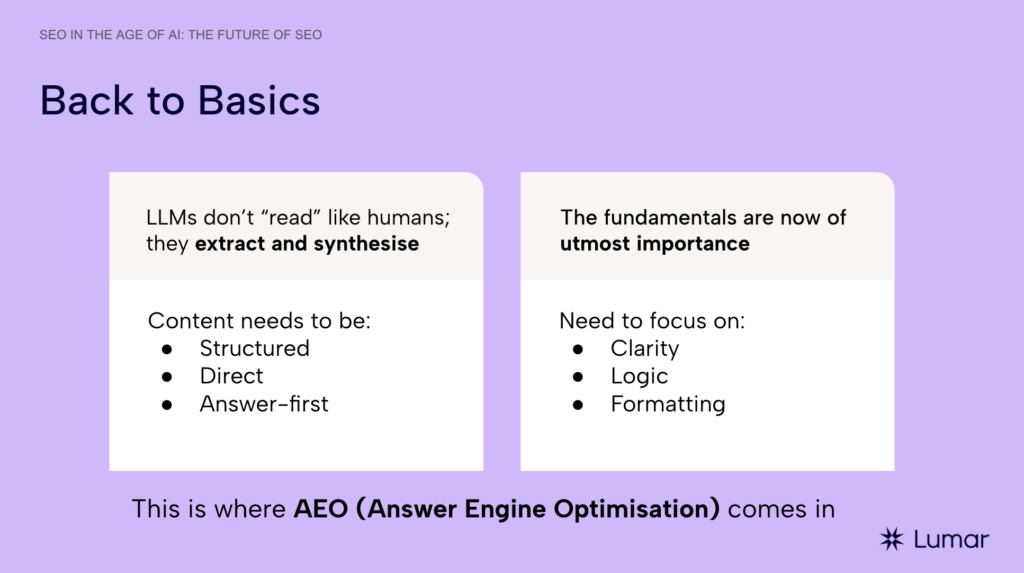
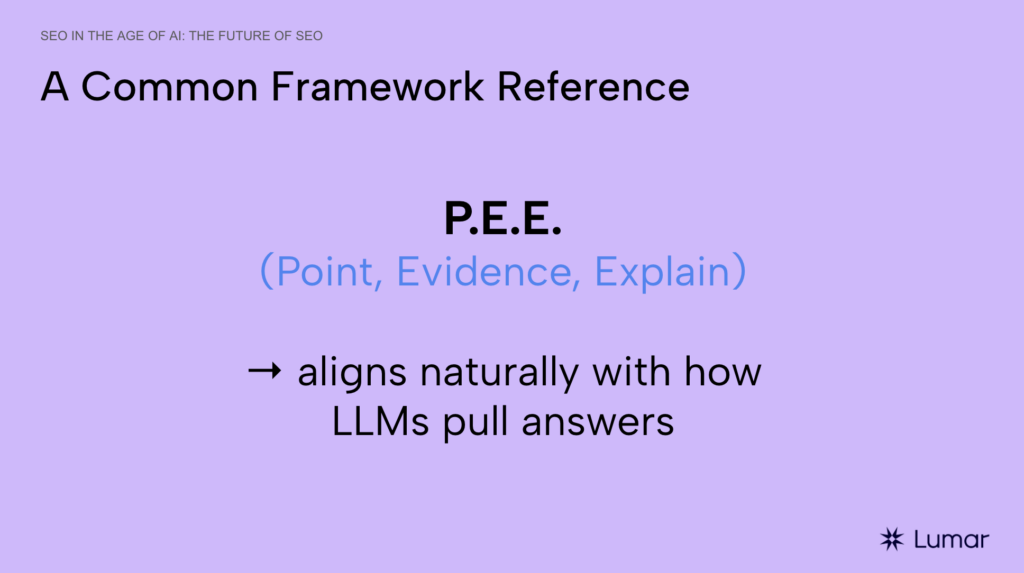
She reminds us of the P.E.E. framework for content: Point, Evidence, Explain.
This aligns quite naturally with how LLMs pull answers.
“At the end of the day, your focal audience isn’t ChatGPT. It isn’t Perplexity. It is still users.”
“Point, evidence, explain,” works for AI. But it works for humans too.
Authority is now multi-source
Ojiaku highlights that your brand is defined across the web, not just on your site.
Subsequently, there needs to be an SEO ecosystem: a large footprint across multiple channels, with SEO at the center.
You need to know where your user journey starts – it may not be Google.
Reddit, TikTok, and LinkedIn are all massive players in the discoverability ecosystem today.
“If your site says one thing, but the rest of the web says something else (or nothing at all), you have a visibility problem.”
— Rejoice Ojiaku, Senior Content Specialist at Wise
Today’s authority signals now include:
- PR
- Partnerships
- Reviews
- Forums
- Editorial Mentions
Ultimately, the more you can work to shape the narrative with this full ecosystem in mind, the more aligned AI search will be with your brand, and the more likely you are to show up in the right places.
The evolving role of SEO teams
SEO isn’t dead. It’s evolving.
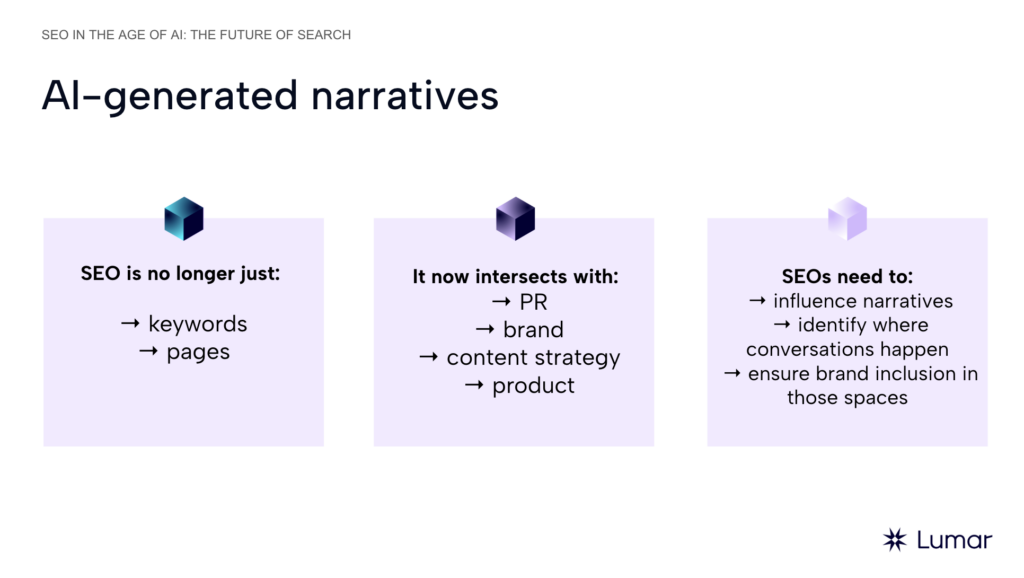
Both Ojiaku and Hill agree that SEO is becoming a cross-functional discipline.
“SEO is no longer just about optimizing pages,” Ojiaku says. “It’s about influencing how your brand shows up in AI-generated narratives.”
But this does mean we need to rethink how we measure SEO success.
Rethinking measurement in an AI world
Ojiaku reminds us that we can’t optimize what we can’t measure.
If your user gets the answer without clicking, but your brand was part of the answer… is that still a win?
We may well think it is, but how do we prove it?
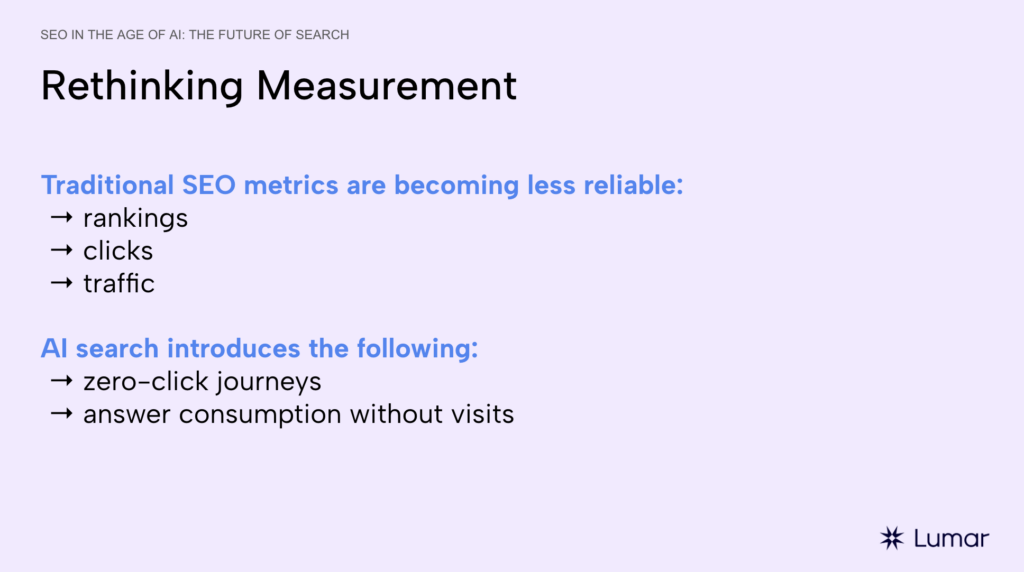
Share of voices is important, but according to Ojiaku, so too is measuring the order you come up.
“The order matters,” she says. “Are you mentioned amongst your competitors? Are you mentioned as number one before your competitors? Are you mentioned as number five?”
We need to ask whether we are presented as a market leader or an alternative. If the latter, why?
We also need to understand the formatting of AI answers too. Are you represented in bold? Bullets? Why?
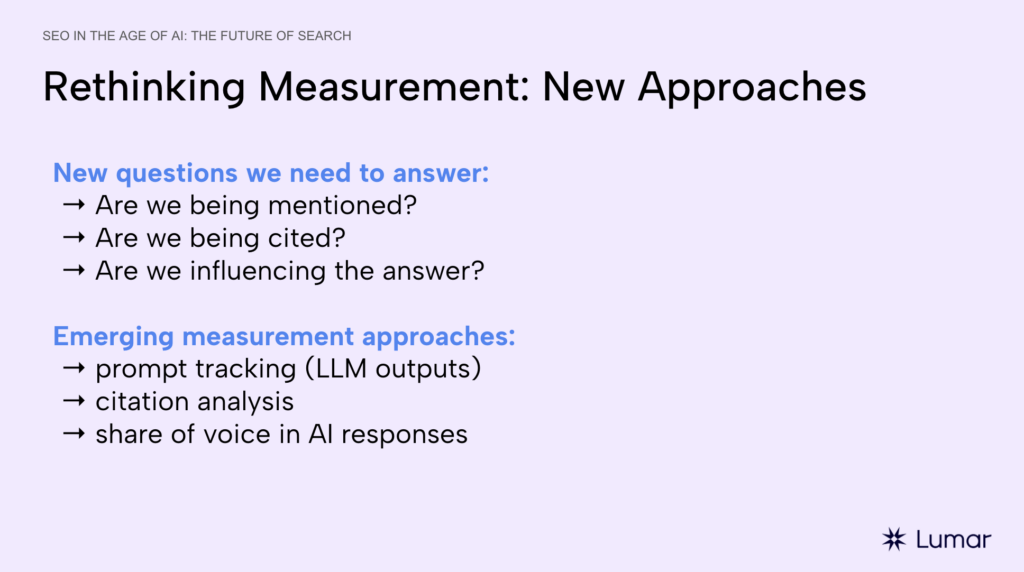
With this in mind, Hill speaks to the importance of having a prompt strategy, starting with building a prompt library that ties in with your brand. (Crawl data from Lumar‘s website optimization platform can really help with this!)
He also advises us to consider prompts across 3 different stages of the funnel…
- Thought leadership stage – when folks are just trying to understand the landscape.
- The consideration point – feature comparison, price comparison, etc.
- When they’re on board – Are there questions that they’re going to the LLMs for that we as a brand should be owning?
Fundamentally, this comes back to thinking of the entire ecosystem; being present across multiple sources at multiple points of the user journey.
Proper representation – while still maintaining good rankings – is a constant process of analysis and monitoring of this ecosystem and the journeys your customers are making.
Fundamentally, GEO and AEO are forcing SEOs to adapt once more. But in an industry that is always evolving, we are in a good place to ensure we have a voice within the wider marketing strategies of the brands we work with.
Further reading and GEO / AEO learning resources
Further reading on optimizing for AI search (and resources mentioned in the webinar session):
Lumar Website Intelligence Academy — AI Search Articles
LLMs Are Not as Complex as You Think — Moz
SEO (& GEO!) Skills You’ll Need in 2026 — Free Lumar Guide
The 2026 AI Search Playbook — Free Lumar eBook


Don’t miss the next Lumar webinar!
Sign up for our newsletter below to be alerted about upcoming webinars, or give us a follow on LinkedIn to stay up-to-date with all the latest news in SEO, GEO, and digital optimization.
Want even more SEO insights on-demand? Browse Lumar’s full library of SEO and website optimization webinars here.