How to tie AI search performance to real business outcomes
Watch now:
How to prove that AI search visibility drives real commercial results — and what to do when the old attribution models break.
It’s one thing to show up in an AI-generated answer; it’s another to show how that visibility actually impacts your bottom line.
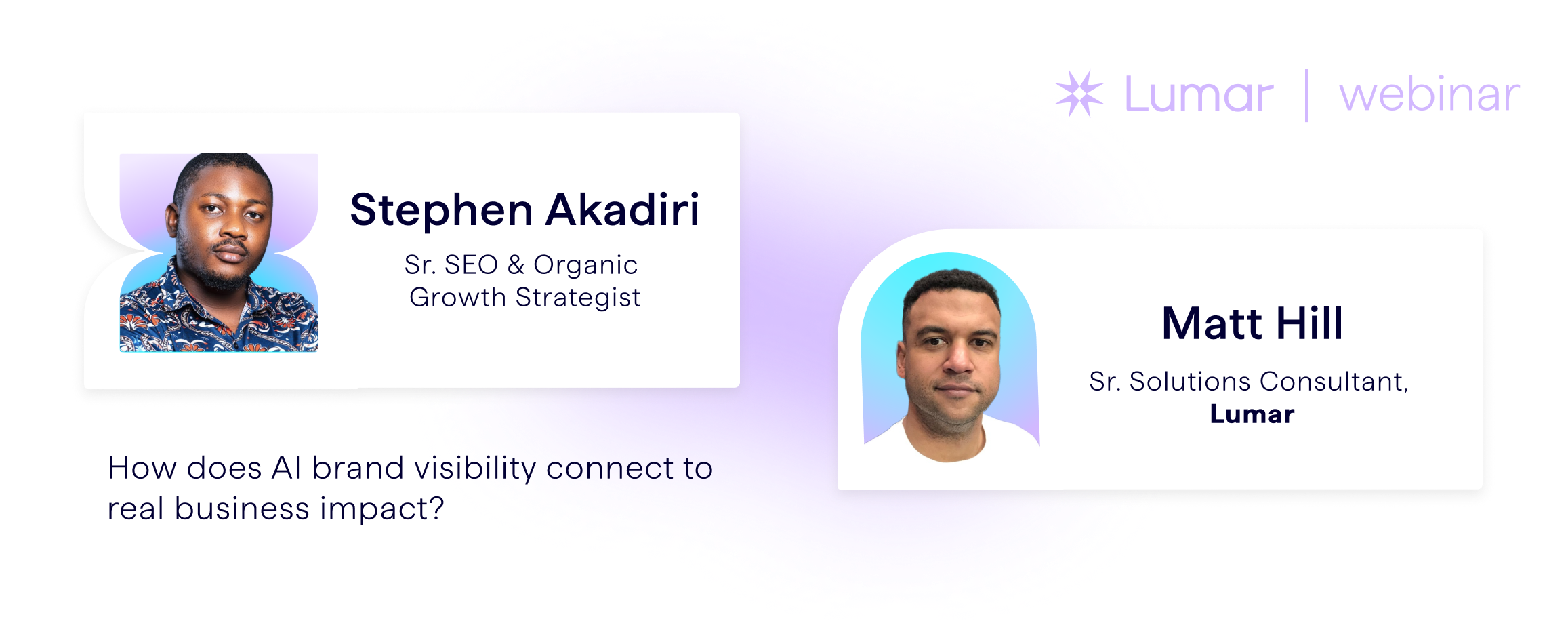
In this AEO / GEO-focused webinar session, learn how to communicate the value of your AI search optimization efforts to business stakeholders from Senior SEO and Organic Growth Strategist Stephen Akadiri and Lumar host and senior solutions consultant Matt Hill.
Move beyond GEO vanity metrics to explore the frameworks that connect your AI search performance to business growth.
Watch the full Lumar webinar session above, or read on for our key takeaways from the session.
Why search ROI attribution models are breaking in the AI era
For Akadiri, AI search has changed user journeys from something relatively legible and linear to something more disrupted and complex.
“AI systems [have] compressed the middle of the journey. Users — now in 2026 — they get recommendations before clicking. They compare vendors before visiting websites, and they sometimes even make decisions before analytics tools ever see them,” says Akadiri.
![Webinar slide from Lumar's GEO and AEO business outcomes session. This slide is titled 'Why the attribution model is breaking' and covers how AI search complicates traditional search ROI attribution models. It lists the journey as: query - SERP - click - site visit - conversion. The 'click' stage has an X on it and explainer text reads: AI search disrupts step three [the click step]. Slide also includes some statistics related to AI search in 2026, such as: 44.2% US organic CTR in March 2024 had been reduced to just 40.3% by March 2025.](https://www.lumar.io/wp-content/uploads/2026/05/1-attribution-model-search-GEO-AEO-biz-webinar-slide-1024x576.png)
AI search is primarily disrupting the ‘click’ stage of the traditional attribution journey. You’ve likely heard about ‘zero-click’ searches, even on traditional search engine results pages (SERPs). AI search is amplifying the number of zero-click searches, as many users can find the information they’re looking for directly within the AI’s generated answers, without ever clicking through to a website.
The core problem this creates is channel misattribution. A user searches for, say, “best expense management software” in ChatGPT, reads a synthesized recommendation, forms a view, and then types that brand name directly into Google. Your analytics dashboard attributes the eventual conversion to branded search or direct — but the decision was shaped in an AI interface your tracking never saw.
Within your analytics, then, you might see a lot more evidence of brand recall. But it’s often very difficult to know whether an increase in branded searches is informed by AI search or whether it can be attributed to other sources – for example, other online mentions, ads, or offline media.
How AI visibility is driving business outcomes
Akadiri reminds us that AI visibility is driving commercial outcomes within the search space – even if it’s hard to prove AI attribution perfectly.
He presents3 ways that AI search may already be influencing your business outcomes, whether or not you’re measuring your AI visibility:
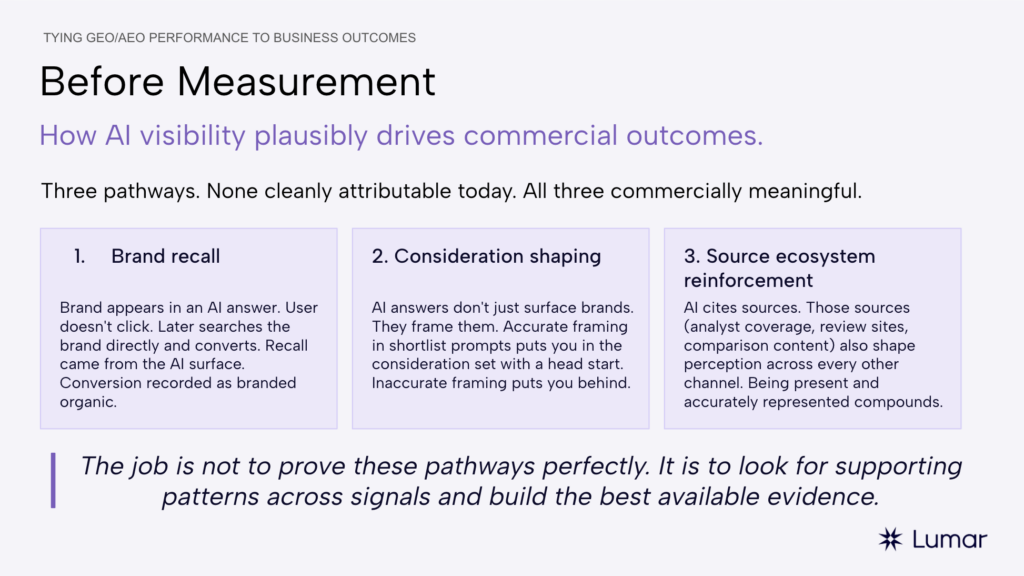
1 – Brand recall
Your brand appears in an AI answer. The user might not click directly from ChatGPT or Claude or Gemini’s response, but it may be their introduction to your brand regardless.They may then later search your brand directly in Google and then click and concert. The brand awareness may have come from the AI surface, even if conversion is later recorded as organic branded search.
2 – Consideration shaping
AI answers don’t just surface brands in a list – they frame them with context and opinions. Accurate and favorable brand framing in an AI answer may put you in a customer’s shortlist for consideration with a head start on competitors. On the other hand, if the AI mentions your brand unfavorably or inaccurately, this may be harming your chances of being considered as a top contender to meet a prospective customer’s needs. How AI talks about your brand matters.
3 – Source ecosystem reinforcement
AI cites sources. Those sources (whether your own website, third-party review sites, or analyst and press coverage) also shape the perception of your brand across every other channel, not just AI answers. Being present and accurately represented across the web compounds.
“Your job as an analyst, or as SEOs, is not to prove these pathways perfectly,” Akadiri says. “It’s just to build a layer of supporting evidence.”
Measuring What You Can: The 3-layer framework
Akadiri recommends the 3-layer AI measurement framework by Aleyda Solis as a good approach to thinking about measurement and attribution in the AI search era.
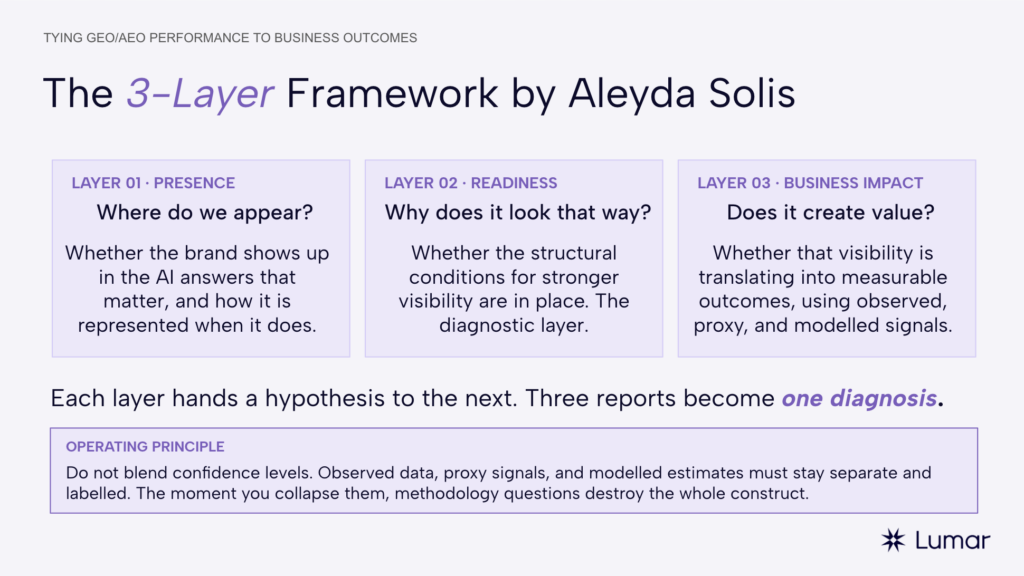
Layer 1 is all about presence. We need to ask ourselves: Are we showing up in AI answers? But also, how we are represented (accurately, inaccurately) when we do show up?
Layer 2 is readiness. Here, we need to ask ourselves whether we have the optimization structures in place for accurate brand representation and stronger AI visibility.

Layer 3 is business impact. Is your brand’s AI visibility creating actual business value? Is this viewable in observed data, inferred via proxy signals, or estimated through attribution modeling?
The ‘business signals’ aspect of AI measurement can be broken down into three sub-layers:
- Observed signals: What your analytics can actually see (AI-referred sessions, conversion rates from AI referral channels)
- Proxy signals: What analytics can’t see but can be inferred — branded search trends, direct traffic spikes, survey responses from new signups asking how they found you
- Modeled signals: Estimates of pipeline influence. Not precise, but commercially directional.
5 KPIs for AI search
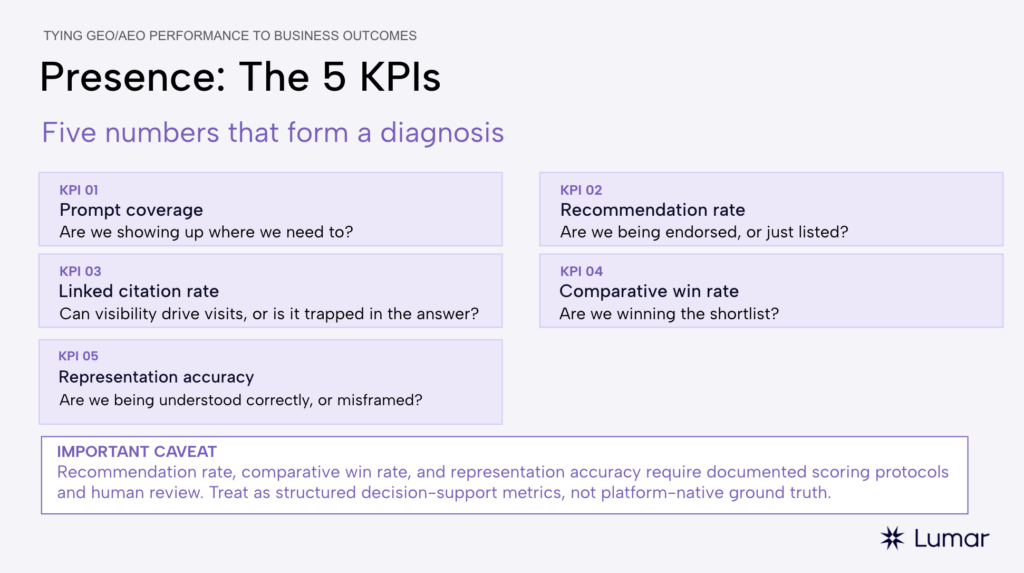
Akadiri also points to 5 KPIs that can help brands better diagnose their AI search and LLM performance. They are:
- Prompt coverage – are we showing up where we need to?
- Recommendation rate – are we being endorsed or just listed?
- Linked citation rate – can visibility drive visits or is it trapped in the answer?
- Comparative win rate – are we winning the shortlist?
- Representation accuracy – are we being understood correctly or misframed?
“Visibility alone is not success,” he says.
GEO/AEO Foundations: What actually matters when optimizing for AI search visibility
“I want to be very careful here because technical foundations reduce friction,” Akadiri says. “But they do not guarantee citation,” says Akadiri, as an important note to SEOs and marketers who are starting to optimize for AI search.
A lot of what actually matters in the AI era is foundational SEO stuff – clear, quickly rendered pages, with content that is easy to parse and that is of value to the person reading it (or the search crawler, or the AI bot).
GEO / AEO checklist:
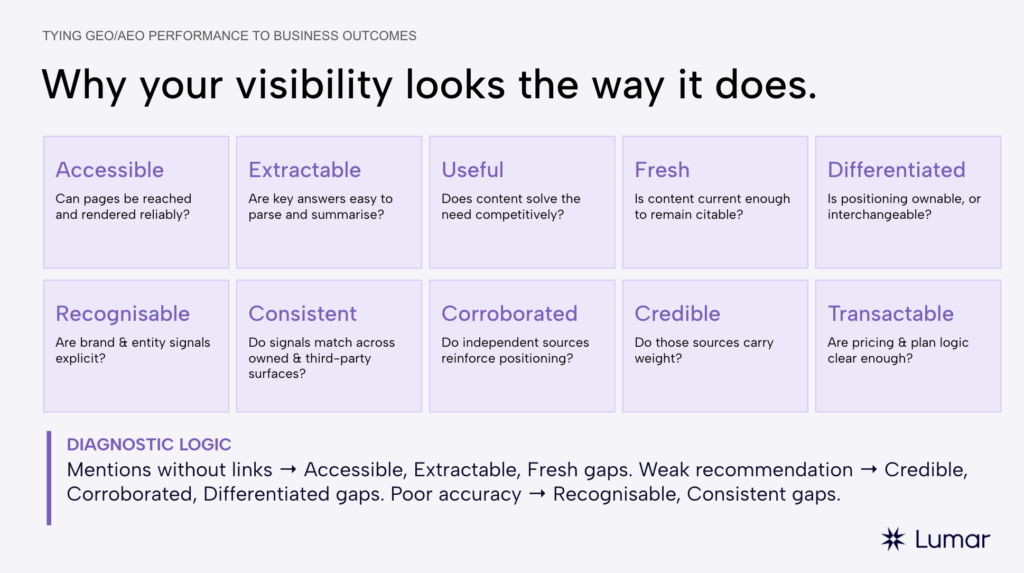
Some key GEO / AEO checklist items include making sure your content is:
- Accessible – Can pages be reached and rendered reliably?
- Extractable – Are key answers easy to parse and summarise?
- Useful – Does content solve the need competitively?
- Fresh – Is content current enough to remain citable?
- Differentiated – Is positioning ownable, or interchangeable?
- Recognizable – Are brand & entity signals explicit?
- Consistent – Do signals match across owned & third-party surfaces?
- Corroborated – Do independent sources reinforce positioning?
- Credible – Do those sources carry weight?
- Transactable – Are pricing & plan logic clear enough?
Tracking observed and proxy signals of AI search performance
We do, of course, need to go a little further in our metrics and measurement today with the addition of AI search as a key channel in users’ journeys.
Akadiri shows us how we can build an observed layer in GA4 relatively quickly:
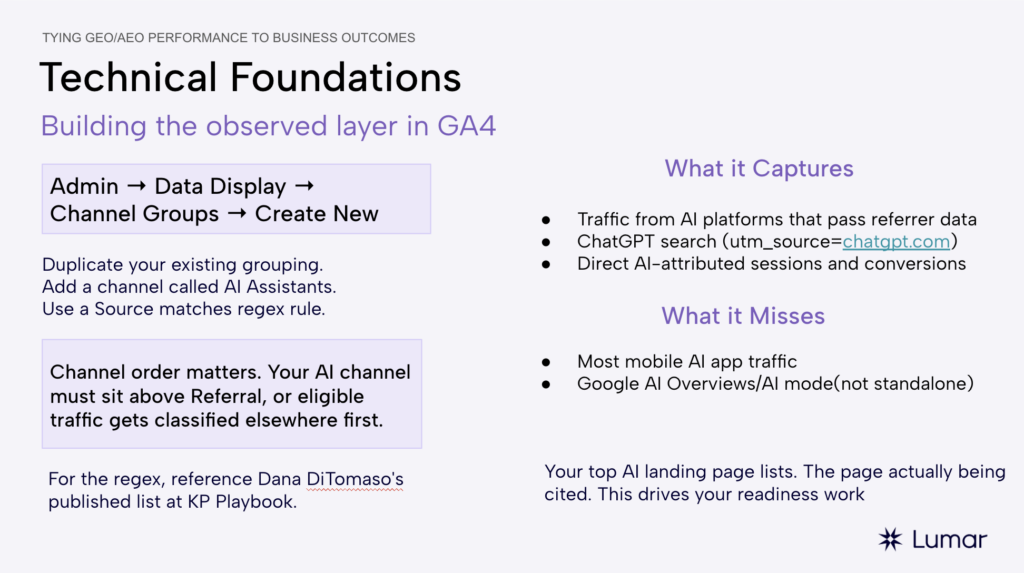
In GA4, under Admin > Data Display > Channel Groups, you can create or duplicate an existing group and build a channel specifically for AI-referred traffic. This gives you an “observed layer” baseline — a floor of measurable data, even if it can’t capture everything (it won’t track mobile app traffic or Google AI Overviews, for example).
While this observed layer shows us what the analytics platform can see, Akadiri calls this the floor — and suggests that proxy signals can show us the ceiling…
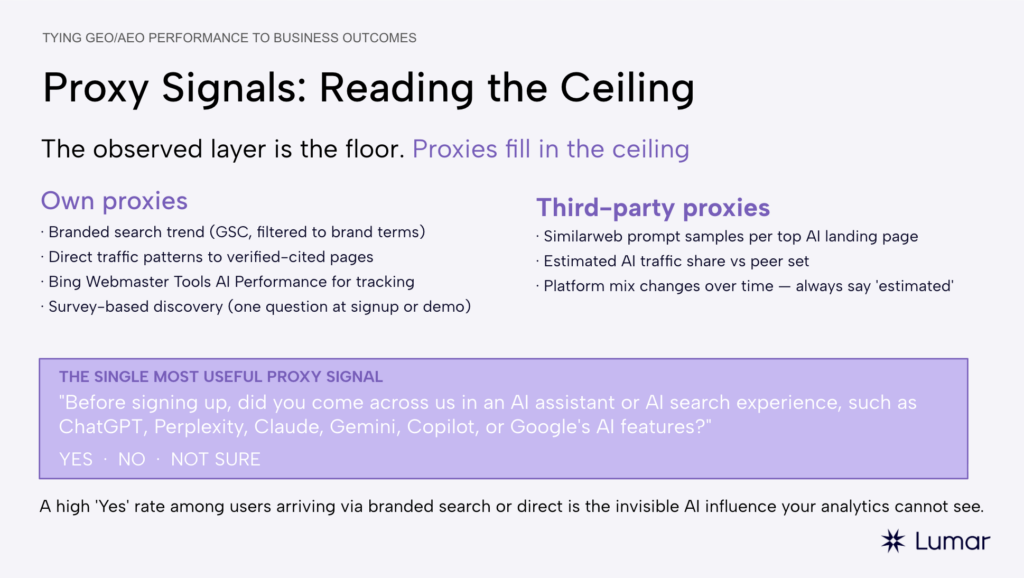
Proxy signals can include branded search trends and direct traffic patterns, but Akadiri also points to the value of quick survey questions we can ask users at signup or checkout – “Did you come across us in any AI platforms?” – this can be very useful for looking at which LLMs to focus your optimization efforts on.
What a defensible GEO/AEO operating model looks like in 2026
Akadiri closed with a practical eight-step operating model for tracking your GEO/AEO performance and tying it. Here’s what it looks like:
- Define your priority AI platforms based on measurable referral data, audience usage, and commercial relevance to your business.
- Build a prompt library of 50–100 prompts to track mapped to your product, brand, and buyer journey. As Akadiri put it: “I would rather track 75 commercially meaningful prompts than 5,000 low-quality ones with no strategic value.”
- Track the five presence KPIs monthly (prompt coverage – recommendation rate – linked citation rate – comparative win rate – representation accuracy) — and track them separately from your traditional SEO metrics.
- Fix crawl issues. Use server-side or hybrid rendering for primary content. Implement schema correctly across your key pages — and for international sites, don’t forget hreflang tags.
- Improve entity consistency across owned and third-party surfaces.
- Set up your GA4 AI channel group and add a survey question asking about AI discovery at signup or checkout.
- Build a tiered GEO dashboard that clearly labels what’s observed versus what’s proxy versus what’s modeled. Don’t present all of it as equally reliable data.
- Refresh your modeled estimates quarterly. AI systems evolve quickly — what was true about ChatGPT’s crawl behavior six months ago may not be true today.
A tool like Lumar’s GEO platform can support many of these steps — from identifying technical issues that limit AI discoverability to tracking prompt coverage and content performance for AI search.
In closing, Akadiri reminds us that we know AI search has changed how users discover and evaluate our brands before they even get to our websites. While there is no direct revenue attribution from AI search, it is still possible – and indeed crucial – to build out a layered reporting system to track your AI visibility today. This is both useful for SEOs and leadership to really see how AI visibility is driving business outcomes.
“Visibility may drive outcome through brand recall, through consideration shaping, and through ecosystem reinforcements,” he says. “None of this is cleanly attributable. But they are commercially meaningful.”
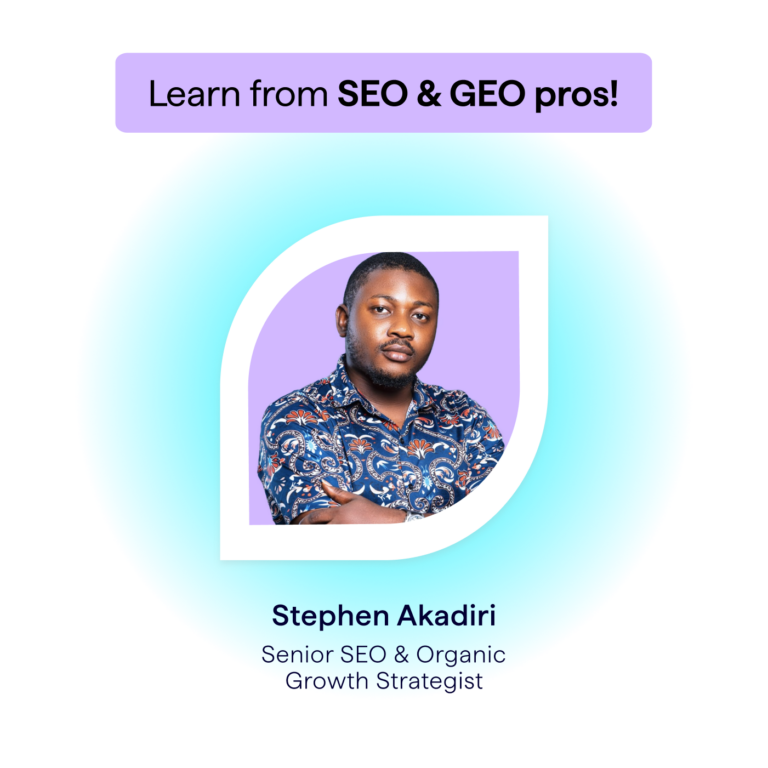
Meet the Webinar Speaker
- Expert Guest: Stephen Akadiri, Senior SEO and Organic Growth Strategist
Further reading and GEO / AEO learning resources
Further reading on optimizing for AI search (and resources mentioned in the webinar session):
Lumar Website Intelligence Academy — AI Search Articles
SEO (& GEO!) Skills You’ll Need in 2026 — Free Lumar Guide
The 2026 AI Search Playbook — Free Lumar eBook

Don’t miss the next Lumar webinar!
Sign up for our newsletter below to be alerted about upcoming webinars, or give us a follow on LinkedIn to stay up-to-date with all the latest news in SEO, GEO, and digital optimization.
Want even more SEO insights on-demand? Browse Lumar’s full library of SEO and website optimization webinars here.