
GEO / AEO Explainer Series
In this Lumar series, we’re exploring tactics and strategies for generative engine optimization (GEO), also known as answer engine optimization (AEO) — that is, how to boost your brand’s visibility and likelihood of earning mentions or citations from LLMs and AI-powered platforms like ChatGPT, Claude, Gemini, Perplexity, or Google’s AI overviews and AI mode.
Entities for AI Search: How to Make Your Brand Recognizable to LLMs
Before a generative AI system can cite your content, recommend your product, or include your brand in an answer, it needs to understand one thing:
Who you are.
In AI systems, an entity is a clearly defined, uniquely identifiable thing or concept — such as a company, product, person, or idea — that can be distinguished from others and connected to related information when they are embedded in a vector space. LLMs and retrieval systems use entities (not just keywords) to organize knowledge, linking them to attributes, relationships, and contexts. For your brand to be surfaced in AI-generated answers, it needs to exist as a recognizable entity within this network of meaning.
That’s where Entity GEO comes in. This aspect of generative engine optimization (or GEO, also known as answer engine optimization, or AEO) focuses on ensuring AI systems recognize your brand as an entity in order to include it in generative responses to users’ prompts. Entity GEO is a foundational pillar of AI search optimization, moving beyond keyword matching to establish a verifiable brand identity for the machines.
Effective Entity GEO builds a consistent, accurate identity for your brand across the web (not just on your website). This includes maintaining consistent brand descriptions across platforms, using structured data such as Organization, Product, or Person schema, securing inclusion in trusted third-party databases and knowledge graphs, and publishing content that clearly connects your brand with the topics you want to be known for. These entity signals help AI systems reliably recognize your brand, associate it with the right areas of expertise, and reference it accurately in generated responses.

On Brand Entity-Building for GEO:
“The brands that train AI to recognize who they are — through consistent entity signals, schema, and thought-leadership — will own visibility in 2026.”
. . .
“AI doesn’t think in keywords; it thinks in entities and relationships. That means the old way of optimizing for rankings doesn’t guarantee you’ll show up in AI responses… My tip: stop chasing prompts and start tracking entity presence.”
— Aimee Jurenka, SEO Strategist @ RicketyRoo
In our 2026 AI Search Playbook, we discuss both Entity GEO and Brand Authority GEO. While Entity GEO and Brand Authority GEO are closely related, they serve two distinct functions when it comes to influencing generative AI systems. Understanding the difference is critical because AI must first recognize your brand as a distinct entity before it can evaluate whether or not that entity is authoritative and trustworthy enough to cite.
Think of it this way:
- Entity GEO answers “Who are you?”
- Brand Authority GEO answers “Should we trust you?”
Both entity recognition and establishing brand authority are required for consistent inclusion in AI-generated responses, but they operate at different layers of AI understanding. At the Entity GEO layer, AI systems are not yet judging whether your brand is good or authoritative. They are determining whether your brand:
- Exists as a distinct concept
- Can be clearly identified and disambiguated
- Has stable, consistent facts associated with it
How AI uses entity signals
Entity signals help AI answer foundational questions about your brand and product or service offering, such as:
- Is this a real organization, product, or person?
- Is this brand distinct from similarly named entities?
- What does this brand do?
Entity GEO tactics
Entity GEO efforts center on identity consistency and factual corroboration, including:
- Ensure consistent, accurate brand descriptions across platforms (your website, social media profiles, third-party databases, press coverage).
- Use entity-building structured data on your website, for example: ‘Organization’, ‘Product’, ‘Person’ schema.
- Get your brand included in trusted third-party databases and resources (such as Wikipedia, G2, industry lists, etc.)
- Build topical authority through content to create a clear relationship between your brand and key topics related to your offering and industry.

“Optimizing content for a specific set of keywords is increasingly seen as outdated… Strategy will pivot towards topic clustering, leveraging structured data, internal linking, and entity-focused content to position brands as authorities on broader subjects.”
— Natalie Stubbs, Senior Technical SEO @ Lumar
Outcomes of strong Entity GEO
The goal of Entity GEO is to ensure AI systems can:
- Reliably recognize your brand
- Correctly associate your brand with specific topics
- Confidently reference your brand without confusion
“I see GEO / AEO as the next phase of my Topic Entity Strategy — shifting from optimizing for search engines to teaching AI systems how to understand your expertise.
- Traditional entities (like people, places, or brands) tell AI who you are.
- Topic entities tell AI what you’re known for.
By mapping your brand to the core concepts you want AI to associate you with, like “local SEO”, “AI visibility”, or “semantic optimization”, you create a retrievable web of meaning.
This approach moves GEO / AEO beyond theory: instead of tracking prompts or keywords,
I track topic entity presence; how often your expertise shows up in AI answers, how well it’s understood, and how consistently it’s connected back to your brand.
That’s how we measure, optimize, and benchmark visibility in the age of retrieval.”
— Aimee Jurenka, SEO Strategist @ RicketyRoo
Entity-building and the GEO/AEO funnel
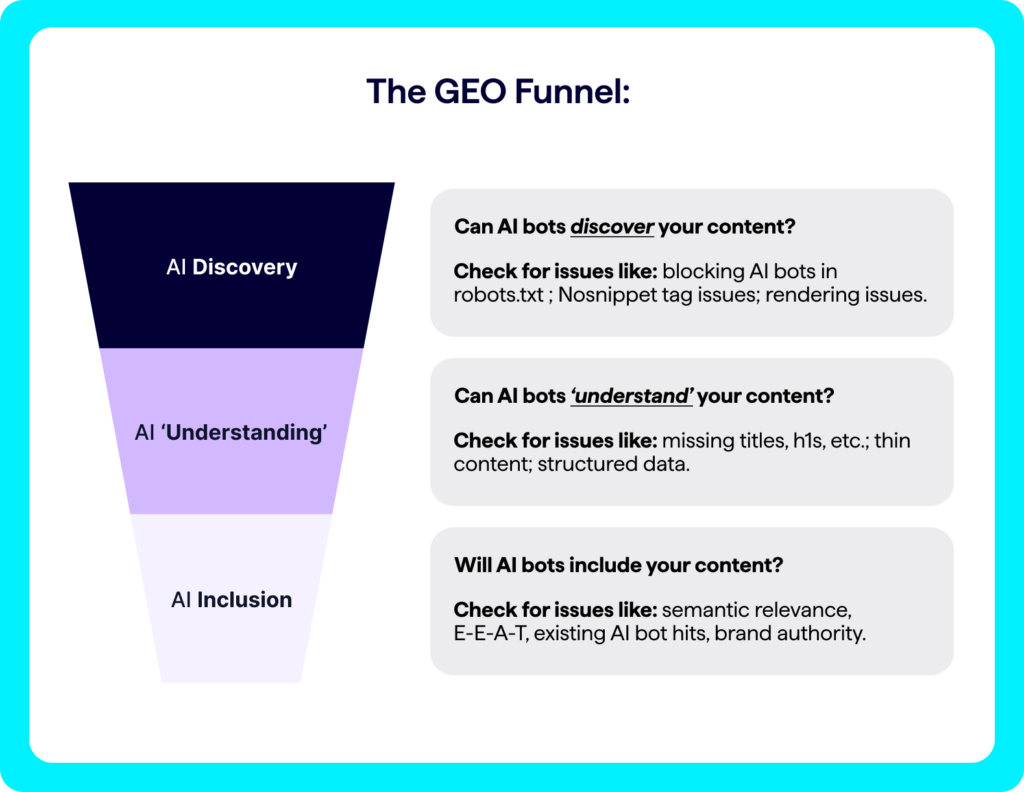
We’ve previously introduced the ‘GEO Funnel’ concept as a way of understanding the stages of generative engine optimization:
- AI Discovery: First, AI needs to be able to discover and retrieve your content.
- AI Understanding: Then, AI needs to ‘understand’ your content and who you are.
- AI Selection & Inclusion: Finally, AI systems need to ‘judge’ and evaluate your content and your brand against others’ to determine which is the most trustworthy source, the best content to cite, or the best brand to mention in response to a user’s particular query.
Entity GEO focuses on making sure your brand is recognized as a unique entity by AI systems. This aligns with the ‘AI Understanding’ stage in the GEO Funnel.