
In this guide to generative engine optimization (GEO), we outline a simple 4-pillar framework to guide your AI search visibility strategies in 2026.
GEO / AEO Explainer Series
In this Lumar series, we’re exploring tactics and strategies for generative engine optimization (GEO), also known as answer engine optimization (AEO) — that is, how to boost your brand’s AI visibility and likelihood of earning mentions or citations from LLMs and AI-powered platforms like ChatGPT, Claude, Gemini, Perplexity, or Google’s AI overviews and AI mode.
Explore more GEO resources in our Website Intelligence Academy: GEO / AI Search.
Executive Summary: The 4 Pillars of a Strong GEO / AEO Strategy
The challenge with GEO? Knowing where to start.
Today, most brands know they need to show up in AI search. Fewer know how to systematically build toward that LLM visibility. Without a clear framework, GEO efforts tend to be scattered — a schema fix here, a content refresh there — without a coherent strategy or framework tying them together.
A more effective approach is to organize your GEO strategy around the four key pillars that determine whether AI platforms will find, understand, and ultimately cite your brand:
| Pillar | Area of Focus |
|---|---|
| 1. Technical GEO | Can AI bots access and render your content? |
| 2. Content GEO | Is your content structured for AI extraction and preference? |
| 3. Entity GEO | Does AI know what your brand is and what it does? |
| 4. Brand Authority GEO | Does AI trust your brand enough to recommend it? |
Each pillar targets a different layer of how AI systems evaluate your brand.
Together, these four GEO pillars cover every stage of the AI visibility funnel (more on that below!), from AI discovery to understanding and citation.
Introduction: A GEO / AEO Strategy Framework for AI Search Visibility
Today, the definition of “online brand visibility” has been fundamentally reshaped by the widespread consumer use of AI platforms like ChatGPT, Claude, and Gemini.
Traditional SEO remains essential, and strong SEO foundations directly support AI search performance. But winning in this new AI-augmented search landscape also requires Generative Engine Optimization (GEO) — a discipline focused specifically on making your brand a source that AI retrieves, understands, trusts, selects, cites, and recommends. GEO isn’t replacing your existing organic search strategy; it’s extending it to cover the AI search landscape that now sits alongside traditional search engines.
The goal hasn’t changed for marketing teams; you still want your brand in front of the right people, in the right place, at the right moment. What’s changed is that “the right place” is now increasingly inside an AI-generated answer. To build your brand’s online visibility, it’s no longer enough to satisfy a standard keyword query; you must now also satisfy AI reasoning by approaching your content as both a valuable resource for your human readers and a structured dataset for the machines.
Our new Lumar AI Search Playbook introduces a four-pillar GEO strategy designed to help your brand become a trusted entity that AI systems are ready and willing to cite.
Download the full, free GEO strategy guide for 80 pages of AI search explainers, strategy guidance, and insights from 20+ search experts — or read on below for an introduction to the key GEO strategy frameworks that can help guide your AI search optimization efforts this year.
The 4-Pillar GEO Strategy Framework
To help better organize your approach to AI brand visibility, we’ve developed a 4-pillar GEO/AEO strategy framework. This helps you “bucket” your GEO efforts across key areas that increase the likelihood AI platforms will:
- Find your content
- Trust your content
- Select your content
- Mention and cite your brand in responses
👉 Think of this framework as your roadmap for becoming a default source AI systems rely on when generating their answers.
The 4 Pillars of Generative Engine Optimization (GEO)
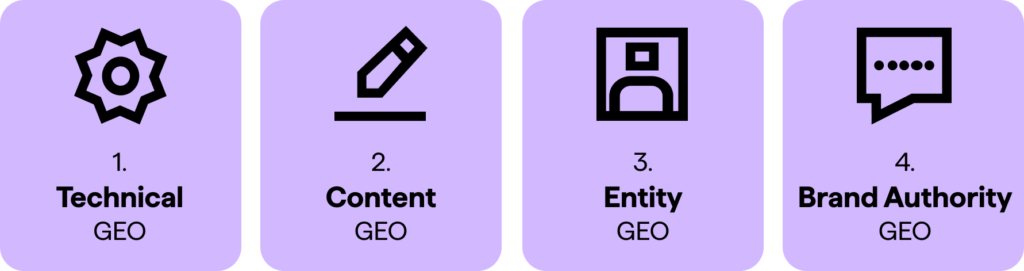
| GEO / AEO Pillar | Focus | GEO Funnel Stage |
|---|---|---|
| 1. Technical GEO | Can AI bots find and access your content? | AI Discovery |
| 2. Content GEO | Can AI understand and extract your content? | AI Understanding & Inclusion |
| 3. Entity GEO | Does AI know who you are? | AI Understanding |
| 4. Brand Authority GEO | Does AI trust and prefer your brand? | AI Inclusion |
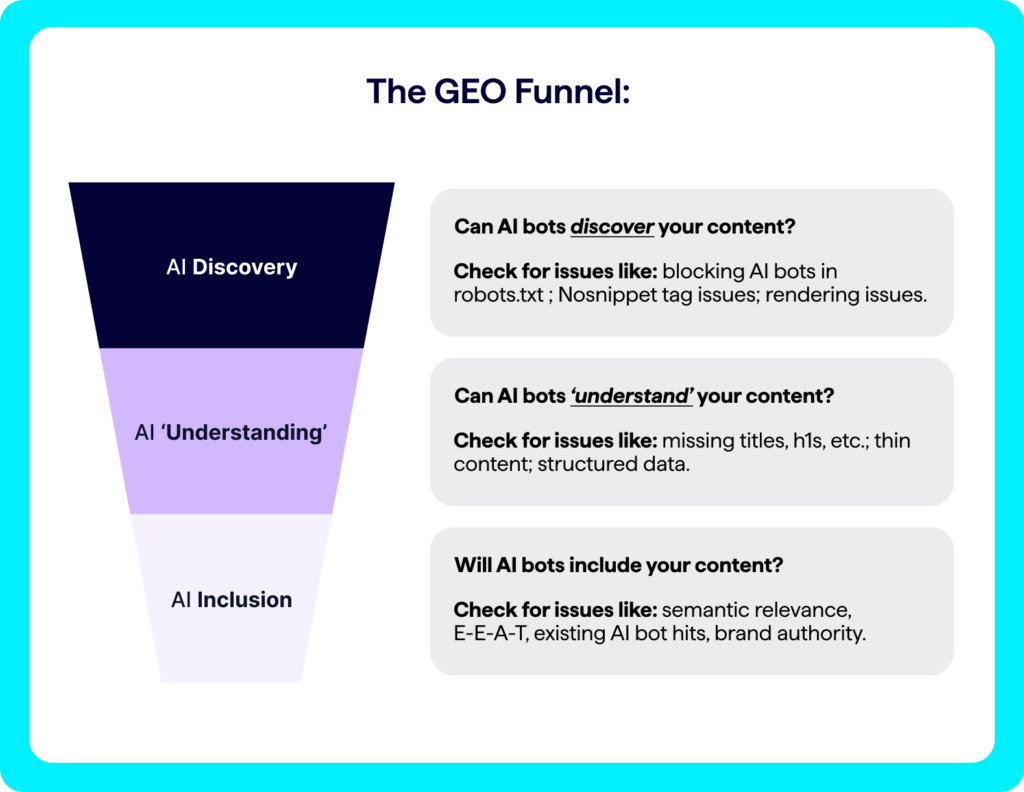
The GEO Funnel
The 4-pillar framework maps directly onto what we’re calling the GEO Funnel — the three stages AI systems move through when deciding whether to include your brand in a generated response:
- AI Discovery: Can AI bots find your content at all? Issues to check include blocked AI bots in robots.txt, nosnippet tag problems, and rendering issues.
- AI Understanding: Can AI bots correctly interpret your content? Issues to check include missing titles and H1s, thin content, and absent structured data.
- AI Inclusion: Will AI bots choose to cite your content? Issues to check include semantic relevance, E-E-A-T signals, existing AI bot engagement, and brand authority.
Optimizing across all four pillars means optimizing for all three stages of this funnel.

“Generative Engine Optimization (GEO) and Answer Engine Optimization (AEO) will dominate SEO in 2026 because they fundamentally redefine what “visibility” means. Instead of ranking as one of ten blue links, the goal becomes earning inclusion and attribution within AI-generated answers. Search experiences are rapidly evolving into dialogue-driven journeys where the model curates, contextualizes, and often executes user intent directly. This will expand from booking to buying and everything in between.
The challenge is that SEOs lose direct control over presentation and traffic paths. LLMs decide what to surface and how to frame it. So, to stay relevant, teams need to think like data publishers and knowledge architects, not just content marketers.
Practical steps include auditing entity coverage across your content, aligning schema markup with topic clusters, publishing factually consistent pages, and monitoring LLM-generated outputs where your brand appears.
Those who understand how information flows through AI systems, from ingestion to retrieval, will outperform those still chasing individual rankings.”
— Jon Clark, Managing Partner, Moving Traffic Media
Now, let’s dive into each of the four GEO pillars, one by one…
Pillar 1: Technical GEO
What is Technical GEO?
Tech GEO is about ensuring AI bots can find, access, and understand your content — and making sure your website is machine-readable for AI systems.
This technical layer of AI search optimization is the backbone that allows your Content, Entity, and Brand Authority GEO strategies to function. If AI cannot access or understand the primary source of information about your brand — your website — chances are, your brand will not be fully or accurately understood or cited by AI.
Technical GEO influences four key outcomes:
- AI Discoverability: How quickly AI and search engine bots discover new and updated content from your brand’s website.
- Content Freshness: Helping AI extract the most up-to-date version of your facts and data.
- Citation Eligibility: Whether your content is technically eligible to be included in generated answers (i.e., AI bots are not blocked by robots.txt or NoSnippet rules).
- AI Renderability: Whether your pages render correctly when accessed by AI systems — necessary for AI to “read” your content as intended.
Technical GEO Checklist
- ✅ Check you are not blocking AI bots (GPTBot, PerplexityBot, Google-Extended, BingBot, CCBot) in your website’s robots.txt file.
- ✅ Ensure robots.txt and nosnippet directives are not preventing AI citation.
- ✅ Fix 4xx / 5xx errors so AI bots can access pages.
- ✅ Continue to optimize for indexability, as many AI tools still rely on traditional search engine indices to discover information.
- ✅ Implement structured data (schema) to make your website content more machine-readable.
- ✅ Maintain strong internal linking across topic clusters.
- ✅ Ensure key content is visible in raw HTML, not only rendered via JavaScript (which many AI systems struggle to process).

“SEOs will need to understand how content is rendered and ensure it is both crawlable and machine-readable.”
— Natalie Stubbs, Senior Technical SEO, Lumar
Pillar 2: Content GEO
What is Content GEO?
Content GEO ensures your content is designed for both human understanding and AI retrieval, assessment, and selection. It focuses on publishing accurate, logically structured, semantically relevant, and comprehensive content that AI systems can extract, summarize, and cite confidently.
If Technical GEO determines whether your content is accessible to AI bots, Content GEO influences whether that content is deemed useful, trustworthy, and likely to be chosen. Where traditional SEO content aimed to satisfy keyword queries, Content GEO focuses on satisfying AI reasoning — ensuring your brand’s insights, explanations, and expertise become the material LLMs rely on when generating answers.
In an AI search landscape, your content takes on yet another role in your broader marketing toolkit: it becomes training material for the models shaping the future of online search.
Content GEO influences:
- AI Extractability: How easily AI can pull direct, factual answers from your pages.
- Citation Preference: Whether AI selects your content over a competitor’s as the authoritative source for a given query.
- Topical Association: How consistently AI connects your brand with expertise in a specific subject area.
- Query Fan-Out Completeness: Whether your content covers a topic thoroughly enough to satisfy multi-part or follow-up queries.
Content GEO Checklist
- ✅ Write clear, factual, answer-first content that directly addresses user questions.
- ✅ Optimize for semantic relevance and full coverage of related subtopics.
- ✅ Build evidence-based content with citations and sources.
- ✅ Structure content into retrievable “chunks” with clear H2/H3 headings.
- ✅ Ensure entity clarity in content chunks / passages — avoid pronouns replacing key entities.
- ✅ Create multimodal content (video, audio, images) and add transcripts and descriptive alt text.
- ✅ Demonstrate E-E-A-T (experience, expertise, authority, and trustworthiness) through expert authorship, original data, and transparent sourcing.

“In 2026, GEO/AEO will be essential for visibility, requiring content to be highly structured, fact-based, and semantically rich to be considered authoritative enough for AI to reference.
Rather than chasing rankings alone, SEOs must now optimize for inclusion in zero-click, conversational responses — ensuring that brand-owned content is answer-ready and aligned with user intent at a granular level.”
— Rejoice Ojiaku, Senior Content Specialist, Wise
Pillar 3: Entity GEO
What is Entity GEO?
Entity GEO focuses on ensuring your brand is clearly recognized as a distinct, identifiable entity by AI systems. Before AI platforms can decide whether to trust or cite your brand, they must first understand who you are — what organization, product, or person the content refers to, and how that entity relates to specific topics, industries, and other entities.
In AI-driven search environments, visibility increasingly depends on this entity-level understanding rather than just keyword relevance in any singular piece of content.
Think of it this way:
- Entity GEO answers: “Who are you?”
- Brand Authority GEO answers: “Should we trust you?”
Both are required for consistent inclusion in AI-generated responses, but Entity GEO must come first. Without it, Brand Authority GEO has nothing to attach to.
Effective Entity GEO builds a consistent, accurate identity for your brand across the web — including consistent brand descriptions across platforms, structured data (Organization, Product, or Person schema), inclusion in trusted third-party databases and knowledge graphs, and content that clearly connects your brand with the topics you want to be known for.
Entity GEO Checklist
- ✅ Ensure consistent, accurate brand descriptions across platforms (website, social media, third-party databases, press coverage).
- ✅ Use entity-building structured data/schema markup on your website (Organization, Product, Person schema).
- ✅ Get your brand included in trusted third-party databases and resources (Wikipedia, G2, industry lists, etc.).
- ✅ Build topical authority through content to create a clear relationship between your brand and key topics in your industry.

“AI visibility will define SEO in 2026 because discovery is no longer confined to search engines; it’s happening inside AI conversations. Whether users are asking ChatGPT for recommendations, researching through Perplexity, or relying on Google’s AI Overviews, brands need to be retrievable in those ecosystems. The challenge is that AI doesn’t think in keywords; it thinks in entities and relationships. That means the old way of optimizing for rankings doesn’t guarantee you’ll show up in AI responses.
For SEOs, this shift requires a mindset change: from optimizing for algorithms to educating AI about your brand. That means building clear topic–entity connections, consistent schema, and credible signals across every channel so your expertise becomes part of the LLM’s “understanding” of your niche.
My tip for 2026: stop chasing prompts and start tracking entity presence. If your brand is being cited, summarized, or referenced by AI, you’re not just visible, you’re trusted by the systems shaping the future of search.”
— Aimee Jurenka, SEO Strategist, RicketyRoo
Pillar 4: Brand Authority GEO
What is Brand Authority GEO?
Brand Authority GEO is about credibility, trust, and preference. Once AI recognizes your brand as an entity, it must decide whether your entity deserves to be included, cited, or recommended in generative responses.
This pillar helps AI answer higher-order questions such as:
- Is this entity reliable?
- Is this entity respected within its field?
- Do other trusted sources validate this entity?
- Would citing this brand improve answer quality?
Brand Authority GEO influences whether AI trusts the content you produce, whether your brand is selected over competitors’, how prominently your brand appears in AI answers, and the tone of those mentions (neutral vs. favorable).
In traditional SEO, a whole sub-industry developed around securing backlinks. In GEO, even brand mentions without a dofollow link can help establish your brand as a trusted, authoritative entity. This means digital PR is having a renaissance — authoritative brand mentions from credible sources that go beyond your own website are rising in importance once again.
Brand Authority GEO Checklist
- ✅ Digital PR & Media Mentions: Secure linked and unlinked brand mentions from industry publications. (Signals: Trust/Co-citation)
- ✅ Expert/Influencer Citations: Get cited or interviewed by established, authoritative experts in your niche. (Signals: Respected within field)
- ✅ Positive Brand Sentiment: Actively manage reviews on key third-party platforms (Google, G2, industry review sites). (Signals: Reliability/Preference)
- ✅ Industry Association & Awards: Become a member of relevant trade bodies and win recognized industry awards. (Signals: Validation by trusted sources)
- ✅ Sponsorships & Partnerships: Partner with established entities to associate your brand with high-authority signals. (Signals: Legitimacy/Ecosystem trust)

“Good content alone is not going to move the needle anymore. We need strong brand authority. Things that have long been seen as “nice to have” or “bonus SEO” are now must-haves, such as Digital PR to generate positive brand sentiment and brand mentions.”
— Tina Reis, Senior SEO Strategist, Muhlert Digital

“Brand authority & reputation management [will be crucial skills to hone for AI search visibility]. Why? To be cited and trusted, we need to clearly communicate who we are, what we offer, and how we solve problems. LLMs prioritize authoritative content with a clear and consistent brand identity.”
“These changes will require continued investment in brand recognition, developing strategies that go beyond the website, and creating content across social media. It’s essential to listen to what users are saying about your brand in forums and incorporate those insights into your site.”
— Ana Perez, SEO Manager
Putting It All Together: The GEO Funnel in Practice
The four pillars aren’t independent checklists — they build on each other sequentially. AI must first discover and access your content (Technical GEO) before it can understand it (Content + Entity GEO), and only then will it evaluate whether or not to select your brand or your content for inclusion in generated responses (Brand Authority GEO).
To improve your brand’s visibility across AI answers, treat GEO strategy as a holistic system — make it easy for AI systems to find your brand’s content, understand it, trust it, and cite it.