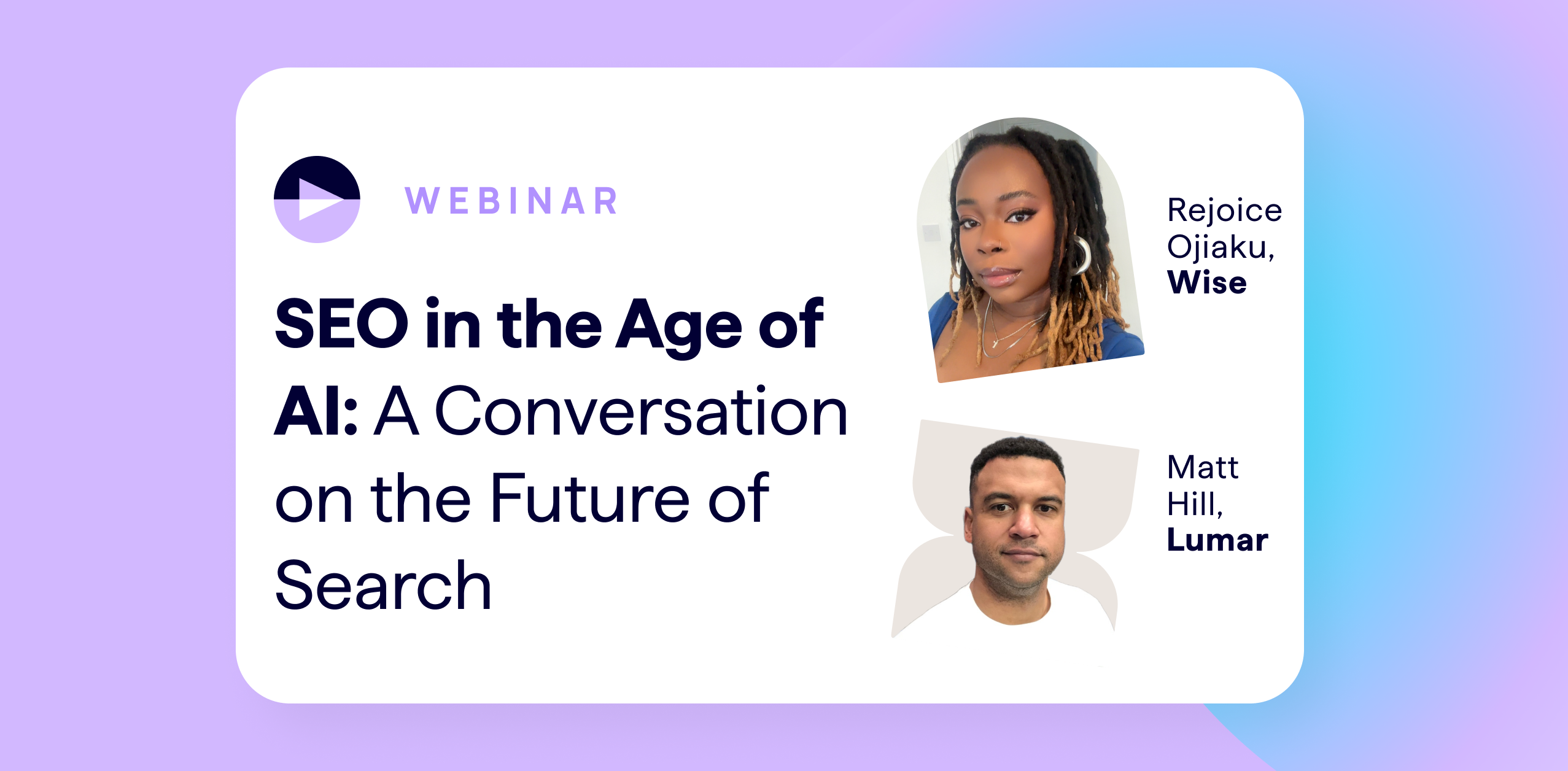
Watch the full webinar session here:
Explaining AI Search to the C-Suite
If you’re a digital marketing or SEO leader tasked with making the case for AI readiness and strategic search visibility, this webinar will equip you with the tools, language, and evidence to lead the GEO/AEO conversation internally.
- SEO pros — Ready to get your C-suite on board with your GEO/AEO strategies?
- CMOs — Ready to understand the buzz around AI search and why your brand needs to start focusing on LLM traffic and AI citations?
In this expert-led webinar session featuring Andy Francos (co-founder, Obsero) and Lumar host Odette Colebrook, we’ll show you:
- Why AI visibility is a growth and brand-control issue worth paying attention to ahead of building out your 2026 strategies and budgets.
- How to use citation, share-of-voice, and query fan-out insights to quantify your brand’s visibility in AI results.
- How to pitch your GEO / AEO strategies to your C-Suite with board-level framing and key metrics.
Watch the full webinar above – including audience poll results and Q&A session — or read on for some top takeaways for this GEO session for CMOs.

Meet the GEO Webinar Speakers:
- Andy Francos – Cofounder at Obsero
- (host) Odette Colebrook – Senior Customer Success Manager at Lumar
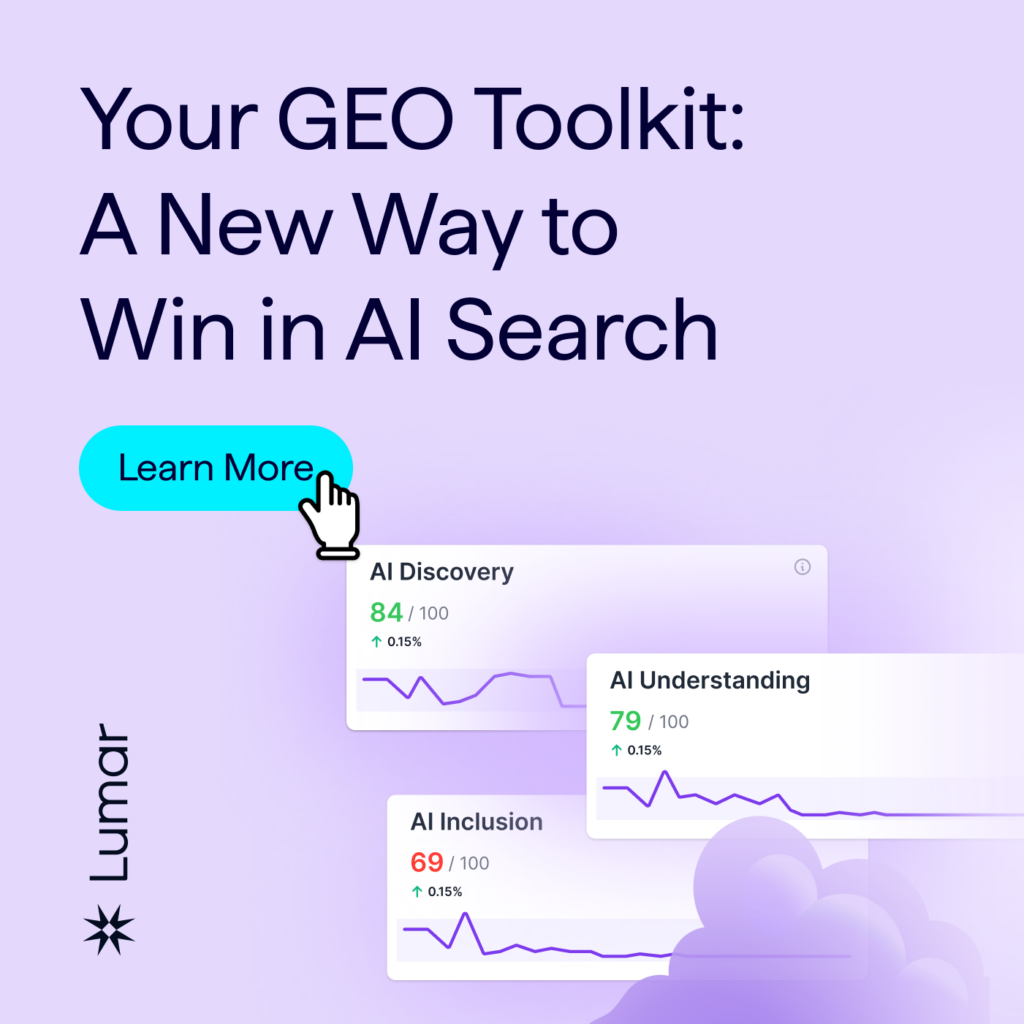
For CMOs and the C-suite, the core message is that search is evolving to include an “answer engine” ecosystem where brand visibility is no longer just about ranking in the top 10 “blue links” but also about being cited, referenced, and synthesized by AI models.
Executive Summary: What CMOs Need to Know About GEO / AEO
- The Shift: The industry is moving from traditional SERPs to AI-driven answer engines (like ChatGPT, Google AI Mode, Perplexity, and Claude).
- The Risk: This shift drives “zero-click behavior,” reducing traditional traffic but increasing the value of being the source of the answer.
- The Opportunity: AI visibility is a “growth and brand-control issue” that must be factored into 2026 strategies and budgets.
Webinar Insights & Recap: What CMOs Need to Know About GEO & Optimizing for Brand Mentions in AI Search
Lumar’s final webinar of the year focused on what executive teams need to understand about AI-driven discovery and the practical steps marketing leaders can take to protect (and grow) visibility as search behavior shifts.
Guest speaker Andy Francos positioned AI search as the biggest change he’s seen in two decades of working in organic growth marketing:
“This is the most fundamental shift that I have seen in 20 years – by a distance,” Francos says. “AI search has changed how brands are discovered.”
His core message for the C-suite: AI search is changing how people discover brands, it’s creating measurement challenges in a zero-click environment, and it requires cross-functional leadership—particularly across SEO, PR, content, and product teams.
Why CMOs should care about brand visibility in AI search
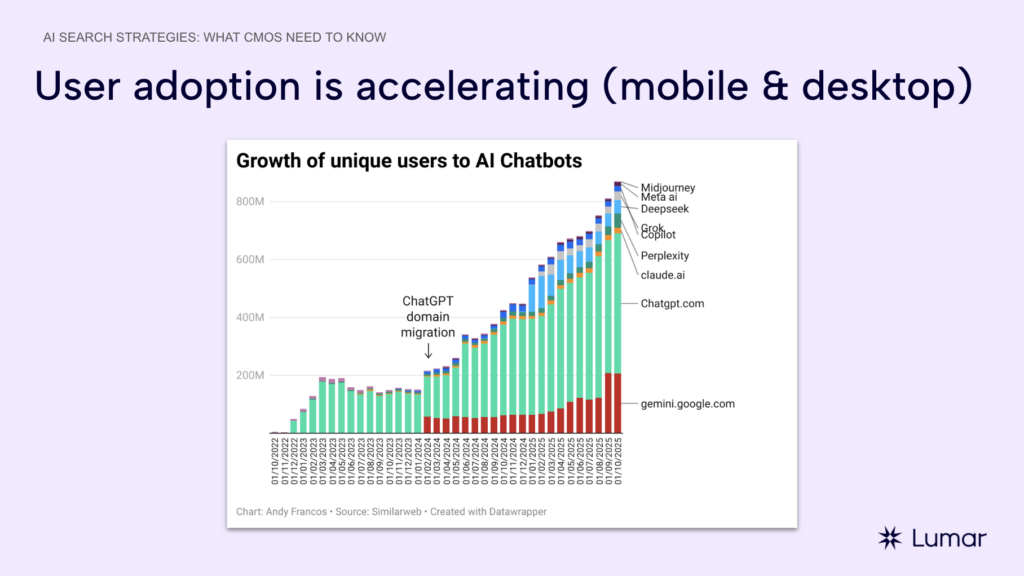
Why CMOs should care about brand visibility in AI search: User adoption of AI chatbots is accelerating (across both mobile and desktop).
It’s important to remember that AI platforms like ChatGPT, Perplexity, et al., are not a straight replacement of Google and traditional search engines — and that Google is a major player in the AI search landscape as well. But there is, as Francos points out, a battle for attention across traditional vs. AI search.
Ultimately, businesses need to ask: where are their customers? Increasingly, they are bringing their queries to AI platforms.
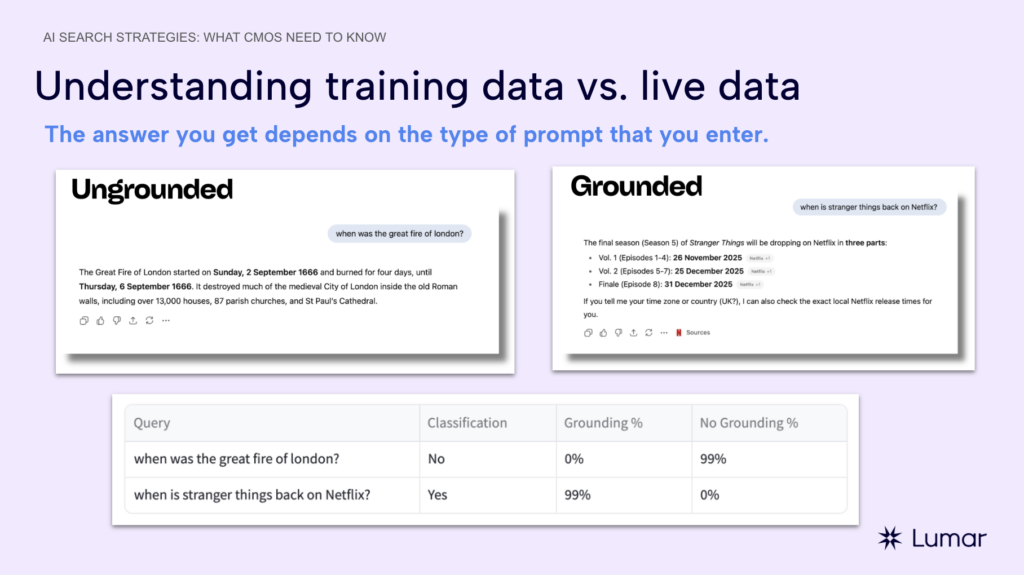
Within AI search, the kind of answers users get depends on the type of prompt they input. Francos categorizes these as ungrounded and grounded prompts. It’s the latter, grounded prompts, that are providing an opportunity for content-producing brands as they are more likely to pull in a range of citations.
Why AI search “hits different” from classic search
Andy explained three shifts executives should care about when it comes to AI search:
1) Zero-click discovery becomes normal: “AI search has changed how brands are discovered… which is a zero-click world.” He defined zero-click as searches where users get the information they need without visiting a website: “it doesn’t result in a click or traffic to a website.”
2) Search platform fragmentation beyond Google: “For years, it was just Google… and now we’re seeing this… fragmentation across the likes of ChatGPT, Perplexity, and it’s essential to make sure that that is part of the strategy.”
3) Results aren’t deterministic anymore: AI answers vary: “[AI search results are different from traditional online search results] because they are probabilistic and not deterministic, meaning that the results are different every time.”
The tactics between SEO and GEO may overlap in many places, but the outcomes differ.
SEO isn’t dead – SEOs should focus on business influence, not labels
Francos cautioned that all the “SEO is dead” headlines appearing in the wake of widespread AI adoption can be misleading: “I do think headlines are blown out of proportion,” he says. “I’ve heard that for many years in my career — [SEO] is just evolving.” (19:19–19:25).
For SEOs engaging in C-suite conversations, he emphasized that naming (“SEO vs GEO vs AEO”) matters less than proving business impact: “Whatever you can do to showcase your influence within the business to drive real results is what is more important than what it’s called.”
Digging down into the key differences between SEO and GEO. SEO has always primarily focused on ranking pages in organic SERPs via technical foundations, content creation, backlink acquisition, click-through optimization, and SERP feature targeting.
GEO – or generative engine optimization – optimizes for being referenced in AI-generated answers. It’s about:
- Freshness as a signal
- Brand trust amplification
- Structured data for retrieval
- Platform fragmentation
- Citation-ready content
How CMOs and SEOs are approaching the AI search shift through different lenses
When speaking to SEOs about AI search, Francos found the following topics, subtopics, and considerations to be mentioned most frequently:
- Entities
- Context
- Zero-click
- Citations
- Passage retrieval
- UGC
- Sentiment
- Brand
- Measurement
- RAG (Retrieval Augmented Generation)
CMOs, on the other hand, brought up different topics when discussing AI search:
- Attribution
- Visibility
- Measurement
- Citations
- Trust
- Influence
- Zero-click
- Business value
- Brand
- Benchmarking
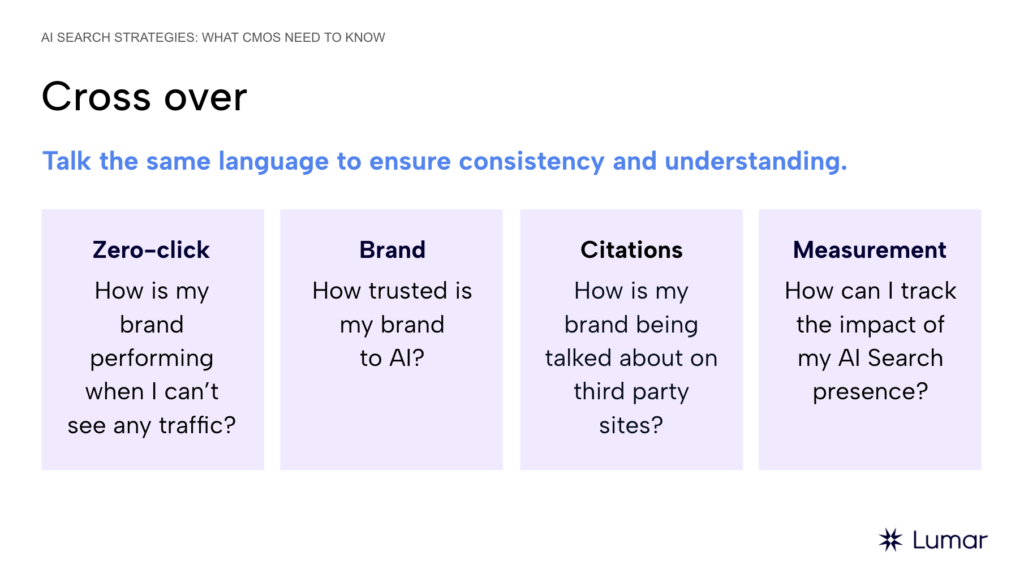
It is where these priorities overlap that really matters.
While SEOs and CMOs may use different language when discussing AI brand visibility, they converge on a few core concerns—especially measurement in a zero-click world:
- “How is my brand performing when I can’t see any traffic?”
- “Is the brand sentiment positive? Is it negative?”
- “If they’re not talking about me and they’re talking about a competitor, how do I influence the conversation?”
- “If I’m visible there and it’s an answer and there’s no direct click to it… how do I know that?”
That is the executive crux: visibility and influence are increasingly off-site and inside answers.
A practical GEO operating model for revenue growth in AI search
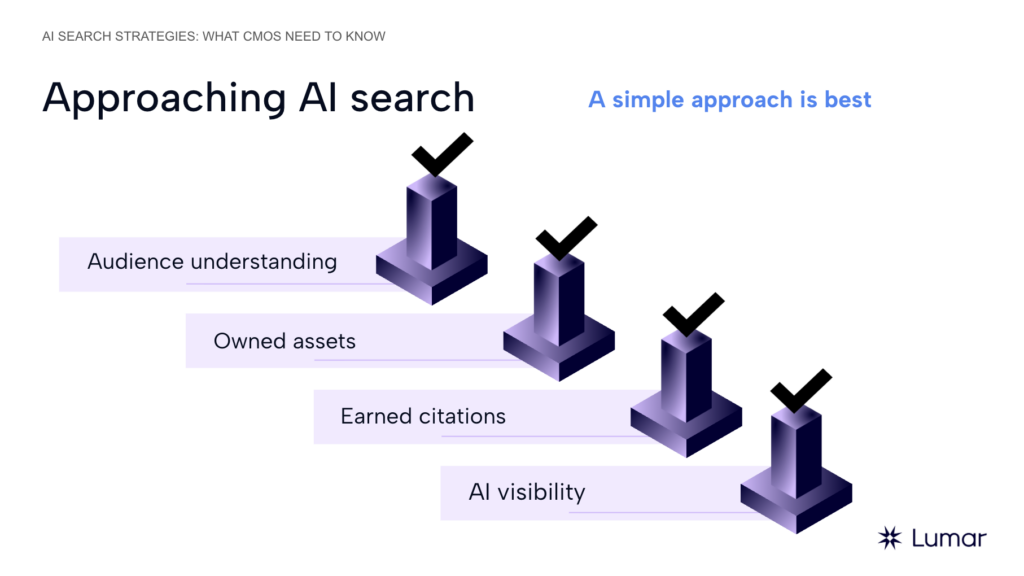
Francos gives a simple, top-level approach for GEO that can help align CMOs and SEOs and provide a framework for cross-functional collaboration:
- Understanding the audience
- Optimizing your owned assets
- Influencing earned citations
- Measuring AI visibility
Understanding user intent and conversational search for GEO
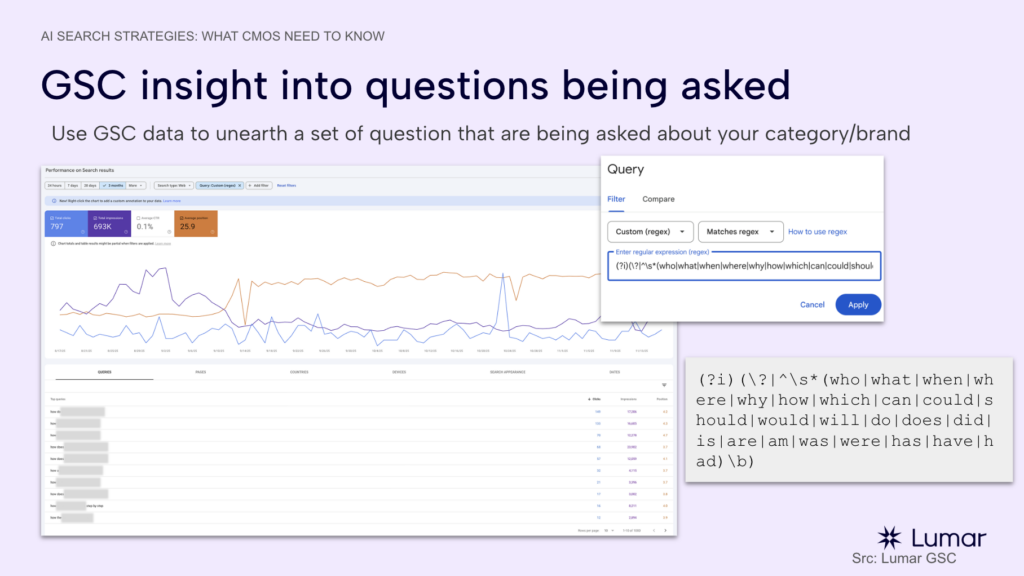
Fundamentally, AI Search is conversational and intent-driven, rather than being focused on any specific keywords.
Francos recommends using your existing Google Search Console (GSC) data to gain insights into the questions users are likely also asking LLMs.
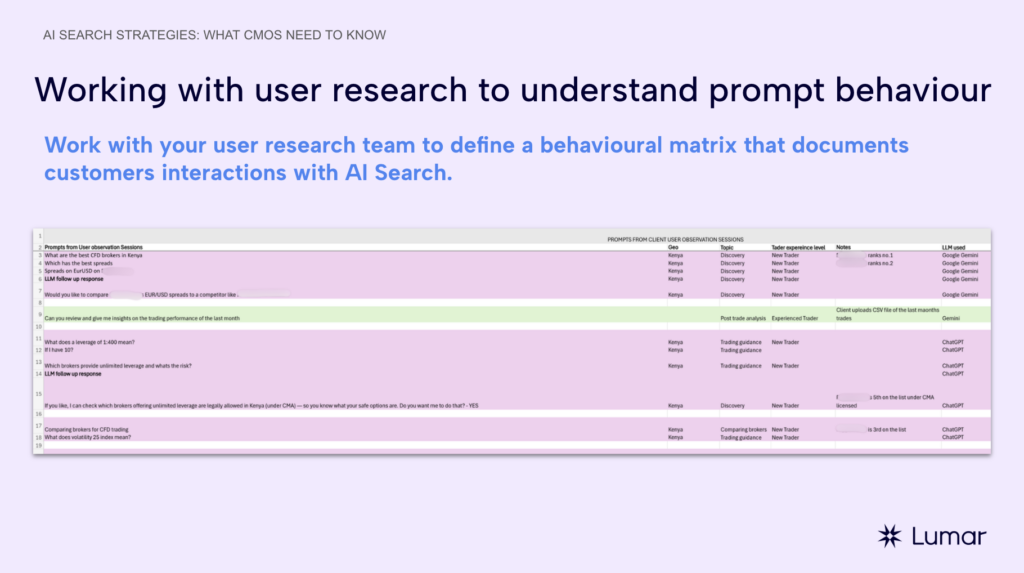
You can also use tools like ‘People Also Ask’ to build more comprehensive coverage of topics related to your category and brand, or work with your user research team to define a behavioral matrix that documents customers’ interactions with AI search.
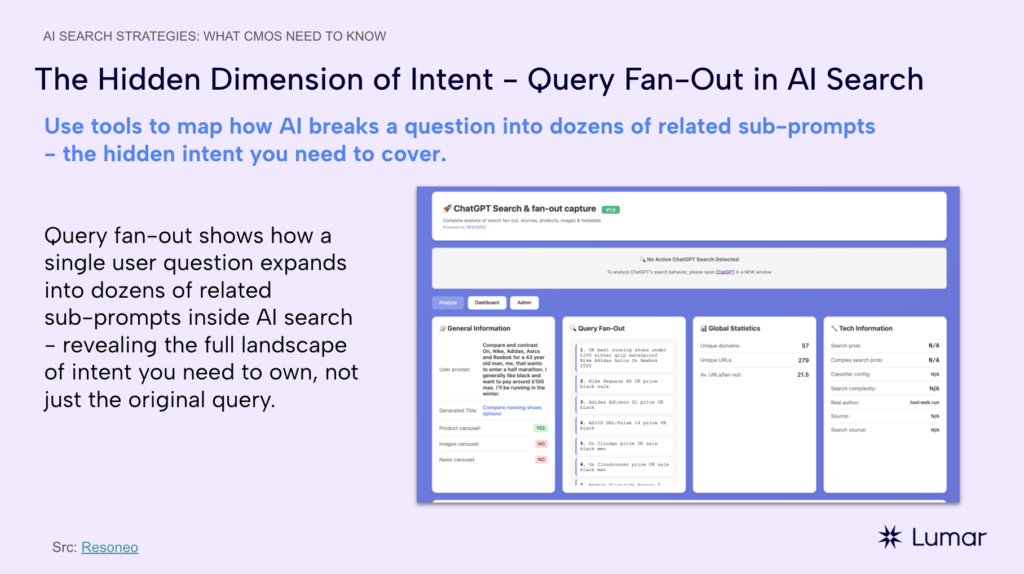
The query fan-out concept shows how AI breaks questions into dozens of related sub-prompts.
Francos notes that this provides a comprehensive understanding of the full landscape of intent, which you need to be optimizing your content around. It’s not just about the original query.
Summary: AI search is changing how brands are found
Francos sums up by reminding us that visibility across ChatGPT, Gemini, Perplexity, and Google’s AI Overviews and AI Mode is shaped by trust, structure, grounding, and citations.
GEO involves building brand visibility where users are spending their time. As models use memory, personalization, query fan-out, and agent data, the brands that win in GEO are the ones that are easy to retrieve information about across platforms, fact-rich, and consistently structured.
SEO and GEO overlap in tactics, but not in output. While SEO is about ranking high in the SERPs, GEO is about earning brand presence inside AI answers.
And there are new KPIs to consider as we face up to this new landscape of intent. Including:
- How often AI retrieves your content.
- How your brand is cited across the web.
- How trusted your brand is to the model.
- How visible you are across platforms.
- How you show up in a zero-click world.
Don’t miss the next Lumar webinar!
Sign up for our newsletter below to be alerted about upcoming webinars, or give us a follow on LinkedIn to stay up-to-date with all the latest news in SEO, GEO, and digital optimization.
Want even more SEO insights on-demand? Browse Lumar’s full library of SEO and website optimization webinars here.