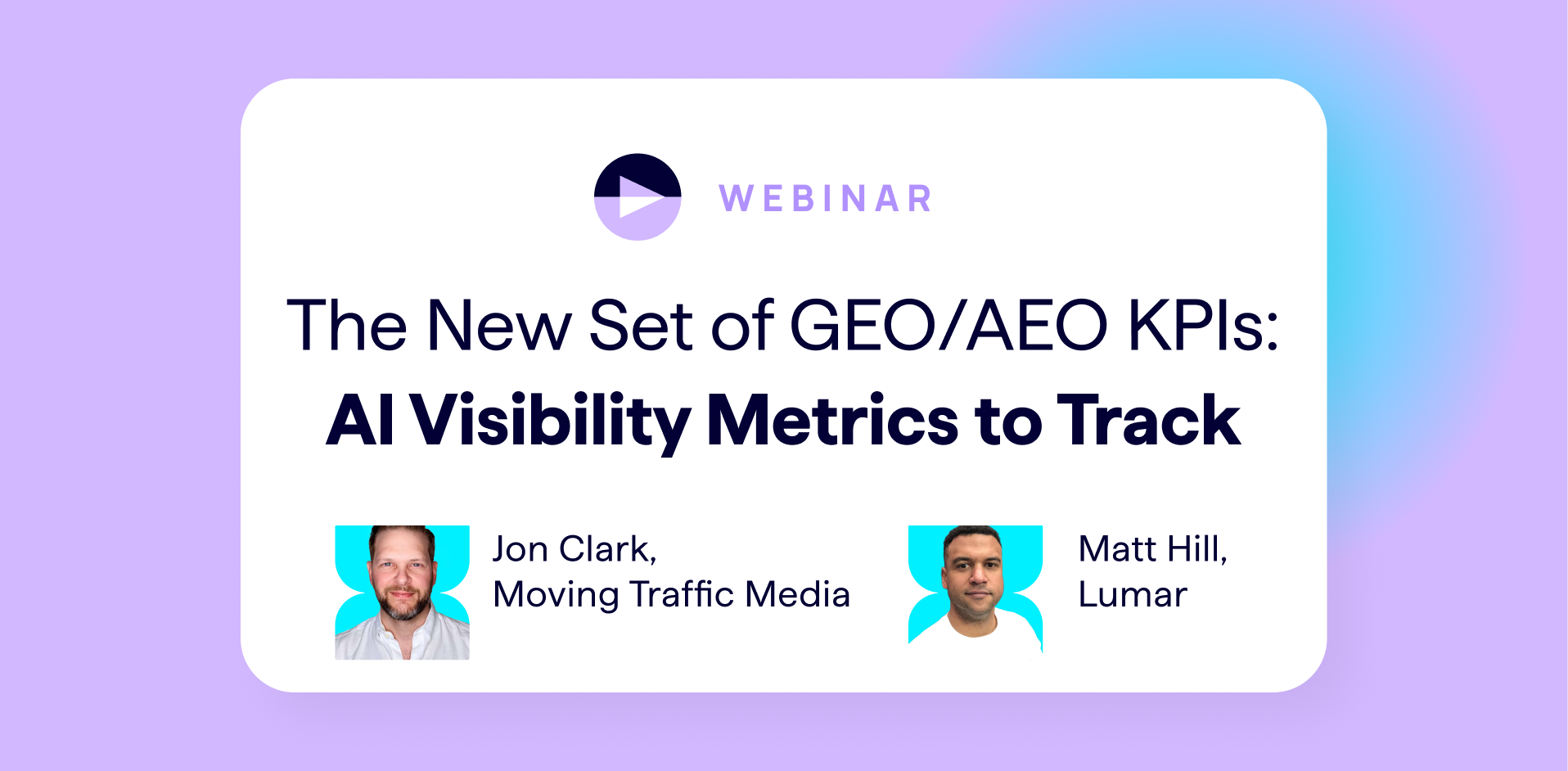
Watch the full GEO/AEO strategy session here:
“This is the best webinar I’ve been to in 2025.”
— Live GEO session attendee
Get Your Brand Mentioned by AI: Technical + Content GEO/AEO Tactics You Can Actually Use
Want your content to be found, understood, and cited by AI engines like ChatGPT, Claude, or Google Gemini? It’s time to get familiar with GEO: generative engine optimization (aka AEO: answer engine optimization).
Gain the latest insights into GEO/AEO strategies and tactics, encompassing both content and technical considerations, from our expert speakers: Jon Earnshaw, CTO at Pi Datametrics, Richard Barrett, Director of SEO Pro Services at Lumar, and Lumar host Matt Hill .
No hype. No silver bullets. Just clear, evidence-based AI and LLM optimization best practices to help your brand stay competitive in the evolving AI search landscape.
Watch the full webinar above – including audience poll results and Q&A session — or read on for our key takeaways from this GEO strategy session.

Meet the GEO Webinar Speakers:
- Jon Earnshaw – CTO at Pi Datametrics
- Richard Barrett – Director of SEO Professional Services at Lumar
- (host) Matt Hill – Senior Solutions Engineer at Lumar
TLDR; Top Tips to Boost AI Brand Visibility
Structure Your Content for Conversation 💬: Abandon keyword-first tactics. Optimize instead for layered query intent that anticipates users’ follow-up questions. Design pages (and your site’s internal links) to answer the user’s first question and the next three or four logical follow-up questions to secure sustained brand citation presence in AI conversations.
The Technical Prerequisite 🚧: Technical SEO is still a non-negotiable first step in GEO/AEO. If your site is not efficiently crawlable and indexable, AI cannot access, understand, and include your content in its responses to users.
Build Authority with E-E-A-T ✅: Combat “bland AI fluff” by emphasizing EEAT (experience, expertise, authority, and trust) principles, flagging clear human authorship, and creating Firsthand, Authentic, Social, Trusted (FAST) content.
Master Internal Linking to Build Conversational Topic Connections 🗺️: Use internal links as conversational bridges to connect topics and build topical ecosystems that LLMs can use for better synthesization.
Monitor Conversational Brand Endurance 📊: Shift measurement from simple clicks and page-one rankings to brand endurance (i.e., being cited across turns 2, 3, and 4 of an LLM conversation) to reflect success in the multi-turn AI search journey.
AI is changing the way users search — and the way SEOs need to optimize.
The SEO world is experiencing a shift. Generative AI search optimization (aka AEO, Answer Engine Optimization, or GEO, Generative Engine Optimization) is reshaping how we optimize our content for the new ways that users find and interact with information, turning traditional online search into a rich, multi-turn conversation.
In this webinar, our expert panelists outline the technical and content roadmap required to not just survive this new AI search era, but to thrive within it.
Here are the definitive strategic takeaways for SEO (or GEO or AEO) professionals navigating the generative search landscape.
The generative AI paradigm shift: it’s all about user behavior and conversational search
The rise of Large Language Models (LLMs) is fundamentally a user behavior challenge for SEOs.
“Make no doubt about it: behavior is changing as much as technology when it comes to search,” notes Jon Earnshaw. This shift is accelerated by younger users (Gen Z and Gen Alpha) who prioritize content that is faster to digest, authentic, and multimodal.
Search is no longer a simple lookup; it’s a dialogue. This is immediately visible in the length and complexity of user prompts on AI systems. Earnshaw revealed that LLM queries now average 23 words —a far cry from the short-tail search engine keywords of the past.
“You don’t use keywords when you talk to ChatGPT; you converse. And that behavior is coming to Google,” says Earnshaw.
From keywords to conversation: mastering user intent across multi-turn dialogues
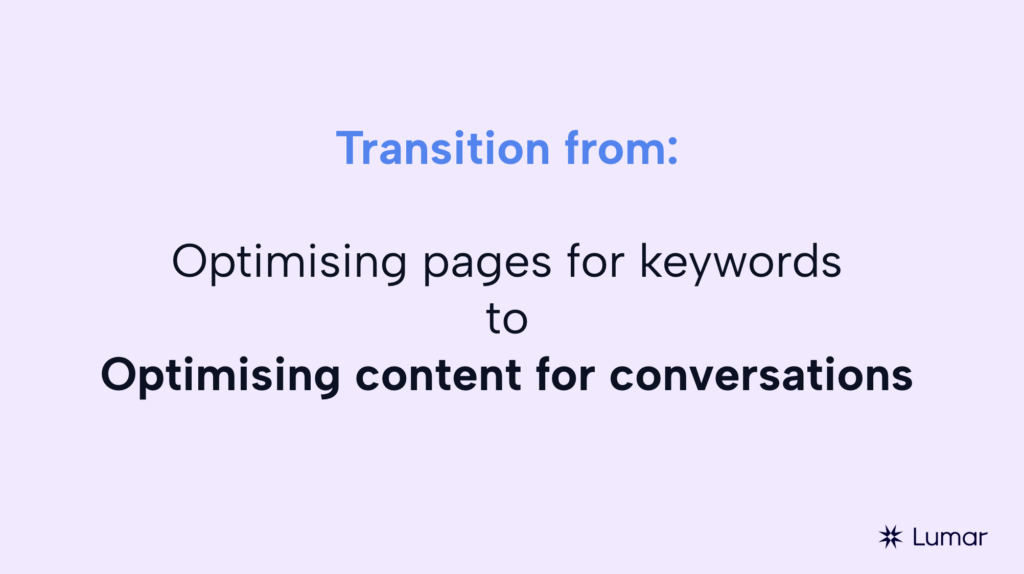
Given that the vast majority of user-inputted LLM queries are unique, attempting to optimize for every possible question is futile. The strategic pivot is clear: abandon the obsession with short-tail keywords as a tactical unit, and instead focus on mastering deep, comprehensive query intent.
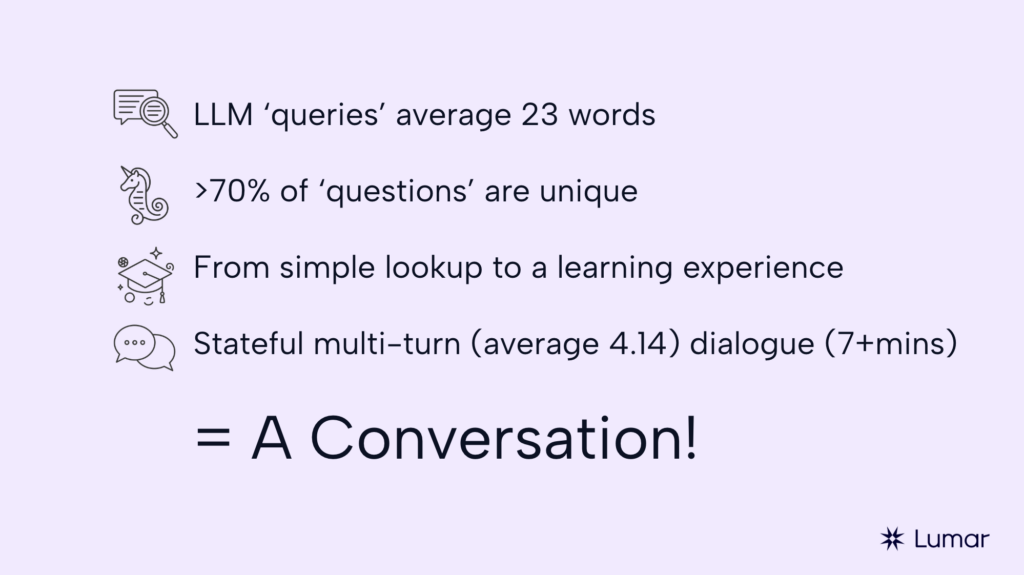
“More than 70% of questions are unique,” says Earnshaw, “So you cannot optimize for [specific user] questions. So it’s okay to use synthetic questions when you are trying to gauge your performance because the synthetic question can have the same intent as a real question.”
“It’s no longer a keyword game. It’s a journey of exploration and discovery.”
Structured content that answers not just the first question, but the second and third, is more likely to be surfaced in AI-powered overviews, according to Earnshaw.
Google’s advice for appearing in AI search experiences
Google’s own documentation on “top ways to ensure your content performs well in Google’s AI experiences on Search” echoes the strategy of creating content that anticipates and answers users’ potential follow-up questions on a given topic:
“Focus on making unique, non-commodity content that visitors from Search and your own readers will find helpful and satisfying. Then you’re on the right path for success with our AI search experiences, where users are asking longer and more specific questions — as well as follow-up questions to dig even deeper.”

“If somebody comes and asks a question and you’re optimized for that, well done. But if that person has follow-up questions, and you have failed to think about that and prepare and answer those, you may turn up for none of the conversation. As simple as that,” says Earnshaw.
“You’ve got to prepare for conversations. We have to anticipate the next turn and the one after that — with an average of four turns per conversation.”
Content structure for AI visibility
The most effective content for AI search is therefore layered and anticipatory. This means:
- H1/Main Content: Addresses the primary, broad intent.
- Supporting Headings/Sections: Anticipate the next three or four logical questions a user might ask after the initial LLM answer.
- Synthesization-Ready Structure: Earnshaw emphasized that structured content now means: cutting the fluff, being accurate, chunking content neatly, and using schema/structured data for better synthesization.
“To be discovered by LLMs, to be synthesized [by AI], you’ve got to get your structure right,” says Earnshaw.
The EEAT and FAST content imperative for GEO/AEO
In a world flooded with AI-generated text, building trust and demonstrating authority are not optional; they are the required ticket to play in search today. Google’s foundational signals of content authority and trustworthiness (E-E-A-T, or “Experience, Expertise, Authority, and Trust”) are more important than ever in the AI search era.
Earnshaw also introduces a new acronym for content optimization that is poised to entice younger generations searching for information beyond traditional search engines and AI alike: FAST content.
FAST content, he explains, is:
- Firsthand
- Authentic
- Social
- Trusted
Creating content that is both FAST and EEAT-optimized should be at the forefront of SEO/GEO strategies moving forward.
SEOs should prioritize experience, expertise, authority, and trust (E-E-A-T) and emphasize clear human authorship. Content created by proven, named experts is a crucial defense against becoming part of the “generic vanilla AI fluff” that LLMs and other search engines will increasingly deprioritize.
The role of internal linking in the AI search era
Internal linking is a critical technical lever SEOs can pull to enable layered topic coverage in the AEO / GEO era. As Lumar’s Richard Barrett explained, internal links are “literally how they discover stuff. Same as Google. They crawl your page, they find the links, they make a big list… It’s also your opportunity to link topics together and build that conversation from your existing site content.”
By strategically connecting pages, you build a topical ecosystem that reinforces conversational pathways:
- Conversation Mapping: Internal links should act as conversational bridges. When answering Question A on Page 1, the anchor text should directly and contextually link to Page 2, which answers the anticipated follow-up Question B.
- Conversion Efficiency: Internal linking is also about maximizing ROI. SEOs should monitor the click depth from the homepage to a piece of content, but more importantly, the click depth from that content to the desired conversion action.
“So, what I’m hearing is that, of course, we have to have our page structure in a good place where it doesn’t just speak to an intended concept, but also answers some of the additional questions that come below that. At the same time, you only have so much room on the page, and people don’t have time to read some of the long-form articles that maybe we historically have prioritized in our SEO space. So, there is a world via internal links where we’re not just creating content for the sake of creating content… but making sure that we’re smart and intentional with our related topics that help answer sub-questions that speak to that [broader] intended concept. It sounds like we have a method through internal linking to still be able to do that, that LLMs will still be able to pick up if employed effectively,” says Matt Hill, senior solutions engineer at Lumar.
Measuring GEO/AEO success with a conversational presence index
The era of measuring success by just simple clicks and first-page ranking is over. LLMs increasingly deliver answers directly to users, reducing traditional click-through rates. The new metric for success may be brand endurance within the LLM conversation.
“What matters is your content turning up at the next question, and the next one, and the next one,” explains Earnshaw.
“The winners are not those who appear at the start of the conversation, but those who endure all the way to the end, to conversion, to whatever a success is [for your brand],”
SEOs working in the GEO/AEO space may want to start building a Conversational Presence Index—a measurement of how long their content persists as a cited source throughout the multi-turn dialogue with an LLM. This involves shifting focus away from single-prompt performance and monitoring the conversation flow:
- Initial Citation: Did we get the first mention?
- Sustained Presence: Were we cited in turn 2, 3, or 4?
- Conversion Path Attribution: Which conversational segments lead directly to a purchase or sign-up?
Practical GEO/AEO example: restructuring seasonal content for AI conversations
The strategic GEO/AEO principles of layered content and internal linking can be impactful for seasonal content (e.g., Black Friday, Christmas, or back-to-school sales). For example, rather than creating and then redirecting a siloed Black Friday 2025 page, Barrett advises a content reinvestment strategy for GEO:
- Break the Page into a Conversation: Instead of treating a 2025 “trending gifts” page you’ve created ahead of holiday sales as a dead end, use it as the starting point for a deeper conversation.
- Establish Conversational Links: Link the current 2025 trends page to historical data (“What were the top trends in 2024? That’ll give you some gift ideas”).
- Create Evergreen Intent Hubs: Use the high-visibility seasonal page to pass authority and context to lower-volume, evergreen intent pages (e.g., “Gift ideas for Dad” or “Best Smart Casual Blazers for Work”).
This approach ensures the high-authority, time-sensitive content fuels the next stage of the conversation, maximizing long-term impact rather than letting valuable visibility dissipate post-season.
Don’t miss the next Lumar webinar!
Sign up for our newsletter below to be alerted about upcoming webinars, or give us a follow on LinkedIn to stay up-to-date with all the latest news in SEO, GEO, and digital optimization.
Want even more SEO insights on-demand? Browse Lumar’s full library of SEO and website optimization webinars here.