
As with traditional SEO, generative engine optimization (aka ‘GEO’, also known as answer engine optimization, or ‘AEO’) can be broken down into several key optimization areas for AI search visibility. We’ve organized these varied aspects of GEO / AEO into 4 core pillars:
- Technical GEO
- Content GEO
- Entity GEO
- Brand Authority GEO (what we’ll be discussing here!)
What is brand authority GEO?
Brand Authority GEO is about building credibility, trust, and preference. Once AI recognizes your brand as an entity, it must decide whether your entity deserves to be included, cited, or recommended in its generative responses.

“Gaining visibility in AI isn’t about optimization—it’s about creating brand and trust signals so strong that AI would be foolish not to put you front and center.”
— Natasha Burtenshaw-deVries, Acquisition Marketing Manager at Well.ca
TL;DR: Building brand authority for AI visibility
Brand Authority GEO is the credibility layer of AI search optimization: it helps generative AI systems decide whether your brand is trustworthy enough to cite, mention, or recommend.
While traditional SEO focuses on site-level signals, Brand Authority GEO focuses on your brand’s reputation beyond just your website — it looks to boost your brand signals across the entire digital ecosystem.
- The Core Objective: The goal is to optimize for AI selection. It’s about ensuring LLMs (like ChatGPT, Gemini, and Claude) perceive your brand as a credible, preferred entity worthy of citation and recommendation.
- Key Trust Signals: AI models evaluate reliability through unlinked brand mentions, digital PR, expert citations, and positive sentiment on third-party review platforms.
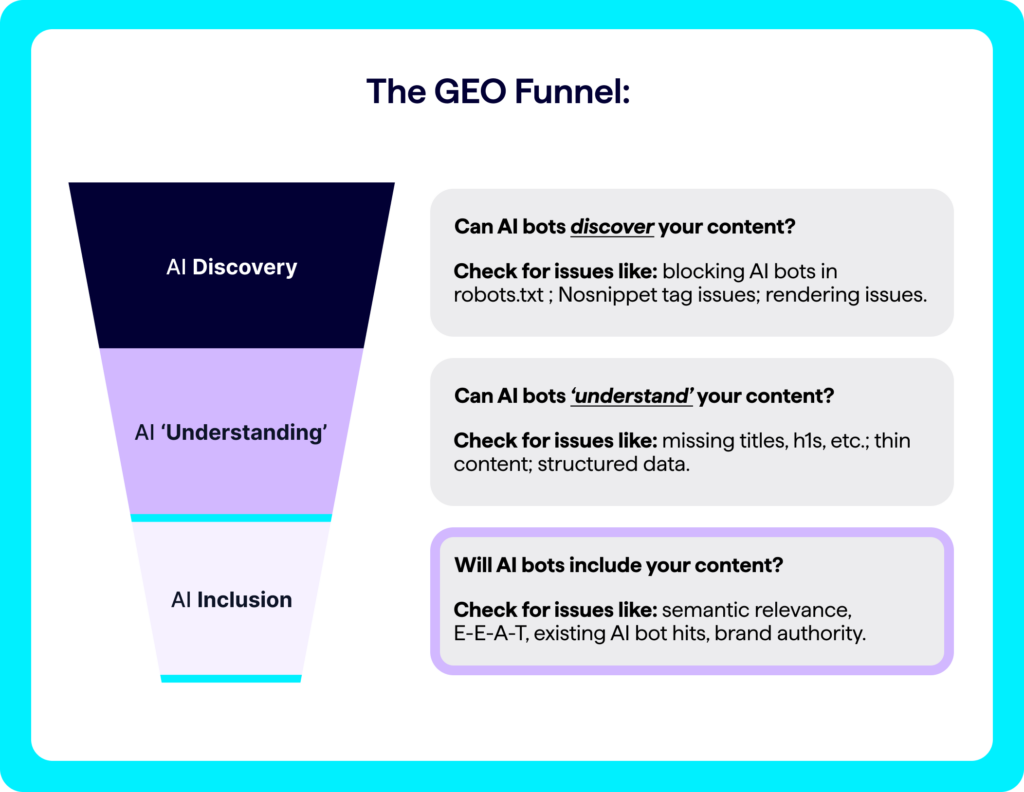
- The GEO Funnel: Brand Authority GEO aligns with the “AI Inclusion” stage, where AI models decide if your brand’s content is authoritative enough to inform their generative response and improve answer quality.
- Tactical Shift: Today, Digital PR and multichannel consistency are no longer “nice-to-haves” if you’re optimizing for online visibility —they are essential for building the validation and influence required for AI to use your perspectives as default answers.
About Lumar’s GEO / AEO Explainer Series
In this Lumar series, we’re exploring strategies for generative engine optimization (GEO), also known as answer engine optimization (AEO) — that is, how to boost your brand’s AI visibility and likelihood of earning mentions or citations from LLMs and AI-powered platforms like ChatGPT, Claude, Gemini, Perplexity, or Google’s AI Overviews and AI Mode.
Why Brand Authority GEO matters
Why does building brand authority matter for generative engine optimization? How your brand appears across the web (not just on your own website!) influences:
- Whether AI trusts the content you produce
- Whether your brand, its content, and its perspectives are selected for inclusion in AI answers over your competitors’
- How prominently your brand appears in AI answers
- The tone/brand sentiment of your AI mentions (neutral vs favorable vs negative)
How generative AI uses brand authority signals
Brand authority signals help AI models answer higher-order questions during their consideration of potential sources to use when constructing a generative answer, such as:
- Is this entity reliable?
- Is this entity respected within its field?
- Do other trusted sources validate this entity?
- Would citing this brand’s content improve answer quality?
Your brand’s perceived reputation — how AI systems will ‘understand’ its credibility — is shaped by signals that go beyond your own website. This means multichannel and multimodal strategies have become increasingly important in the age of AI search.

On trust and authenticity signals:
“As AI tools, platforms and processes accelerate the amount of AI slop being pumped out into the world, finding a way to cut through the noise will be more critical than ever.
‘Just create great content’ has never been enough. In 2026 search and AI platforms will be looking for new ways to discern and understand authenticity and trust.
When everyone says, ‘build your brand,’ what they often mean is: ’be a voice people trust.’”
— Andrew Cock-Starkey, Founder and SEO Consultant at Optimisey
Brand Authority GEO tactics
Brand Authority GEO is driven by external validation and real-world trust signals, including:
- PR and media mentions
- Influencer and expert citations
- Customer reviews and testimonials
- Multichannel content consistency and visibility
- Demonstrated leadership and expertise over time

“Good content alone is not going to move the needle anymore. We need strong brand authority. Things that have long been seen as “nice to have” or “bonus SEO” are now must-haves, such as Digital PR to generate positive brand sentiment and brand mentions.”
— Tina Reis, Senior SEO Strategist at Muhlert Digital

“Brand authority & reputation management [will be crucial skills to hone in 2026]. Why? To be cited and trusted, we need to clearly communicate who we are, what we offer, and how we solve problems. LLMs prioritize authoritative content with a clear and consistent brand identity.
These changes will require continued investment in brand recognition, developing strategies that go beyond the website, and creating content across social media. It’s essential to listen to what users are saying about your brand in forums and incorporate those insights into your site.”
— Ana Perez, SEO Manager
Brand authority in the GEO Funnel
Brand Authority GEO focuses on making sure your brand is recognized as a trustworthy source of information that is likely to be relied upon as a resource when AI systems are generating responses. This aligns to the ‘AI Inclusion’ stage in the GEO Funnel: making sure your brand and its content is optimized for AI selection and inclusion in AI answers.

On brand reputation management for AI visibility:
“As AI and LLMs evaluate brand credibility, SEOs (more than ever) will need skills in monitoring online reputation, managing reviews and UGC platforms to ensure that signals of authority and trust are accurately represented across search.”
—Chloe Steele, SEO Account Manager at Verde Digital
- (Hear more from Chloe in our Lumar webinar session: “SEO & GEO Trends for 2026”)
Key differences between Entity GEO & Brand Authority GEO
Elsewhere, we’ve discussed a sub-discipline of GEO we’re calling Entity GEO — which might, at first glance, seem to overlap with Brand Authority GEO. To avoid confusion, below we’re outlining some of the key differences between Entity GEO and Brand Authority GEO, so you can see how each of these aspects of AI search optimization requires different tactics and activities.
| Entity GEO: | Brand Authority GEO: |
|---|---|
Establishes who you are | Establishes how trusted you are |
Identity and recognition layer | Credibility and preference layer |
Focuses on brand facts and consistency | Focuses on validation and reputation |
Built through structure and clarity | Built through influence and trust |
| Required for AI brand awareness | Required for AI selection |
Outcomes of a strong Brand Authority GEO plan
The goal of implementing a Brand Authority GEO plan is to optimize your brand’s online reputation so AI systems are more likely to:
- Prefer your brand over less trusted entities
- Cite your content directly
- Mention your brand favorably in recommendations
- Use your perspectives as default answers
How to build brand authority for GEO
In traditional SEO, a whole sub-industry developed around securing backlinks — for GEO, even brand mentions alone without a “dofollow” backlink can help establish your brand as a trusted, authoritative entity.
This means digital PR is having a bit of a renaissance, with the importance of authoritative brand mentions from credible sources that go beyond your own company’s website rising in importance once again.
As Raquel Gonzalez Exposito, CEO & Founder at Seoulful Connect, explains:
“I think brand reputation and authority will be more important than ever in 2026. We’ve always talked about becoming a reference in your niche and getting backlinks from reputable sources, but now it’s even more important to showcase that expertise through your own data, expert quotes or insights, and contributions from real professionals in the field, all of which help strengthen your topical authority.
As we know, brand authority isn’t built overnight. Most of the brands already showing up in AI-generated responses are there because they’ve been doing the work for years and have earned that recognition. We’ve always focused on getting dofollow backlinks, and that’s still relevant, but simple brand mentions will also matter more now, since AI models can recognize and display those sources.
That’s because AI doesn’t just evaluate backlinks; it looks at mentions, reviews, EEAT consistency, and other credibility signals. So, strengthening your digital PR and content marketing efforts will be key. You should also check how AI tools mention your brand to understand how they perceive your business, and identify ways to improve both visibility and trust.”
Press mentions matter for building brand authority, but there are other brand credibility signals you can work with: think industry awards, third-party review websites, influencer mentions on social media, forum threads, and partnership marketing mentions on others’ websites and social profiles.

“Even when content isn’t directly cited via links, LLMs still recognize brand mentions across the web. Digital PR, thought leadership, and high-authority citations all improve your chances of surfacing in AI-driven summaries.”
— Rejoice Ojiaku, Senior Content Specialist at Wise
- (Check out Rejoice’s Lumar webinar session: “SEO in the Age of AI: A Conversation on GEO, AEO & the Future of Search.”)

“PR becomes much more important when mentions are taken as an element of success and not just links.”
— Emina Demiri-Watson, Head of Digital Marketing at Vixen Digital
Your brand authority GEO checklist
□ Digital PR & Media Mentions: Secure unlinked and linked brand mentions from tier-1 industry news sites and major trade publications. (Signals: trust/co-citation)
□ Expert/Influencer Citations: Get cited or interviewed by established, authoritative experts and influencers in your niche. (Signals:
respect within field)
□ Positive Brand Sentiment: Actively manage and generate positive reviews on all key third-party platforms (e.g., Google, Yelp, G2, industry-specific review sites). (Signals: reliability/preference)
□ Industry Association & Awards: Become an accredited member of relevant trade bodies and win recognized industry awards. (Signals: validation by trusted sources)
□ Sponsorships & Partnerships: Partner with established, non-competitive entities to associate your brand with positive, high-authority signals. (Signals: legitimacy/ecosystem trust)

“The way LLM-type search surfaces work means a much wider breadth of opinion is summarized, so a multi-site presence and consistency in what is being said about you is more important than ever.
This means that effective digital PR, getting people to talk about your brand, your story, your data, on trusted websites, with consistency will pay even bigger dividends than before, link or not.”
— Mark Williams-Cook, Director at Candour
- (Hear more from Mark in our Lumar webinar session: “SEO & GEO Trends for 2026”)

“I believe in having your brand mentioned (linked or unlinked) in contextual and topically relevant articles on websites other than your own to improve visibility in LLMs and AI search. The more your brand appears across the web, the easier it is for AI crawlers to find it — and the more likely you are to be cited or mentioned in AI searches and LLMs.”
. . .
“Work on strengthening your brand alongside your content efforts. Allocate part of your SEO budget to Digital PR and securing brand mentions on sites other than your own to improve trust and authority for both Google and LLMs.”
— Katarina Dahlin, Senior Growth Hacker at WhitePress
Get the Lumar tools you need for GEO / AEO
About Lumar’s GEO / AEO explainer series
In this Lumar series, we’re exploring strategies for generative engine optimization (GEO), also known as answer engine optimization (AEO) — that is, how to boost your brand’s AI visibility and likelihood of earning mentions or citations from LLMs and AI-powered platforms like ChatGPT, Claude, Gemini, Perplexity, or Google’s AI Overviews and AI Mode.