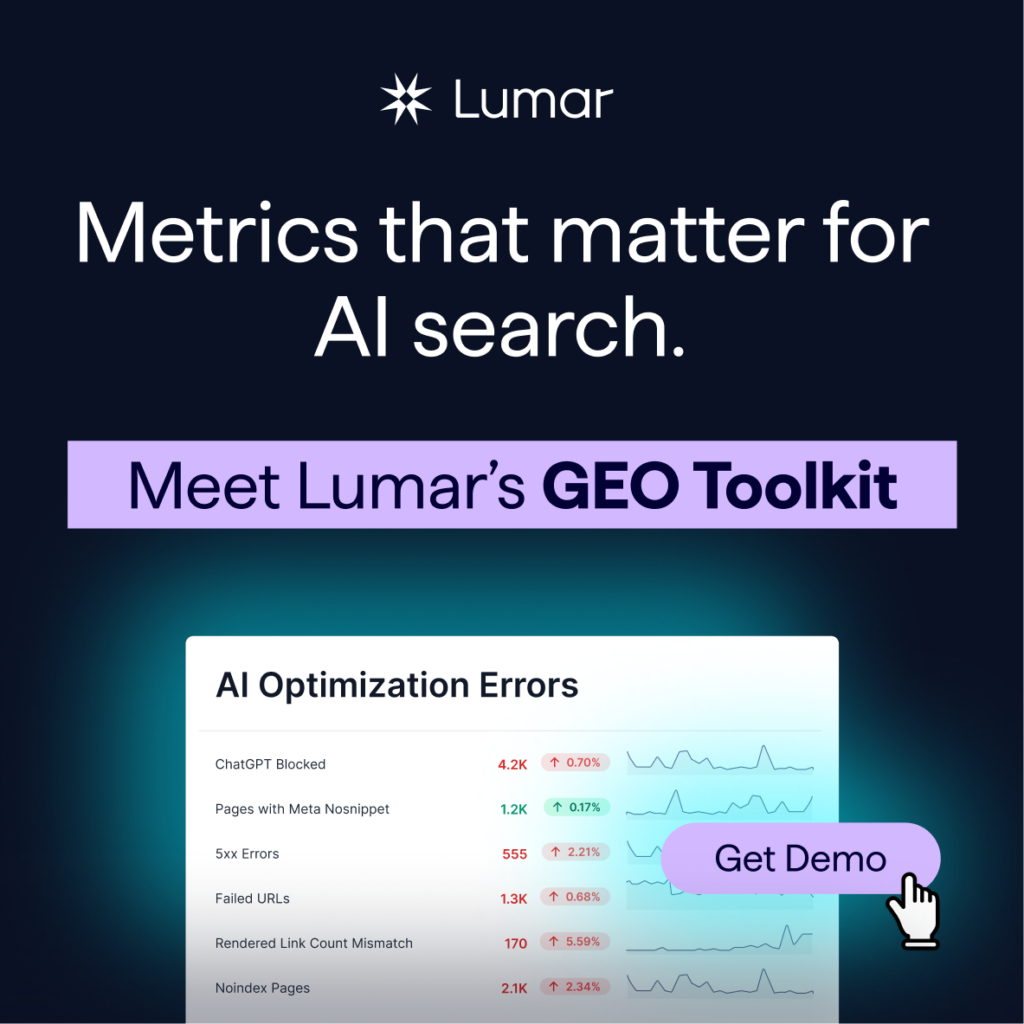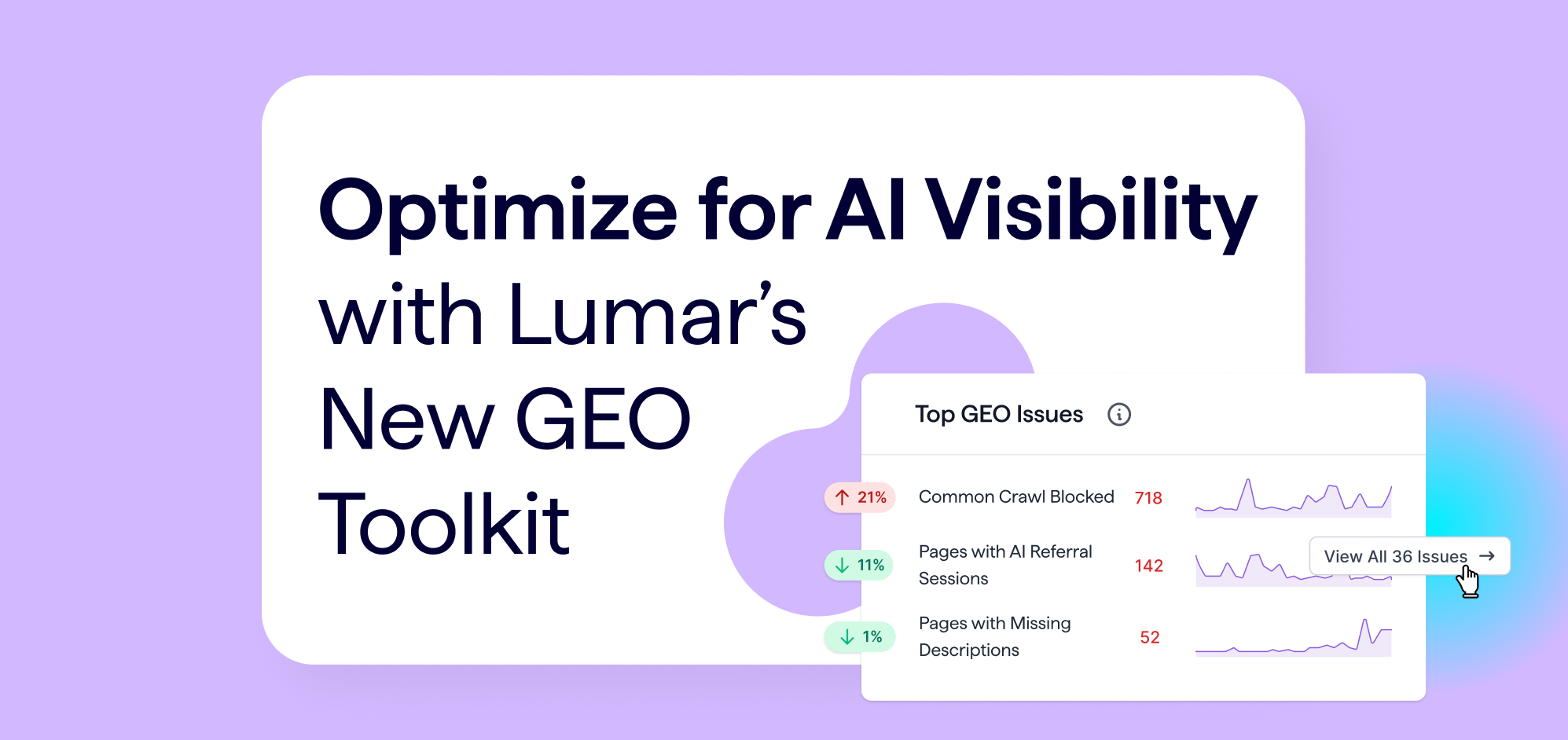

Three questions every GEO program should be able to answer about its brand’s visibility in AI search
- Does your brand appear in AI answers for the topics that matter most to your business?
- When your brand appears in AI responses, how is it being described — and is that description accurate, favorable, and consistent?
- When you make technical or content changes on your website, can you measure whether those changes are improving your brand’s AI visibility over time?
For most teams tackling generative engine optimization (GEO) right now, these questions are genuinely difficult to answer with confidence. The data either doesn’t exist or exists in a form that doesn’t scale — via manual prompt tests, informal spot checks, or tools that count AI mentions without explaining what they mean. That’s what Lumar’s AI Search Visibility features are built to address.
AI Search Visibility is a dedicated prompt tracking and AI brand visibility reporting tool, launching today as part of Lumar’s growing GEO platform. It tracks your brand’s visibility across today’s most popular AI answer engines — ChatGPT, Google AI Overviews, Google AI Mode, Gemini, Perplexity, and Claude — measuring not just whether your brand is mentioned, but how it’s being represented. And because it lives inside the Lumar platform, your AI visibility data connects directly to your website crawl analysis and our GEO technical and content diagnostics — so visibility gaps can be diagnosed and acted on in a single workflow.
Get a Lumar AI Visibility Platform Demo
What Lumar AI Search Visibility does: core capabilities
AI Search Visibility is structured around a simple premise: systematic, repeatable tracking of your brand across the AI platforms your buyers are actually using today.
You configure the topics that matter to your business — the strategic thematic areas where your brand needs to win AI visibility and brand mentions — then define the specific prompts you’d like to track within each topic. Lumar runs those prompts across ChatGPT, Google AI Overviews, Google AI Mode, Gemini, Perplexity, and Claude, and extracts data from every answer, including:
- brand mentions
- citation positions
- qualitative brand sentiment assessments
The result is a consistent, structured dataset of meaningful AI visibility metrics that your team can track over time — not a snapshot from a random afternoon of manual testing, but a repeatable view of your brand's AI presence across the platforms and topics that matter most for your business, auto-refreshed at a cadence that suits your workflow.
And, by combining this AI brand visibility data with Lumar’s technical website crawl data and SEO and GEO insights, users gain a unified view of their brand’s digital presence across both traditional and generative search landscapes.
AI visibility scores: a key GEO metric to track right now
At the center of Lumar’s AI Search Visibility toolkit is your AI Visibility Score: a single, weighted metric that combines brand mention frequency and citation quality across AI platforms into one easily reportable number.
The AI Visibility Score serves dual purposes:
- For GEO practitioners and managers, it's a trend line — a reliable indicator that moves in response to the technical and content-focused optimizations your team is making to improve AI search visibility, giving you a feedback loop that basic AI mention counts alone can't provide.
- For marketing leadership, it's a defensible GEO summary metric: something you can put in a board deck, track quarter over quarter, and use to justify continued GEO investment.
The AI visibility score reflects what's actually happening across your configured prompts and AI platforms — and because it's backed by up to two years of stored data, it supports the kind of longitudinal narrative that proves a GEO program is producing real results, not just busywork.
Beyond mere brand presence: AI brand sentiment scores
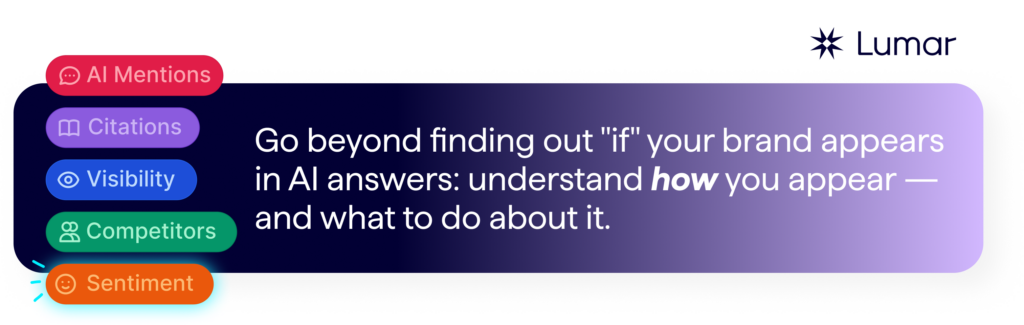
Whether your brand appears in an AI answer is one question. How it appears is a different (and arguably more important) one.
AI engines don't just mention brands. They describe them. They characterize a brand’s capabilities, frame positioning, note limitations, and place brands in context relative to competitors — often before a potential buyer has ever visited your site or spoken to your team. That description shapes brand perception in ways that a simple mention count won’t capture.
Lumar’s AI Brand Sentiment Score is built to measure this qualitative dimension of AI answers. It provides an assessment of how your brand is being presented by different AI systems — not just whether it's mentioned — so your team can understand whether AI search is reinforcing your brand positioning or creating a problematic narrative that needs to be addressed.
For teams managing brand perception as well as AI search visibility, this is the data point that mention-only tracking tools fail to provide. AI Brand Sentiment Scores are the metrics that move GEO measurement from mere presence tracking to real brand intelligence.
Competitor AI mentions benchmarking with topic-level visibility
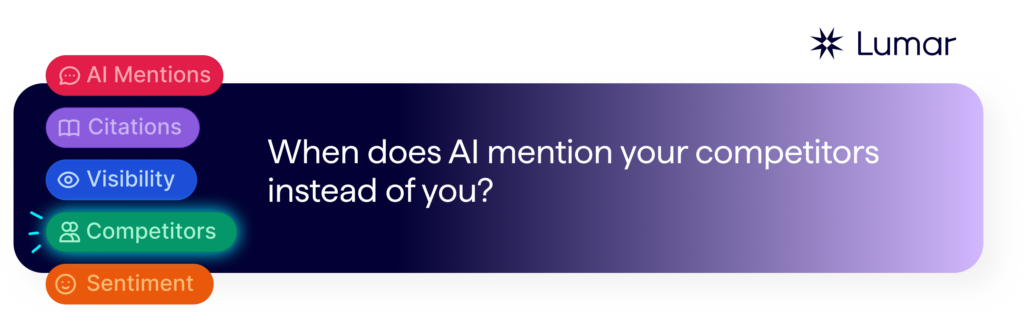
Understanding your own brand’s AI visibility is only half the picture. The other half is knowing which of your competitors are being cited instead of you, and for which topics.
For every prompt you configure in Lumar, our AI Search Visibility tools also surface the other brands being cited alongside (or instead of) yours. Competitor benchmarking gives you AI Visibility Score comparisons across the same prompt landscape, share-of-voice trend data over time, and a clear view of which topic areas competitors are winning and where opportunities exist.
The topic-level structure adds a second layer of strategic competitive insight. Prompts are organized within topic clusters, and AI Search Visibility provides aggregated roll-ups at the topic level — so alongside prompt-level citation data, you get a strategic view of which broader topical themes your brand is winning in AI search and where your topical authority is weak. That topic-level data is particularly useful for content strategy decisions and for leadership presentations where the headline story matters more than individual data points.
The integration advantage: why AI visibility data belongs in your website optimization platform
There's no shortage of tools that will tell you where your brand appears in AI answers. The more important question is what you can do with that information once you have it.
Most AI visibility tools are simple monitoring tools. They surface where you appear in AI answers, and they stop there. The gap they leave open — between "we have an AI visibility problem" and "here's what's causing it and what to do next" — is where most GEO programs get stuck.
Because AI Search Visibility lives inside Lumar, your AI visibility data sits alongside deep website crawl analysis, technical GEO and SEO metrics, and content evaluation tools in a single workflow. That means teams can move from "our AI Visibility Score is underperforming in this topic area" to investigating the technical and content factors that impact it without switching platforms or reconciling data sets from siloed tools.
Built for the whole GEO team
GEO programs typically involve at least three distinct stakeholders, each with different data and insight needs. Lumar’s AI Search Visibility is built to serve all three.
- For Technical SEO/GEO Managers: Reproducible, prompt-level AI visibility data across all major AI platforms, with the ability to connect visibility gaps to technical website factors like robots.txt, rendering, schema, or indexability, in the same platform. That’s AI visibility data you can diagnose, not just monitor.
- For Content Managers: Topic-level AI visibility data that shows where your brand's topical authority is strong in AI search and where coverage gaps exist — giving content teams a structured basis for prioritizing content creation, refreshes, and retirement decisions rather than relying on intuition alone.
- For VPs of Marketing and CMOs: The AI Visibility Score and trend data provide leadership-ready metrics for GEO reporting — reproducible, methodology-backed, and designed to demonstrate that AI search investment is translating into measurable brand presence over time.
How to get started with AI visibility tracking in Lumar
Getting up and running with AI Search Visibility in Lumar is straightforward:
- Create a project. Set your brand name, domain, the AI platforms you want to track, and your preferred prompt tracking cadence — daily, weekly, fortnightly, or monthly.
- Configure your topics and prompts. Define the topic clusters that reflect your strategic search landscape, then add the specific prompts within each topic that your target buyers are likely asking AI engines.
- Lumar runs your prompts across all configured platforms, extracting brand mentions, citation positions, competitor data, and qualitative brand sentiment assessments from every answer.
- Review your dashboard. Your Visibility Score, Brand Mentions Score, topic-level roll-ups, competitor rankings, and citation details are all surfaced in your Lumar AI Visibility Dashboard — and updated at your chosen cadence, with data retained for up to two years.
Get a platform demo
Lumar’s AI Search Visibility features give your team the structured GEO measurement infrastructure to track brand presence across AI answer engines, understand how your brand is being represented, and connect that data to a clear path of action — all inside the Lumar platform.
Already a Lumar customer? Speak to your account team about adding AI Search Visibility to your plan.
Get your Lumar AI Visibility platform demo
Ready to start tracking and improving your brand’s visibility across AI platforms?
Let us know a bit more about you in the form to get started with your platform demo!
GEO learning resources:

Free eBook Download: The 2026 AI Search Playbook
80+ pages of GEO/AEO strategy insights, expainers, and insights from 20+ SEO pros on how they are approaching AI search optimization in 2026.
Go from AI Visibility analytics to a full GEO action plan
Connect AI prompt tracking data with the broader Lumar GEO suite: Lumar connects your AI brand visibility data to deep website crawl analytics so you can easily spot the pages that could be driving AI citations but aren't and fix whatever's holding them back.
Lumar takes you from AI visibility diagnosis to a prioritized GEO action plan, all in one place.