A Practical Framework for Aligning SEO, PPC & Content Marketing
Go from SEO silo to joined-up growth engine with better cross-channel marketing alignment.
Get a tactical framework for aligning technical SEO with PPC and content marketing to build a multichannel growth engine that works. Learn from search expert Kevin Kapezi (Director of Growthack) and Lumar host Eric Grabiak in this on-demand webinar session.
Watch now:
This is hands-on guidance, ideal for SEO professionals, digital marketers, and CMOs looking for cross-channel alignment that drives results.
Watch the full Lumar webinar session above, or read on for the top takeaways.

Meet the Webinar Speakers
- Presenter: Kevin Kapezi, Director of Growthack.io
- Host: Eric Grabiak, Senior Success Manager at Lumar.
TL;DR / Executive Summary: How SEOs Can Create Better Multichannel Alignment Across Teams
What this webinar covers:
Kevin Kapezi, Director of Growthack.io and a former in-house SEO lead at Experian B2B, joined Lumar’s Eric Grabiak to make a compelling case for why siloed marketing teams leave serious revenue on the table — and what to do about it.
The core argument:
According to Kapezi, SEO is not a distribution channel. It’s a structural layer that helps humans understand your brand, platforms interpret it, and AI recommend it. That means SEOs need to be in the room for business-level conversations — not just website audits.
The framework:
Kevin introduced the D-C-B-A-S Reverse Framework, which argues that winning brands build from the ground up: Distribution → Content → Brand → Authority → Search Strategy. Most search-focused teams start at the top (search strategy) and wonder why broader marketing and business performance doesn’t improve.
Four multichannel workflows covered:
- Using search data to reveal demand and align SEO with PPC;
- Site architecture as a commercial lever, not just a technical one;
- Product insights and sales feedback as the real driver of content strategy;
- Migrations as a high-impact opportunity to rebuild your site around customer “lenses.”
Real-world results shared:
- SaaS MQL-to-SQL acceptance rate improved from below 15% to 30%
- +157% course leads for a UK driving school after fixing page intent issues
- +244% sales for a mobility equipment retailer after a Shopify migration
- €2 million in global growth for a sports pitch manufacturer after a structured site rebuild
Webinar Recap: Multichannel Alignment for SEOs
For our guest speaker, Kevin Kapezi, winning brands are customer-first.
This means brands need to properly understand customer demand and the kind of products they are interested in.
If the brands we are working with fail to do this, it’s on us as SEOs to identify those opportunities and fill those gaps.
Why Marketing Silos Are Still a Problem
When our webinar opened with a live audience poll — “How aligned are your SEO, PPC, and content teams today?” — the results were telling. The majority of attendees reported “some collaboration,” a significant portion said teams were “mostly siloed with occasional overlap,” and only a minority described their teams as “fully integrated.”
For Kevin Kapezi, Director of Growthack.io, this wasn’t surprising. It’s exactly the problem that shaped his entire approach to search engine optimization.
Kevin started his career not in marketing but in customer service, doing outbound calls for Specsavers to win back customers who had canceled their direct debits. That experience — understanding why people leave, what they need, and how to re-engage them — became the lens through which he sees SEO.
“My whole approach to marketing or SEO is always about customers. The biggest brands win essentially through understanding their customers and ensuring that they’re aligned.”
Before founding Growthack.io, Kevin was an SEO lead within a large B2B organization, where he saw first-hand how enterprise organizations compartmentalize: product teams with their own KPIs, PPC teams in one corner of the office, SEO teams in another, and nobody talking to each other.
When he set up his own agency, he was determined to do things differently.
Multichannel Marketing Team Alignment
A key problem for organizations seeking to achieve this comprehensive understanding of their customers is that their SEO, PPC, content, product, and other teams operate in separate silos. This means they work with minimal alignment between them, and they operate towards their own respective targets.
Kapezi sees this as a particular issue at the enterprise level. For example, your product team might be naming numerous products with no regard for organic search, page cannibalization, or even audience perception. They may have completely different KPIs from the search team.
“SEO is often seen as a distribution channel,” he says. “We can probably blame Universal Analytics for that. You used to be able to attribute your revenue quite easily, but now that’s completely impossible.”
“The way that I’ve always seen SEO is that our role, especially at a technical level, is to be deeply involved with the business at all marketing levels from the C-suite to individual teams – because we manage the website as a whole.”
For Kapezi, then, the solution is to stop starting with search and to aim for a unified strategy in which channels operate as a team rather than independently. KPIs are established collectively. Data is shared across teams. Collaboration on campaigns is nurtured. And the customer experience is seamless across channels.
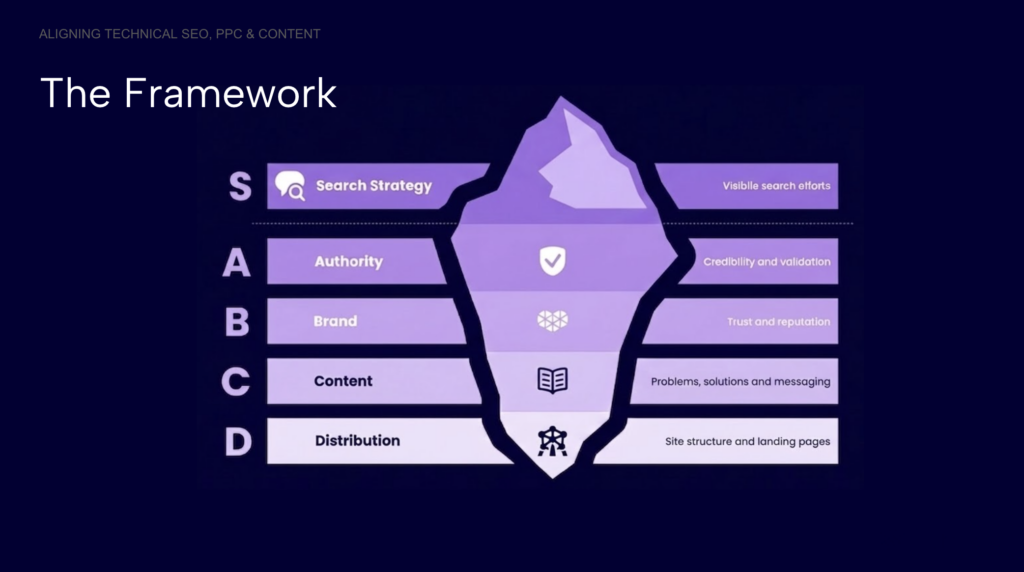
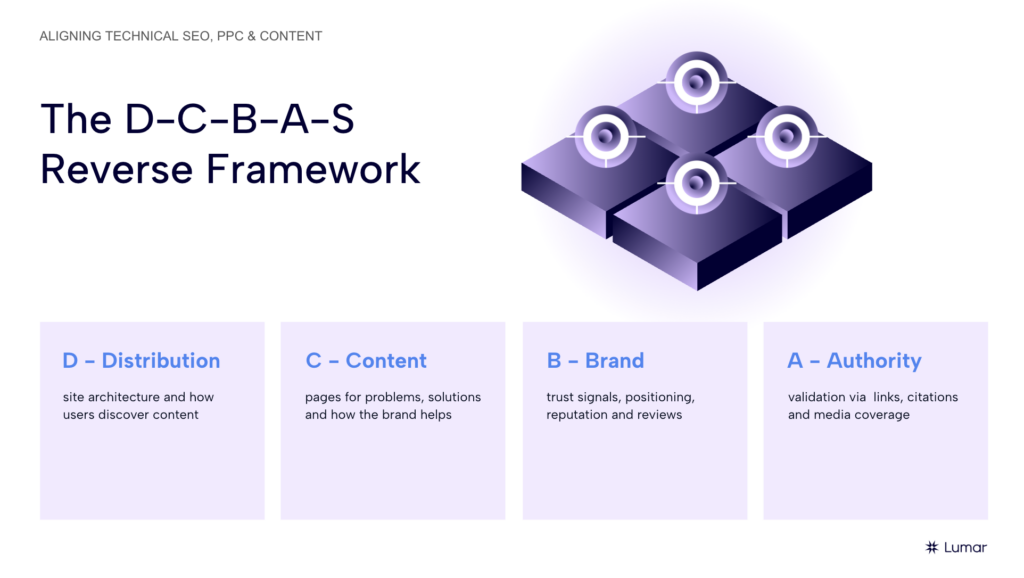
Kapezi has established his own framework for this. The DCBAS reverse framework:
- Distribution – Site architecture and how users discover content.
- Content – Pages for problems, solutions, and how the brand helps.
- Brand – Trust signals, positioning, reputation, and reviews.
- Authority – Validation via links, citations, and media coverage.
- Search – Visible search metrics.
“Winners build from ‘D’ [distribution] up,” he says. “I can quickly spot if an SEO project is going to be a success or not by understanding the distribution aspect.”
Kapezi believes the role of SEOs is often understated. But things are changing.
The rise of AI search and GEO means SEO pros are much more often part of the overall conversation – increasingly having a seat at the table in brand discussions, as well as in how social media and the site’s content impact visibility.
How SEO Can Inform Other Marketing Channels: Four Key Workflows
1. Revealing Demand with Search Data
For Kapezi, SEOs are well-positioned to align their search data to reveal demand and improve performance across other channels.
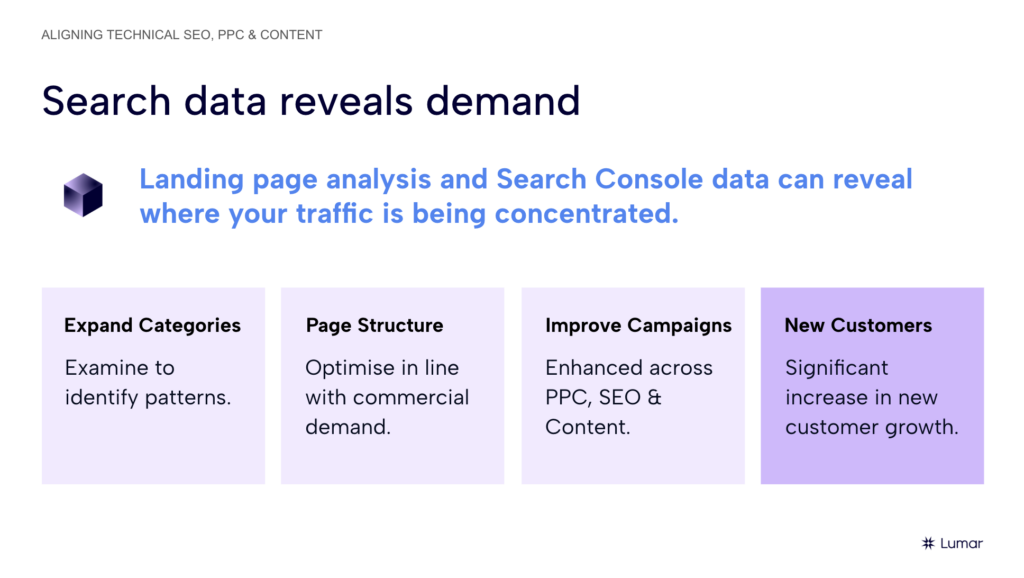
He points to a real-world example of this with the work his agency has carried out for driving course website Pass Me Fast.
The site had a “prices” page, which was performing well for PPC impressions, but not for clicks and engagement. By converting these pages to the more topically relevant “courses” (with the content still including price information) they managed to improve clicks and to start ranking for one of their most commercial terms.
This resulted in +157% course leads within 90 days of launch.
Kapezi and his team also audited the site to work out top-performing pages vs. topics to avoid. This meant they could direct content teams towards getting the course content right, rather than focusing their efforts on more general automotive material like car maintenance, insurance, etc.
They also looked at off-site content, highlighting the need for a YouTube presence where there is high demand for learning to drive content.
2. Enabling Performance With Website Architecture
Another key workflow for SEOs to have multichannel impact, according to Kapezi, is to optimize site architecture – particularly with a view to improving conversions for high-value products.
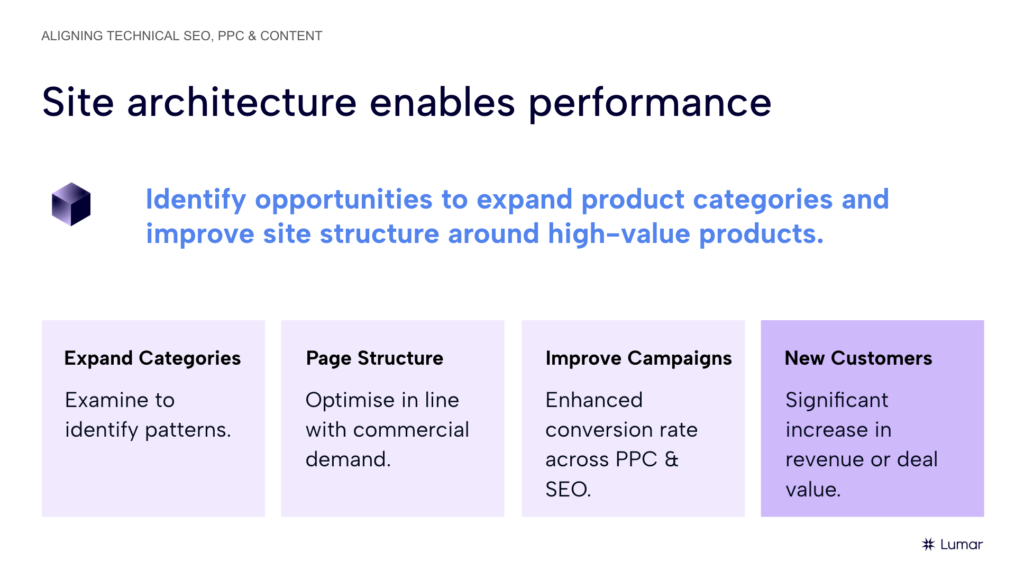
“It’s one of the biggest levers we have as technical SEOs,” he says. “And it’s where we can get really involved in a business.”
One example for Kapezi is with the work he has done for Manage @ Home, a site specializing in accessibility aids.
When Growthack came on board, Manage @ Home only really had one landing page. This called for the construction of sub-category pages so that they could appear for more search terms, broader queries, as well as improving their on-site UX.
Now, if a customer is searching for “lightweight rollators”, “all-terrain rollators”, etc., there are specific landing pages for these. And these new sub-categories are better informing their PPC targeting, too.
Over the testing period, the new structure resulted in +63.51% daily clicks and +89.76 impressions. Once the site had migrated, they received +244% sales in January, higher average order values, and a +164% conversion rate.
3. Shaping Content With Product Insights
Kapezi notes how product insights are useful for shaping more effective SEO content.
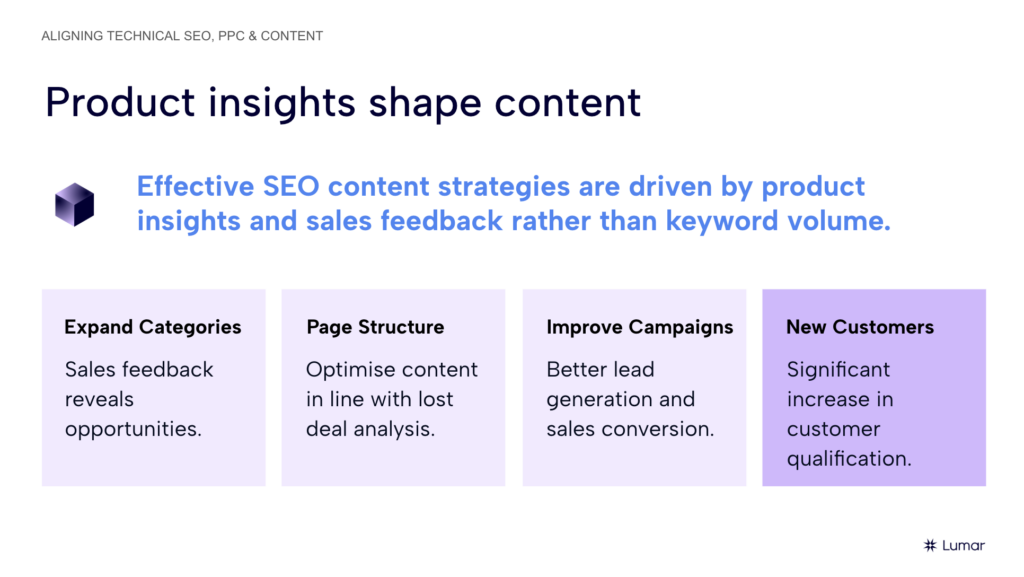
“As technical SEOs, we can certainly align SEO strategy to product problems or sales conversations,” he says.
The questions we need to ask of our clients include:
- What are your top-performing products?
- What products do you have a lot of stock of that you’re not shifting?
- How can we solve a problem for our customers from a sales point of view?
One example for another Growthack client concerned a B2C company who specialize in wine rack installations. According to Kapezi, their best-performing product was for under-the-stairs installs. But on the site, there was no dedicated page about this service. Of course, this was a relatively simple fix.
Sales feedback for B2B brands can better shape SEO content, too. Another example Kapezi notes, was for an SaaS brand who weren’t really using their website as a sales/conversion tool. Tracking the MQL data, he found the site didn’t have the particular products that customers were looking for.
The site also needed more content around why some of their products were a good fit for certain customers and not for others. Business size became a key consideration, too. Some businesses were too small for the suggested solutions, and content was shaped around terms that were too broad.
4. Site Migrations to Scale Performance
According to Kapezi, site migrations are a great opportunity to align your SEO strategy to all the different customer lenses and sales conversations that you might have had.
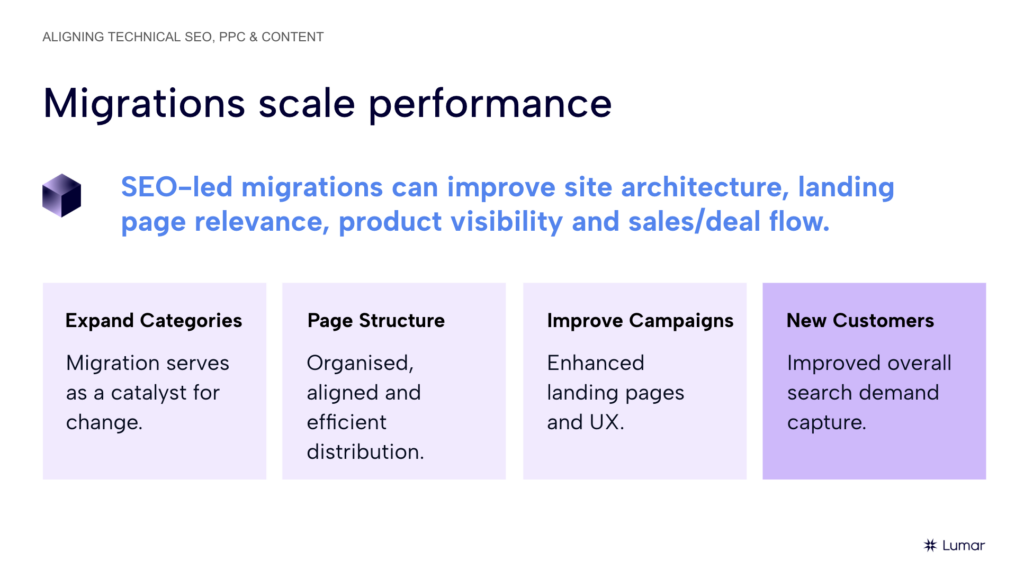
“Our role is to understand these lenses,” he says. “And ensure that we have the different pathways for people to navigate through the website and then become a customer.”
When it comes to planning for a migration, SEOs need to ask: Are we involved at each stage? Is PPC aware of URL changes?
Kapezi also suggests search specialists are part of design discussions.
He notes Growthack’s work with sports surface supplier, SIS Pitches, on their redesign and site migration.
Prior to the migration, the brand offered solutions across a range of categories, but the website structure wasn’t reflecting them, for example: sports, surface, services, and systems.
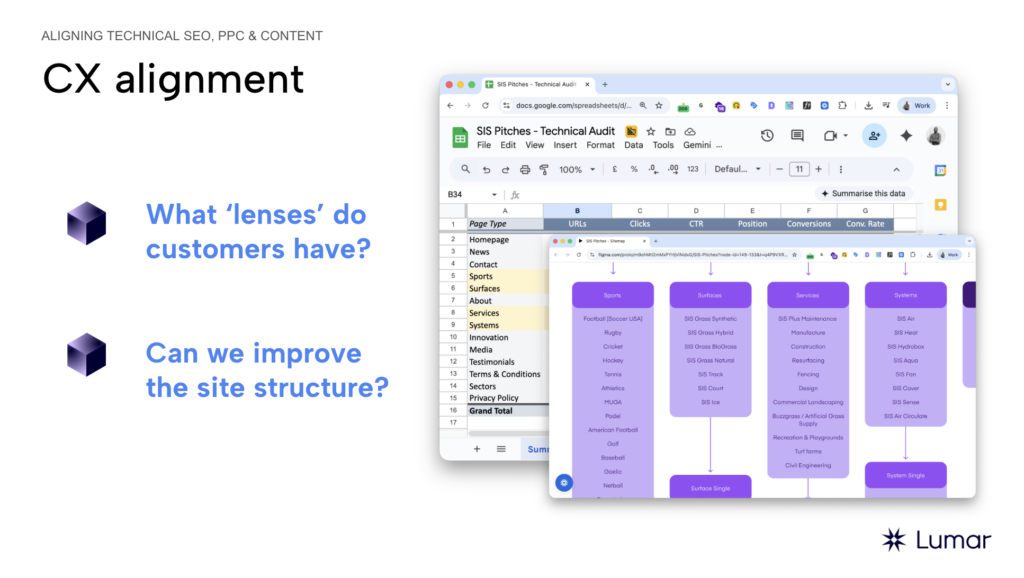
By rebuilding the structure around the commercial pages, the business boasted €2m in global growth, +1,000 qualified CRM leads, as well as +112.5% increase in site conversation rate.
Summary: 4 business outcome examples resulting from better multichannel workflow alignments
Scaling performance during a site migration: Rebrands naturally offer opportunities for SEOs to maximize impact.
Revealing demand with search data: Kapezi saw 157% increase in organic leads after improving demand capture.
Enabling performance with site architecture: Higher-value orders and 45% business growth for a large UK retailer.
Shaping content with product insights: SaaS increased MQL to SQL rate from 12.5% to 30%.
Explore SEO, GEO/AEO, & website optimization solutions –

More SEO & Digital Marketing Resources –

Don’t miss the next Lumar webinar!
Sign up for our newsletter below to be alerted about upcoming webinars, or give us a follow on LinkedIn to stay up-to-date with all the latest news in SEO, GEO, and digital optimization.
Want even more SEO insights on-demand? Browse Lumar’s full library of SEO and website optimization webinars here.